



 Chat with AI
Exam 3: Interdependence and the Gains From Trade

Exam 1: Ten Principles of Economics455 Questions
Exam 2: Thinking Like an Economist645 Questions
Exam 3: Interdependence and the Gains From Trade550 Questions
Exam 4: The Market Forces of Supply and Demand693 Questions
Exam 5: Elasticity and Its Application625 Questions
Exam 6: Supply, Demand, and Government Policies671 Questions
Exam 7: Consumers, Producers, and the Efficiency of Markets547 Questions
Exam 8: Application: The Costs of Taxation507 Questions
Exam 9: Application: International Trade521 Questions
Exam 10: Externalities543 Questions
Exam 11: Public Goods and Common Resources453 Questions
Exam 12: The Design of the Tax System563 Questions
Exam 13: The Costs of Production649 Questions
Exam 14: Firms in Competitive Markets608 Questions
Exam 15: Monopoly662 Questions
Exam 16: Monopolistic Competition649 Questions
Exam 17: Oligopoly522 Questions
Exam 18: The Markets for the Factors of Production592 Questions
Exam 19: Earnings and Discrimination511 Questions
Exam 20: Income Inequality and Poverty478 Questions
Exam 21: The Theory of Consumer Choice568 Questions
Exam 22: Frontiers in Microeconomics461 Questions
Select questions type


Figure 3-5
Hosne's Production Possibilities Frontier
Merve's Production Possibilities Frontier 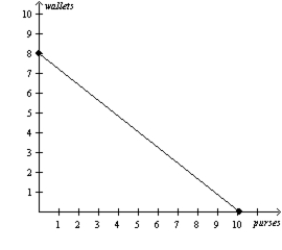
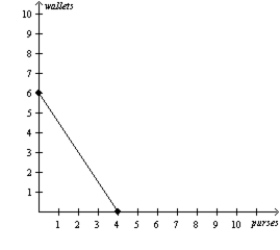 -Refer to Figure 3-5. If Hosne and Merve both spend all of their time making wallets, then total production is
 (Multiple Choice)
4.9/5  (77)
(77) Suppose a gardener produces both tomatoes and squash in his garden. If he must give up 8 bushels of squash to get 5 bushels of tomatoes, then his opportunity cost of 1 bushel of tomatoes is
(Multiple Choice)
5.0/5 (60)
(60) Figure 3-6
Maxine's Production Possibilities Frontier
Daisy's Production Possibilities Frontier 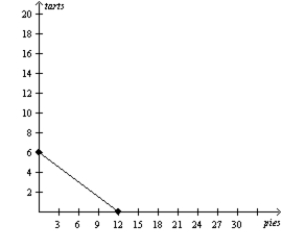
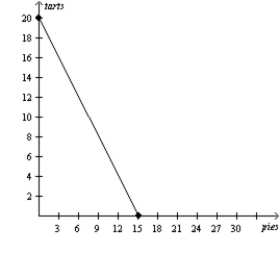 -Refer to Figure 3-6. If Daisy must work 2.5 hours to make each pie, then her production possibilities frontier is based on how many hours of work?
 (Multiple Choice)
4.8/5 (97)
(97) Table 3-33
Chris and Tony's Production Opportunities  -Refer to Table 3-33 Chris and Tony both produce tomatoes and pasta sauce. The table shows their possible production per month if both work the same number of 8 hour days. Which of the following prices would result in a mutually advantageous trade between Chris and Tony?
 (Multiple Choice)
4.8/5 (68)
(68) Figure 3-25
Chile's Production Possibilities Frontier
Colombia's Production Possibilities Frontier 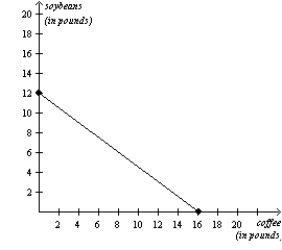
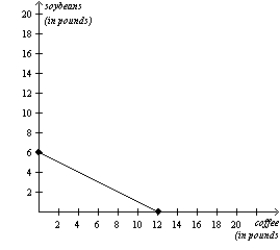 -Refer to Figure 3-25. Chile should specialize in the production of
 (Multiple Choice)
4.9/5 (79)
(79) Figure 3-14
Arturo's Production Possibilities Frontier
Dina's Production Possibilities Frontier 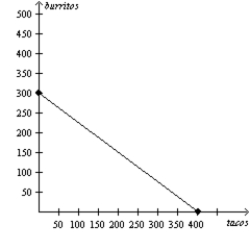
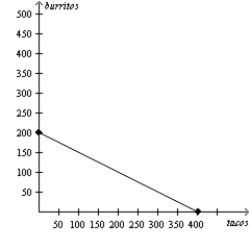 -Refer to Figure 3-14. At which of the following prices would both Arturo and Dina gain from trade with each other?
 (Multiple Choice)
4.7/5 (80)
(80) If Shawn can produce donuts at a lower opportunity cost than Sue, then
(Multiple Choice)
4.7/5 (63)
(63) Table 3-20
Assume that Brad and Theresa can switch between producing wheat and producing beef at a constant rate.  -Refer to Table 3-20. Brad should specialize in the production of
 (Multiple Choice)
5.0/5 (81)
(81) Figure 3-10
Alice and Betty's Production Possibilities in one 8-hour day.
Alice's Production Possibilities Frontier
Betty's Production Possibilities Frontier 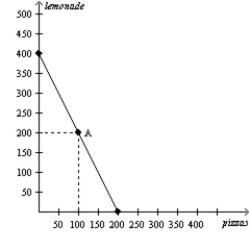
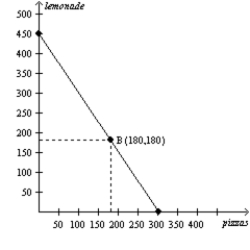 -Refer to Figure 3-10. If Alice produces only lemonade, she can produce
 (Multiple Choice)
4.9/5 (63)
(63) For both parties to gain from trade, the price at which they trade must lie between the two opportunity costs.
(True/False)
4.8/5 (71)
(71) A professor spends 10 hours per day giving lectures and writing papers. For the professor, a graph that shows his various possible mixes of output (lectures given per day and papers written per day) is called his
(Multiple Choice)
4.9/5 (93)
(93) Figure 3-11
The graph below represents the various combinations of ham and cheese (in pounds) that the nation of Bonovia could produce in a given month. 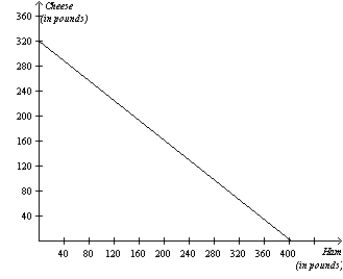 -Refer to Figure 3-11. If the production possibilities frontier shown is for 240 hours of production, then which of the following combinations of ham and cheese could Bonovia produce in 240 hours?
 (Multiple Choice)
4.8/5 (69)
(69) Table 3-5
Assume that Aruba and Iceland can switch between producing coolers and producing radios at a constant rate.  -Refer to Table 3-5. Assume that Aruba and Iceland each has 80 labor hours available. If each country divides its time equally between the production of coolers and radios, then total production is
 (Multiple Choice)
4.8/5 (64)
(64) Scenario 3-1
The production possibilities frontiers below show how much Greg and Catherine can each produce in 8 hours of time.
Greg's Production Possibilities
Catherine's Production Possibilities 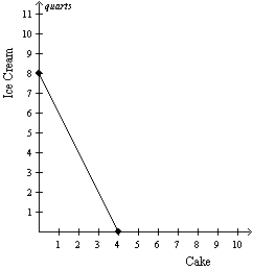
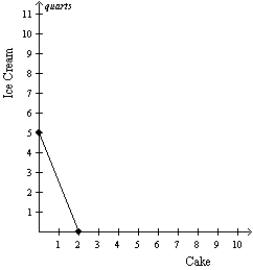 -Refer to Scenario 3-1. Which if any good(s) does Greg have an absolute advantage producing?
 (Essay)
4.8/5 (76)
(76) Table 3-26
Assume that Japan and Korea can switch between producing cars and producing airplanes at a constant rate.
 -Refer to Table 3-26. Korea has an absolute advantage in the production of
 (Multiple Choice)
4.9/5 (84)
(84) Table 3-28
Barb and Jim run a business that sets up and tests computers. Assume that Barb and Jim can switch between setting up and testing computers at a constant rate. The following table applies.
 -Refer to Table 3-28. Barb's opportunity cost of setting up one computer is testing
 (Multiple Choice)
4.8/5 (79)
(79) Figure 3-15
Perry's Production Possibilities Frontier
Jordan's Production Possibilities Frontier 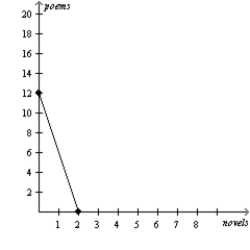
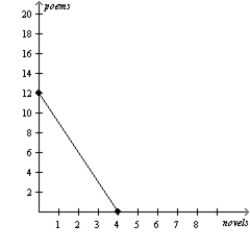 -Refer to Figure 3-15. Jordan should specialize in the production of
 (Multiple Choice)
4.8/5 (67)
(67) 
Filters
- Essay(0)
- Multiple Choice(0)
- Short Answer(0)
- True False(0)
- Matching(0)