



 Chat with AI
Exam 3: Interdependence and the Gains From Trade

Exam 1: Ten Principles of Economics455 Questions
Exam 2: Thinking Like an Economist645 Questions
Exam 3: Interdependence and the Gains From Trade550 Questions
Exam 4: The Market Forces of Supply and Demand693 Questions
Exam 5: Elasticity and Its Application625 Questions
Exam 6: Supply, Demand, and Government Policies671 Questions
Exam 7: Consumers, Producers, and the Efficiency of Markets547 Questions
Exam 8: Application: The Costs of Taxation507 Questions
Exam 9: Application: International Trade521 Questions
Exam 10: Externalities543 Questions
Exam 11: Public Goods and Common Resources453 Questions
Exam 12: The Design of the Tax System563 Questions
Exam 13: The Costs of Production649 Questions
Exam 14: Firms in Competitive Markets608 Questions
Exam 15: Monopoly662 Questions
Exam 16: Monopolistic Competition649 Questions
Exam 17: Oligopoly522 Questions
Exam 18: The Markets for the Factors of Production592 Questions
Exam 19: Earnings and Discrimination511 Questions
Exam 20: Income Inequality and Poverty478 Questions
Exam 21: The Theory of Consumer Choice568 Questions
Exam 22: Frontiers in Microeconomics461 Questions
Select questions type


Table 3-36  -Refer to Table 3-36. Assume that Antigua and Barbuda each has 60 minutes available. If each island spends all its time producing the good in which it has a comparative advantage, then total production is
 (Multiple Choice)
4.8/5  (88)
(88) Table 3-31
 -Refer to Table 3-31. For the farmer, the opportunity cost of 15 pounds of meat is
 (Multiple Choice)
4.9/5 (69)
(69) Table 3-9
Assume that Maya and Miguel can switch between producing mixers and producing toasters at a constant rate.
 -Refer to Table 3-9. Which of the following combinations of mixers and toasters could Maya produce in 60 hours?
 (Multiple Choice)
4.8/5 (74)
(74) Table 3-24
Assume that England and Spain can switch between producing cheese and producing bread at a constant rate.

-Refer to Table 3-24. The opportunity cost of 1 unit of cheese for England is
-Refer to Table 3-24. The opportunity cost of 1 unit of cheese for England is (Multiple Choice)
4.7/5 (68)
(68) The gains from specialization and trade are based on ______ advantage.
(Short Answer)
4.8/5 (67)
(67) In one month, Moira can knit 2 sweaters or 4 scarves. In one month, Tori can knit 1 sweater or 3 scarves. Moira's opportunity cost of knitting scarves is lower than Tori's opportunity cost of knitting scarves.
(True/False)
4.8/5 (75)
(75) Table 3-19 Summary of the Gains from Trade
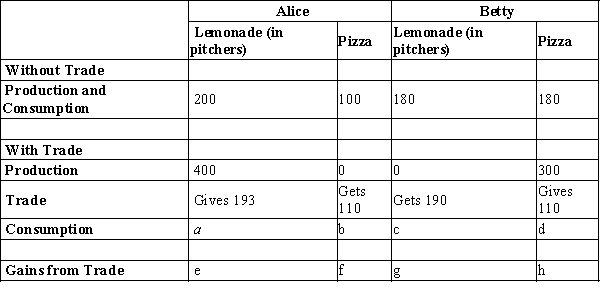 -Refer to Table 3-19. The values in the table represent the amounts of lemonade and pizzas that Alice and Betty can produce in one week without and with specialization and trade. What are Alice and Betty's gains from specialization and trade?
 (Multiple Choice)
4.8/5 (89)
(89) Table 3-41
 -Refer to Table 3-41. What is Russia's opportunity cost of one radio?
 (Short Answer)
4.7/5 (82)
(82) Figure 3-19
Chile's Production Possibilities Frontier
Colombia's Production Possibilities Frontier 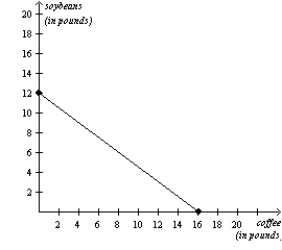
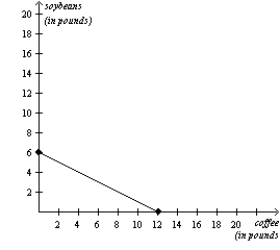 -Refer to Figure 3-19. Chile's opportunity cost of one pound of soybeans is
 (Multiple Choice)
4.8/5 (90)
(90) Table 3-38 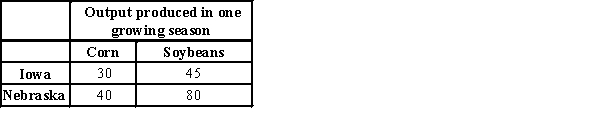 -Refer to Table 3-38. Iowa and Nebraska can both produce corn and soybeans, and can switch between the production of corn and soybeans at a constant rate. The table illustrates the amount of corn or soybeans each state can produce in one growing season. Using the information from the table, Iowa's opportunity cost of producing one bushel of corn is
 (Multiple Choice)
4.7/5 (83)
(83) Table 3-34
Assume that Indonesia and India can switch between producing rice and bananas at a constant rate.
 -Refer to Table 3-34. At which of the following prices, if any, can India and Indonesia both gain from trade?
 (Multiple Choice)
4.9/5 (87)
(87) Serena Williams should pay someone else to mow her lawn instead of mowing it herself, unless
(Multiple Choice)
4.8/5 (91)
(91) Figure 3-16
Hosne's Production Possibilities Frontier
Merve's Production Possibilities Frontier 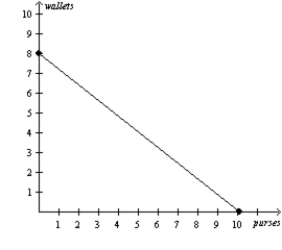
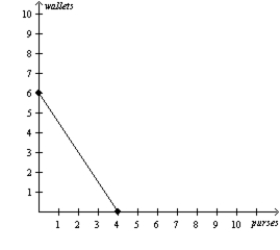 -Refer to Figure 3-16. Merve should specialize in the production of
 (Multiple Choice)
4.8/5 (81)
(81) Table 3-24
Assume that England and Spain can switch between producing cheese and producing bread at a constant rate.
-Refer to Table 3-24. England should specialize in the production of
-Refer to Table 3-24. England should specialize in the production of (Multiple Choice)
4.8/5 (84)
(84) Consider two individuals - Howard and Mai - each of whom would like to wear sweaters and eat tasty food. The gains from trade between Howard and Mai are least obvious in which of the following cases?
(Multiple Choice)
4.9/5 (83)
(83) Figure 3-15
Perry's Production Possibilities Frontier
Jordan's Production Possibilities Frontier 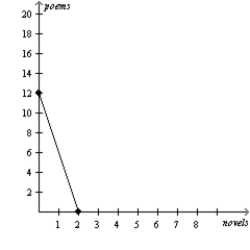
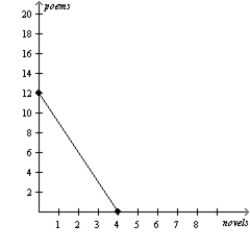 -Refer to Figure 3-15. If Perry and Jordan switch from each person dividing their time equally between the production of novels and poems to each person spending all of their time producing the good in which they have a comparative advantage, then total production of novels will increase by
 (Multiple Choice)
4.7/5 (66)
(66) Table 3-15

-Refer to Table 3-15. Assume that the farmer and the rancher each has 40 labor hours available. If each person divides his time equally between the production of meat and potatoes, then total production is
-Refer to Table 3-15. Assume that the farmer and the rancher each has 40 labor hours available. If each person divides his time equally between the production of meat and potatoes, then total production is (Multiple Choice)
4.8/5 (87)
(87) Table 3-7
Assume that the farmer and the rancher can switch between producing meat and producing potatoes at a constant rate.
 -Refer to Table 3-7. Which of the following combinations of meat and potatoes could the rancher not produce in 24 hours?
 (Multiple Choice)
5.0/5 (87)
(87) Table 3-39
Assume that Japan and Korea can switch between producing cars and producing airplanes at a constant rate.

-Refer to Table 3-39. Japan should specialize in the production of
-Refer to Table 3-39. Japan should specialize in the production of (Multiple Choice)
4.9/5 (71)
(71) 
Filters
- Essay(0)
- Multiple Choice(0)
- Short Answer(0)
- True False(0)
- Matching(0)