



 Chat with AI
Exam 3: Interdependence and the Gains From Trade

Exam 1: Ten Principles of Economics455 Questions
Exam 2: Thinking Like an Economist645 Questions
Exam 3: Interdependence and the Gains From Trade550 Questions
Exam 4: The Market Forces of Supply and Demand693 Questions
Exam 5: Elasticity and Its Application625 Questions
Exam 6: Supply, Demand, and Government Policies671 Questions
Exam 7: Consumers, Producers, and the Efficiency of Markets547 Questions
Exam 8: Application: The Costs of Taxation507 Questions
Exam 9: Application: International Trade521 Questions
Exam 10: Externalities543 Questions
Exam 11: Public Goods and Common Resources453 Questions
Exam 12: The Design of the Tax System563 Questions
Exam 13: The Costs of Production649 Questions
Exam 14: Firms in Competitive Markets608 Questions
Exam 15: Monopoly662 Questions
Exam 16: Monopolistic Competition649 Questions
Exam 17: Oligopoly522 Questions
Exam 18: The Markets for the Factors of Production592 Questions
Exam 19: Earnings and Discrimination511 Questions
Exam 20: Income Inequality and Poverty478 Questions
Exam 21: The Theory of Consumer Choice568 Questions
Exam 22: Frontiers in Microeconomics461 Questions
Select questions type


Figure 3-14
Arturo's Production Possibilities Frontier
Dina's Production Possibilities Frontier 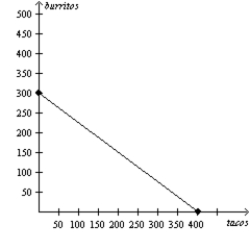
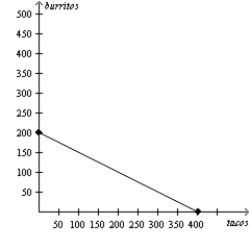 -Refer to Figure 3-14. Suppose Arturo is willing to trade 6 burritos to Dina for each 10 tacos that Dina produces and sends to Arturo. Which of the following combinations of tacos and burritos could Dina then consume, assuming Dina specializes in taco production and Arturo specializes in burrito production?
 (Multiple Choice)
4.9/5  (77)
(77) Tom's opportunity cost of mowing a lawn is 2 loads of laundry. Jen's opportunity cost of mowing a lawn is 1.5 loads of laundry. What is the range of prices for mowing a lawn at which Tom and Jen could both benefit from trade?
(Essay)
4.9/5 (80)
(80) Trade can benefit everyone in society because it allows people to specialize in activities in which they have a comparative advantage.
(True/False)
4.9/5 (83)
(83) Table 3-37
Assume that Aruba and Iceland can switch between producing coolers and producing radios at a constant rate.  -Refer to Table 3-37. Aruba should export
 (Multiple Choice)
4.9/5 (74)
(74) Suppose that a worker in Cornland can grow either 40 bushels of corn or 10 bushels of oats per year, and a worker in Oatland can grow either 20 bushels of corn or 5 bushels of oats per year. There are 20 workers in Cornland and 20 workers in Oatland. Which of the following statements is true?
(Multiple Choice)
4.8/5 (81)
(81) Table 3-28
Barb and Jim run a business that sets up and tests computers. Assume that Barb and Jim can switch between setting up and testing computers at a constant rate. The following table applies.
 -Refer to Table 3-28. Barb has an absolute advantage in
 (Multiple Choice)
4.8/5 (86)
(86) Figure 3-23
The graph below represents the various combinations of ham and cheese (in pounds) that the nation of Bonovia could produce in a given month. 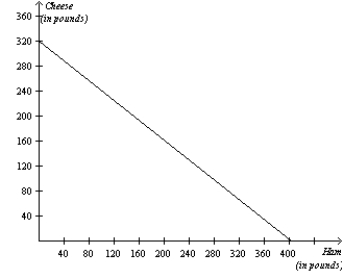 -Refer to Figure 3-23. In the nation of Cropitia, the opportunity cost of a pound of cheese is 1.5 pounds of ham. Bonovia and Cropitia both can gain from trading with one another if one pound of cheese trades for
 (Multiple Choice)
4.8/5 (73)
(73) To produce 100 bushels of wheat, Farmer A requires fewer inputs than does Farmer B. We can conclude that Farmer A has an absolute advantage over Farmer B in producing wheat.
(True/False)
4.7/5 (86)
(86) Figure 3-1
Panel (a)
Panel (b) 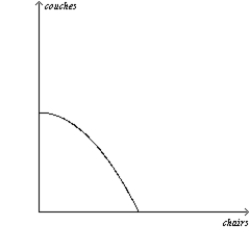
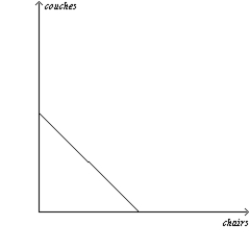 -Refer to Figure 3-1. The rate of tradeoff between producing chairs and producing couches is constant in
 (Multiple Choice)
4.8/5 (78)
(78) If a country has a lower opportunity cost than its potential trading partner, the country should decide to be self-sufficient.
(True/False)
4.9/5 (78)
(78) If US workers can produce everything in less time than Mexican workers, it is not possible for the US to gain from trade with Mexico.
(True/False)
4.7/5 (78)
(78) Jake can complete an oil change in 45 minutes and he can write a poem in 90 minutes. Ming-la can complete an oil change in 30 minutes and she can write a poem in 90 minutes. Jake's opportunity cost of writing a poem is lower than Ming-la's opportunity cost of writing a poem.
(True/False)
4.7/5 (79)
(79) An assumption of the production possibilities frontier model is that technology is fixed.
(True/False)
4.8/5 (83)
(83) Table 3-9
Assume that Maya and Miguel can switch between producing mixers and producing toasters at a constant rate.
 -Refer to Table 3-9. Assume that Maya and Miguel each has 60 hours available. If each person divides his/her time equally between the production of mixers and toasters, then total production is
 (Multiple Choice)
4.9/5 (82)
(82) Figure 3-16
Hosne's Production Possibilities Frontier
Merve's Production Possibilities Frontier 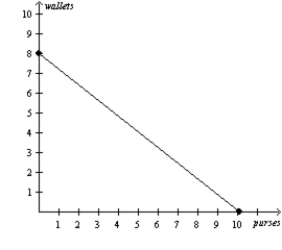
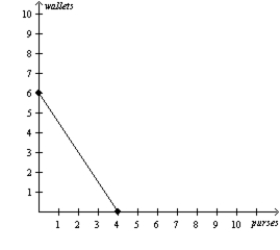 -Refer to Figure 3-16. Hosne should specialize in the production of
 (Multiple Choice)
5.0/5 (86)
(86) Tom produces baseball gloves and baseball bats. Steve also produces baseball gloves and baseball bats, but Tom is better at producing both goods. In this case, trade could
(Multiple Choice)
4.7/5 (72)
(72) Figure 3-5
Hosne's Production Possibilities Frontier
Merve's Production Possibilities Frontier 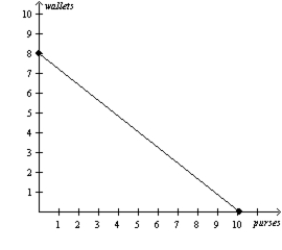
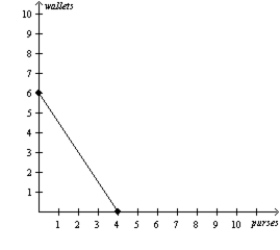 -Refer to Figure 3-5. If Hosne must work 0.5 hour to make each purse, then her production possibilities frontier is based on how many hours of work?
 (Multiple Choice)
4.7/5 (85)
(85) Figure 3-7
Bintu's Production Possibilities Frontier
Juba's Production Possibilities Frontier 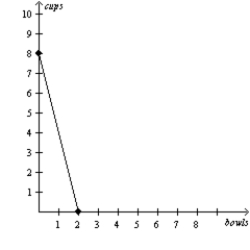
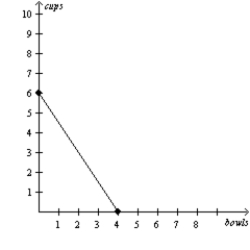 -Refer to Figure 3-7. If the production possibilities frontier shown for Juba is for 2 hours of work, then how long does it take Juba to make one bowl?
 (Multiple Choice)
4.8/5 (71)
(71) 
Filters
- Essay(0)
- Multiple Choice(0)
- Short Answer(0)
- True False(0)
- Matching(0)