



 Chat with AI
Exam 3: Interdependence and the Gains From Trade

Exam 1: Ten Principles of Economics455 Questions
Exam 2: Thinking Like an Economist645 Questions
Exam 3: Interdependence and the Gains From Trade550 Questions
Exam 4: The Market Forces of Supply and Demand693 Questions
Exam 5: Elasticity and Its Application625 Questions
Exam 6: Supply, Demand, and Government Policies671 Questions
Exam 7: Consumers, Producers, and the Efficiency of Markets547 Questions
Exam 8: Application: The Costs of Taxation507 Questions
Exam 9: Application: International Trade521 Questions
Exam 10: Externalities543 Questions
Exam 11: Public Goods and Common Resources453 Questions
Exam 12: The Design of the Tax System563 Questions
Exam 13: The Costs of Production649 Questions
Exam 14: Firms in Competitive Markets608 Questions
Exam 15: Monopoly662 Questions
Exam 16: Monopolistic Competition649 Questions
Exam 17: Oligopoly522 Questions
Exam 18: The Markets for the Factors of Production592 Questions
Exam 19: Earnings and Discrimination511 Questions
Exam 20: Income Inequality and Poverty478 Questions
Exam 21: The Theory of Consumer Choice568 Questions
Exam 22: Frontiers in Microeconomics461 Questions
Select questions type


Table 3-26
Assume that Japan and Korea can switch between producing cars and producing airplanes at a constant rate.
 -Refer to Table 3-26. Without trade, Japan produced and consumed 50 cars and 6 airplanes and Korea produced and consumed 27 cars and 7 airplanes. Then, each country agreed to specialize in the production of the good in which it has a comparative advantage and trade 28 cars for 8 airplanes. As a result, Japan gained
 (Multiple Choice)
4.9/5  (81)
(81) Table 3-31
 -Refer to Table 3-31. Relative to the farmer, the rancher has an absolute advantage in the production of
 (Multiple Choice)
4.8/5 (79)
(79) Table 3-23
Assume that the farmer and the rancher can switch between producing pork and producing tomatoes at a constant rate.
 -Refer to Table 3-23. The opportunity cost of 1 pound of pork for the farmer is
 (Multiple Choice)
5.0/5 (79)
(79) Figure 3-2
Brazil's Production Possibilities Frontier 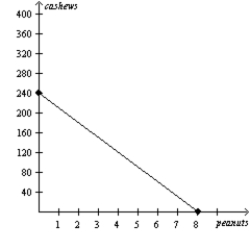 -Refer to Figure 3-2. If the production possibilities frontier shown is for two months of production, then which of the following combinations of peanuts and cashews could Brazil produce in two months?
 (Multiple Choice)
4.8/5 (69)
(69) Figure 3-21
Uzbekistan's Production Possibilities Frontier
Azerbaijan's Production Possibilities Frontier 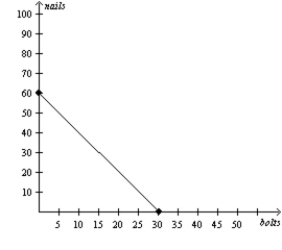
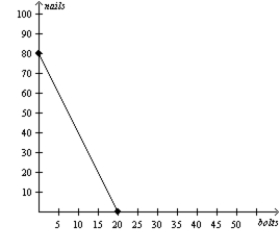 -Refer to Figure 3-21. Suppose Uzbekistan decides to increase its production of bolts by 10. What is the opportunity cost of this decision?
 (Multiple Choice)
4.7/5 (75)
(75) Figure 3-20
Canada's Production Possibilities Frontier
Mexico's Production Possibilities Frontier 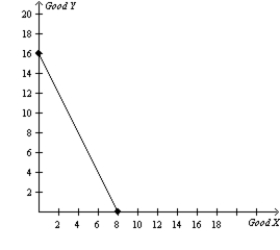
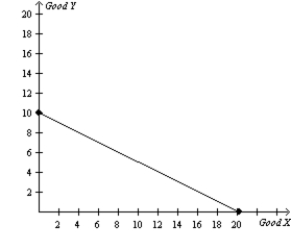 -Refer to Figure 3-20. Canada has a comparative advantage in the production of
 (Multiple Choice)
4.8/5 (81)
(81) Table 3-24
Assume that England and Spain can switch between producing cheese and producing bread at a constant rate.

-Refer to Table 3-24. England has a comparative advantage in the production of
-Refer to Table 3-24. England has a comparative advantage in the production of (Multiple Choice)
4.7/5 (78)
(78) For both parties to gain from trade, the price at which they trade must lie exactly in the middle of the two opportunity costs.
(True/False)
4.8/5 (77)
(77) Table 3-3
Production Opportunities 
-Refer to Table 3-3. Which of the following combinations of cheese and wine could England not produce in 40 hours?
-Refer to Table 3-3. Which of the following combinations of cheese and wine could England not produce in 40 hours? (Multiple Choice)
4.7/5 (87)
(87) Table 3-23
Assume that the farmer and the rancher can switch between producing pork and producing tomatoes at a constant rate.
-Refer to Table 3-23. Without trade, the farmer produced and consumed 2 pounds of pork and 4 pounds of tomatoes and the rancher produced and consumed 4 pounds of pork and 2 pounds of tomatoes. Then, each person agreed to specialize in the production of the good in which he has a comparative advantage and trade 4 pounds of pork for 6 pounds of tomatoes. As a result,
-Refer to Table 3-23. Without trade, the farmer produced and consumed 2 pounds of pork and 4 pounds of tomatoes and the rancher produced and consumed 4 pounds of pork and 2 pounds of tomatoes. Then, each person agreed to specialize in the production of the good in which he has a comparative advantage and trade 4 pounds of pork for 6 pounds of tomatoes. As a result, (Multiple Choice)
4.8/5 (89)
(89) Table 3-21
Assume that Jamaica and Norway can switch between producing coolers and producing radios at a constant rate. The following table shows the number of coolers or number of radios each country can produce in one day.  -Refer to Table 3-21. Jamaica's opportunity cost of one cooler is
 (Multiple Choice)
4.8/5 (80)
(80) Table 3-8
Assume that England and Spain can switch between producing cheese and producing bread at a constant rate.
 -Refer to Table 3-8. Which of the following combinations of cheese and bread could Spain produce in 24 hours?
 (Multiple Choice)
4.9/5 (81)
(81) Assume a farmer has the ability to produce corn and/or beans. Whenever the farmer spends 1 hour less producing corn and 1 hour more producing beans, he reduces his output of corn by 2 bushels and raises his output of beans by 3 bushels. In view of these assumptions, the farmer's production possibilities frontier is bowed out.
(True/False)
4.8/5 (71)
(71) Table 3-6
Assume that Zimbabwe and Portugal can switch between producing toothbrushes and producing hairbrushes at a constant rate.  -Refer to Table 3-6. Which of the following combinations of toothbrushes and hairbrushes could Portugal produce in 30 minutes?
 (Multiple Choice)
4.8/5 (95)
(95) Table 3-21
Assume that Jamaica and Norway can switch between producing coolers and producing radios at a constant rate. The following table shows the number of coolers or number of radios each country can produce in one day.
-Refer to Table 3-21. Jamaica has an absolute advantage in the production of
-Refer to Table 3-21. Jamaica has an absolute advantage in the production of (Multiple Choice)
4.8/5 (73)
(73) Table 3-41
 -Refer to Table 3-41. Which country has an absolute advantage in producing radios?
 (Short Answer)
4.8/5 (83)
(83) Suppose that the country of Xenophobia chose to isolate itself from the rest of the world. Its ruler proclaimed that Xenophobia should become self-sufficient, so it would not engage in foreign trade. From an economic perspective, this idea would
(Multiple Choice)
4.8/5 (80)
(80) Figure 3-18
Bintu's Production Possibilities Frontier
Juba's Production Possibilities Frontier 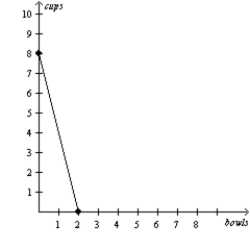
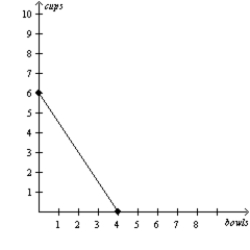 -Refer to Figure 3-18. The opportunity cost of 1 bowl for Bintu is
 (Multiple Choice)
4.9/5 (79)
(79) Country A and country B both produce shirts and shorts. Country B has an absolute advantage producing both shirts and shorts. Is there any condition under which the two countries could gain from trade?
(Essay)
4.7/5 (77)
(77) 
Filters
- Essay(0)
- Multiple Choice(0)
- Short Answer(0)
- True False(0)
- Matching(0)