



 Chat with AI
Exam 3: Interdependence and the Gains From Trade

Exam 1: Ten Principles of Economics455 Questions
Exam 2: Thinking Like an Economist645 Questions
Exam 3: Interdependence and the Gains From Trade550 Questions
Exam 4: The Market Forces of Supply and Demand693 Questions
Exam 5: Elasticity and Its Application625 Questions
Exam 6: Supply, Demand, and Government Policies671 Questions
Exam 7: Consumers, Producers, and the Efficiency of Markets547 Questions
Exam 8: Application: The Costs of Taxation507 Questions
Exam 9: Application: International Trade521 Questions
Exam 10: Externalities543 Questions
Exam 11: Public Goods and Common Resources453 Questions
Exam 12: The Design of the Tax System563 Questions
Exam 13: The Costs of Production649 Questions
Exam 14: Firms in Competitive Markets608 Questions
Exam 15: Monopoly662 Questions
Exam 16: Monopolistic Competition649 Questions
Exam 17: Oligopoly522 Questions
Exam 18: The Markets for the Factors of Production592 Questions
Exam 19: Earnings and Discrimination511 Questions
Exam 20: Income Inequality and Poverty478 Questions
Exam 21: The Theory of Consumer Choice568 Questions
Exam 22: Frontiers in Microeconomics461 Questions
Select questions type


Table 3-33
Chris and Tony's Production Opportunities  -Refer to Table 3-33 Chris and Tony both produce tomatoes and pasta sauce. The table shows their possible production per month if both work the same number of 8 hour days. Which of the following statements is correct?
 (Multiple Choice)
4.8/5  (71)
(71) Table 3-23
Assume that the farmer and the rancher can switch between producing pork and producing tomatoes at a constant rate.
 -Refer to Table 3-23. The farmer has a comparative advantage in the production of
 (Multiple Choice)
5.0/5 (83)
(83) Table 3-6
Assume that Zimbabwe and Portugal can switch between producing toothbrushes and producing hairbrushes at a constant rate.  -Refer to Table 3-6. Assume that Zimbabwe and Portugal each has 180 machine minutes available. If each country divides its time equally between the production of toothbrushes and hairbrushes, then total production is
 (Multiple Choice)
4.9/5 (81)
(81) Table 3-37 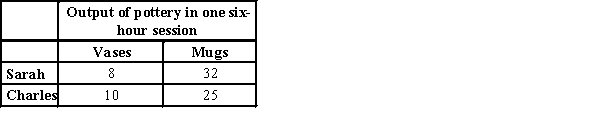
-Refer to Table 3-37. Sarah and Charles are both potters and each can switch between the production of vases and mugs at a constant rate. The table shows the total number of vases or decorative mugs that each person can produce in a six-hour session of producing pottery.
-Refer to Table 3-37. Sarah and Charles are both potters and each can switch between the production of vases and mugs at a constant rate. The table shows the total number of vases or decorative mugs that each person can produce in a six-hour session of producing pottery. (Multiple Choice)
4.9/5 (76)
(76) For two individuals who engage in the same two productive activities, it is impossible for one of the two individuals to
(Multiple Choice)
4.8/5 (90)
(90) Table 3-34
Assume that Indonesia and India can switch between producing rice and bananas at a constant rate.
 -Refer to Table 3-34. For which good(s) does Indonesia have a comparative advantage
 (Multiple Choice)
4.9/5 (84)
(84) Table 3-27
Assume that Huang and Min can switch between producing parasols and producing porcelain plates at a constant rate.
 -Refer to Table 3-27. Min has an absolute advantage in the production of
 (Multiple Choice)
5.0/5 (72)
(72) Figure 3-20
Canada's Production Possibilities Frontier
Mexico's Production Possibilities Frontier 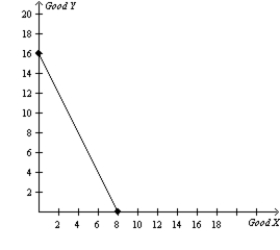
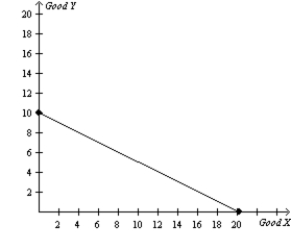 -Refer to Figure 3-20. At which of the following prices would both Canada and Mexico gain from trade with each other?
 (Multiple Choice)
4.8/5 (73)
(73) If Wrex can produce more math problems per hour and more book reports per hour than Maxine can, then Wrex cannot gain from trading math problems and book reports with Maxine.
(True/False)
4.8/5 (72)
(72) Which of the following statements about comparative advantage is not true?
(Multiple Choice)
4.9/5 (85)
(85) Suppose the United States has a comparative advantage over Mexico in producing pork. The principle of comparative advantage asserts that
(Multiple Choice)
4.7/5 (75)
(75) Figure 3-3
Arturo's Production Possibilities Frontier
Dina's Production Possibilities Frontier 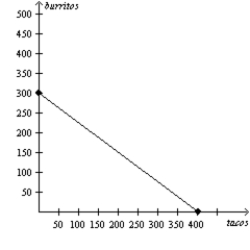
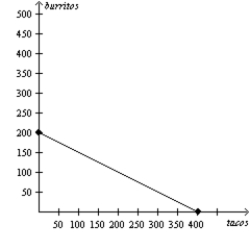 -Refer to Figure 3-3. If Arturo and Dina each divides his/her time equally between the production of tacos and burritos, then total production is
 (Multiple Choice)
4.8/5 (100)
(100) International trade can make some individuals within a country worse off, even as it makes the country as a whole better off.
(True/False)
4.8/5 (88)
(88) If a country has a higher opportunity cost to produce a good, that means that this country can never possess a comparative advantage in the production of any good.
(True/False)
4.8/5 (75)
(75) Figure 3-16
Hosne's Production Possibilities Frontier
Merve's Production Possibilities Frontier 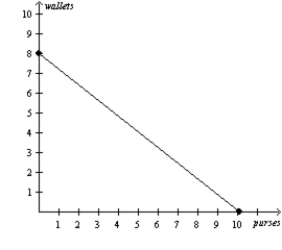
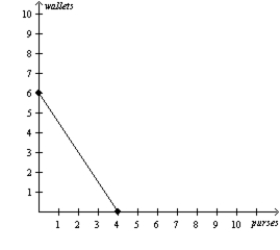 -Refer to Figure 3-16. Hosne's opportunity cost of one wallet is
 (Multiple Choice)
4.8/5 (83)
(83) Figure 3-21
Uzbekistan's Production Possibilities Frontier
Azerbaijan's Production Possibilities Frontier 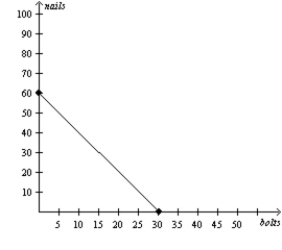
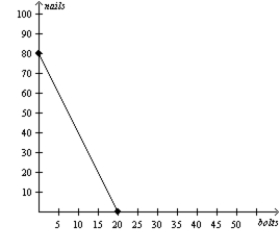 -Refer to Figure 3-21. If Uzbekistan and Azerbaijan switch from each country dividing its time equally between the production of bolts and nails to each country spending all of its time producing the good in which it has a comparative advantage, then total production will increase by
 (Multiple Choice)
4.8/5 (73)
(73) Figure 3-23
The graph below represents the various combinations of ham and cheese (in pounds) that the nation of Bonovia could produce in a given month. 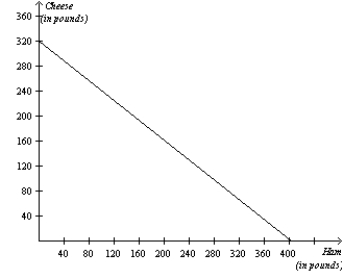 -Refer to Figure 3-23. In the nation of Cropitia, the opportunity cost of a pound of ham is 0.3 pounds of cheese. Bonovia and Cropitia both can gain from trading with one another if one pound of ham trades for
 (Multiple Choice)
5.0/5 (73)
(73) Gary and Diane must prepare a presentation for their marketing class. As part of their presentation, they must do a series of calculations and prepare 50 PowerPoint slides. It would take Gary 10 hours to do the required calculation and 10 hours to prepare the slides. It would take Diane 12 hours to do the calculations and 20 hours to prepare the slides.
a.How much time would it take the two to complete the project if they divide the calculations equally and the slides equally?
b.How much time would it take the two to complete the project if they use comparative advantage and specialize in calculating or preparing slides?
c.If Diane and Gary have the same opportunity cost of $5 per hour, is there a better solution than for each to specialize in calculating or preparing slides?
(Essay)
4.9/5 (95)
(95) Table 3-30
Assume that Falda and Varick can switch between producing wheat and producing cloth at a constant rate.  -Refer to Table 3-30. Varick has a comparative advantage in the production of
 (Multiple Choice)
4.7/5 (72)
(72) 
Filters
- Essay(0)
- Multiple Choice(0)
- Short Answer(0)
- True False(0)
- Matching(0)