



 Chat with AI
Exam 3: Interdependence and the Gains From Trade

Exam 1: Ten Principles of Economics455 Questions
Exam 2: Thinking Like an Economist645 Questions
Exam 3: Interdependence and the Gains From Trade550 Questions
Exam 4: The Market Forces of Supply and Demand693 Questions
Exam 5: Elasticity and Its Application625 Questions
Exam 6: Supply, Demand, and Government Policies671 Questions
Exam 7: Consumers, Producers, and the Efficiency of Markets547 Questions
Exam 8: Application: The Costs of Taxation507 Questions
Exam 9: Application: International Trade521 Questions
Exam 10: Externalities543 Questions
Exam 11: Public Goods and Common Resources453 Questions
Exam 12: The Design of the Tax System563 Questions
Exam 13: The Costs of Production649 Questions
Exam 14: Firms in Competitive Markets608 Questions
Exam 15: Monopoly662 Questions
Exam 16: Monopolistic Competition649 Questions
Exam 17: Oligopoly522 Questions
Exam 18: The Markets for the Factors of Production592 Questions
Exam 19: Earnings and Discrimination511 Questions
Exam 20: Income Inequality and Poverty478 Questions
Exam 21: The Theory of Consumer Choice568 Questions
Exam 22: Frontiers in Microeconomics461 Questions
Select questions type


Both Dave and Caroline produce sweaters and socks. If Dave's opportunity cost of 1 sweater is 3 socks and Caroline's opportunity cost of 1 sweater is 5 socks, then
(Multiple Choice)
4.8/5  (66)
(66) Suppose there are only two people in the world. Each person's production possibilities frontier also represents his or her consumption possibilities when
(Multiple Choice)
4.9/5 (65)
(65) Figure 3-18
Bintu's Production Possibilities Frontier
Juba's Production Possibilities Frontier 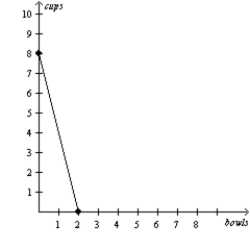
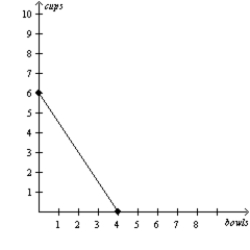 -Refer to Figure 3-18. If Bintu and Juba switch from each person dividing her time equally between the production of cups and bowls to each person spending all of her time producing the good in which she has a comparative advantage, then total production will increase by
 (Multiple Choice)
4.8/5 (68)
(68) It takes Heather 1 hour to change the oil in the car and 20 minutes to do the dishes. It takes Zach 1.5 hours to change the oil in the car. For Zach to have a comparative advantage changing the oil it must take him more than ______ minutes to do the dishes.
(Short Answer)
4.7/5 (72)
(72) Figure 3-14
Arturo's Production Possibilities Frontier
Dina's Production Possibilities Frontier 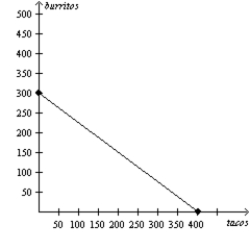
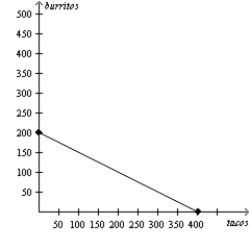 -Refer to Figure 3-14. Arturo's opportunity cost of one burrito is
 (Multiple Choice)
4.8/5 (93)
(93) Fred trades 2 tomatoes to Barney in exchange for 1 pumpkin. Fred and Barney both gain from the exchange. We can conclude that, for Barney, the opportunity cost of producing 1 pumpkin is greater than 2 tomatoes.
(True/False)
4.8/5 (93)
(93) Table 3-24
Assume that England and Spain can switch between producing cheese and producing bread at a constant rate.

-Refer to Table 3-24. If England and Spain each spends all its time producing the good in which it has a comparative advantage and the countries agree to trade 2 units of bread for 6 units of cheese, then England will consume
-Refer to Table 3-24. If England and Spain each spends all its time producing the good in which it has a comparative advantage and the countries agree to trade 2 units of bread for 6 units of cheese, then England will consume (Multiple Choice)
4.9/5 (72)
(72) Jennifer takes 2 hours to make a loaf of bread and 1 hour to make a dozen cookies. Janet takes 3 hours to make a loaf of bread and 3/4 hours to make a dozen cookies. Who, if either, has an absolute advantage baking bread? Who, if either, has an absolute advantage making cookies?
(Essay)
4.8/5 (77)
(77) Table 3-5
Assume that Aruba and Iceland can switch between producing coolers and producing radios at a constant rate.  -Refer to Table 3-5. Which of the following represents Iceland's production possibilities frontier when 100 labor hours are available?
 (Multiple Choice)
4.8/5 (90)
(90) Figure 3-19
Chile's Production Possibilities Frontier
Colombia's Production Possibilities Frontier 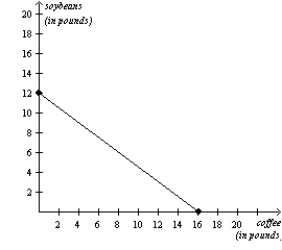
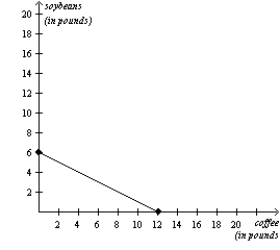 -Refer to Figure 3-19. Chile and Colombia would not be able to gain from trade if Colombia's opportunity cost of one pound of soybeans changed to
 (Multiple Choice)
5.0/5 (88)
(88) It takes Ross 6 hours to produce a bushel of corn and 2 hours to wash and polish a car. It takes Courtney 6 hours to produce a bushel of corn and 1 hour to wash and polish a car. Courtney and Ross cannot gain from specialization and trade, since it takes each of them 6 hours to produce 1 bushel of corn.
(True/False)
4.9/5 (71)
(71) Table 3-6
Assume that Zimbabwe and Portugal can switch between producing toothbrushes and producing hairbrushes at a constant rate.  -Refer to Table 3-6. Which of the following combinations of toothbrushes and hairbrushes could Zimbabwe not produce in 120 minutes?
 (Multiple Choice)
4.8/5 (77)
(77) Table 3-15

-Refer to Table 3-15. Which of the following combinations of meat and potatoes could the rancher not produce in 40 hours?
-Refer to Table 3-15. Which of the following combinations of meat and potatoes could the rancher not produce in 40 hours? (Multiple Choice)
4.8/5 (82)
(82) Table 3-13
Juanita and Shantala run a business that programs and tests cellular phones. Assume that Juanita and Shantala can switch between programming and testing cellular phones at a constant rate. The following table applies.
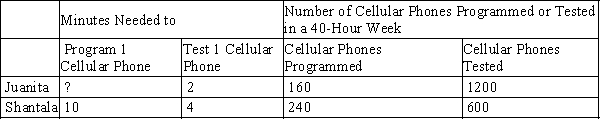 -Refer to Table 3-13. Which of the following points would be on Juanita's production possibilities frontier, based on a 40-hour week?
 (Multiple Choice)
4.9/5 (72)
(72) Table 3-26
Assume that Japan and Korea can switch between producing cars and producing airplanes at a constant rate.
 -Refer to Table 3-26. Japan has an absolute advantage in the production of
 (Multiple Choice)
4.9/5 (87)
(87) A farmer has the ability to grow either corn or cotton or some combination of the two. Given no other information, it follows that the farmer's opportunity cost of a bushel of corn multiplied by his opportunity cost of a bushel of cotton
(Multiple Choice)
4.8/5 (80)
(80) Figure 3-21
Uzbekistan's Production Possibilities Frontier
Azerbaijan's Production Possibilities Frontier 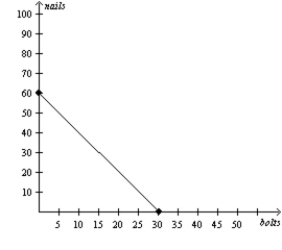
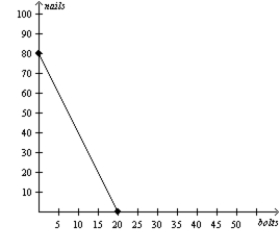 -Refer to Figure 3-21. If Uzbekistan and Azerbaijan each spends all its time producing the good in which it has a comparative advantage and trade takes place at a price of 12 bolts for 36 nails, then
 (Multiple Choice)
4.8/5 (69)
(69) Which of the following is not a reason people choose to depend on others for goods and services?
(Multiple Choice)
4.8/5 (86)
(86) Which of the following is not an example of the principle that trade can make everyone better off?
(Multiple Choice)
4.8/5 (70)
(70) 
Filters
- Essay(0)
- Multiple Choice(0)
- Short Answer(0)
- True False(0)
- Matching(0)