



 Chat with AI
Exam 3: Interdependence and the Gains From Trade

Exam 1: Ten Principles of Economics455 Questions
Exam 2: Thinking Like an Economist645 Questions
Exam 3: Interdependence and the Gains From Trade550 Questions
Exam 4: The Market Forces of Supply and Demand693 Questions
Exam 5: Elasticity and Its Application625 Questions
Exam 6: Supply, Demand, and Government Policies671 Questions
Exam 7: Consumers, Producers, and the Efficiency of Markets547 Questions
Exam 8: Application: The Costs of Taxation507 Questions
Exam 9: Application: International Trade521 Questions
Exam 10: Externalities543 Questions
Exam 11: Public Goods and Common Resources453 Questions
Exam 12: The Design of the Tax System563 Questions
Exam 13: The Costs of Production649 Questions
Exam 14: Firms in Competitive Markets608 Questions
Exam 15: Monopoly662 Questions
Exam 16: Monopolistic Competition649 Questions
Exam 17: Oligopoly522 Questions
Exam 18: The Markets for the Factors of Production592 Questions
Exam 19: Earnings and Discrimination511 Questions
Exam 20: Income Inequality and Poverty478 Questions
Exam 21: The Theory of Consumer Choice568 Questions
Exam 22: Frontiers in Microeconomics461 Questions
Select questions type


Suppose that a worker in Boatland can produce either 5 units of wheat or 25 units of fish per year, and a worker in Farmland can produce either 25 units of wheat or 5 units of fish per year. There are 10 workers in each country. Political pressure from the fish lobby in Farmland and from the wheat lobby in Boatland has prevented trade between the two countries on the grounds that cheap imports would kill the fish industry in Farmland and the wheat industry in Boatland. As a result, Boatland produces and consumes 25 units of wheat and 125 units of fish per year while Farmland produces and consumes 125 units of wheat and 25 units of fish per year. If the political pressure were overcome and trade were to occur, each country would completely specialize in the product in which it has a comparative advantage. If trade were to occur, the combined output of the two countries would increase by
(Multiple Choice)
4.8/5  (65)
(65) Figure 3-13
Peru's Production Possibilities Frontier 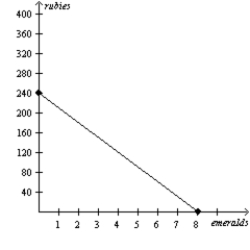 -Refer to Figure 3-13. Suppose Madagascar is willing to trade 40 rubies to Peru for each emerald that Peru produces and sends to Madagascar. Which of the following combinations of emeralds and rubies could Peru then consume, assuming Peru specializes in emerald production?
 (Multiple Choice)
4.8/5 (82)
(82) Harry is a computer company executive, earning $200 per hour managing the company and promoting its products. His daughter Quinn is a high school student, earning $6 per hour helping her grandmother on the farm. Harry's computer is broken. He can repair it himself in one hour. Quinn can repair it in 10 hours. Harry's opportunity cost of repairing the computer is lower than Quinn's.
(True/False)
4.8/5 (74)
(74) Table 3-20
Assume that Brad and Theresa can switch between producing wheat and producing beef at a constant rate.  -Refer to Table 3-20. What is Brad's opportunity cost of producing one bushel of wheat?
 (Multiple Choice)
4.8/5 (86)
(86) Table 3-41
 -Refer to Table 3-41. Which country has a comparative advantage in producing radios?
 (Short Answer)
4.8/5 (76)
(76) If a person chooses self-sufficiency, then she can only consume what she produces.
(True/False)
4.8/5 (87)
(87) Table 3-31
 -Refer to Table 3-31. For the rancher, the opportunity cost of 16 pounds of meat is
 (Multiple Choice)
4.8/5 (86)
(86) Table 3-4
Assume that Andrea and Paul can switch between producing wheat and producing beef at a constant rate.  -Refer to Table 3-4. Which of the following combinations of wheat and beef could Andrea produce in one 8-hour day?
 (Multiple Choice)
4.9/5 (91)
(91) Table 3-31
-Refer to Table 3-31. For the farmer, the opportunity cost of 1 pound of potatoes is
-Refer to Table 3-31. For the farmer, the opportunity cost of 1 pound of potatoes is (Multiple Choice)
4.8/5 (70)
(70) Table 3-29
Juanita and Shantala run a business that programs and tests cellular phones. Assume that Juanita and Shantala can switch between programming and testing cellular phones at a constant rate. The following table applies.
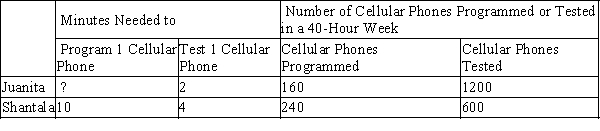 -Refer to Table 3-29. Shantala has an absolute advantage in
 (Multiple Choice)
4.8/5 (85)
(85) When two countries trade with one another, it is most likely because
(Multiple Choice)
4.9/5 (82)
(82) Figure 3-25
Chile's Production Possibilities Frontier
Colombia's Production Possibilities Frontier 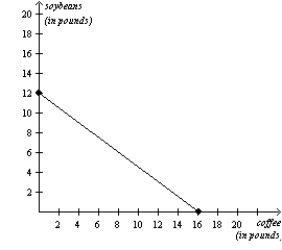
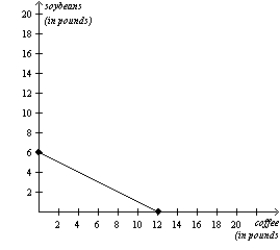 -Refer to Figure 3-25. Colombia should specialize in the production of
 (Multiple Choice)
4.9/5 (93)
(93) Table 3-38 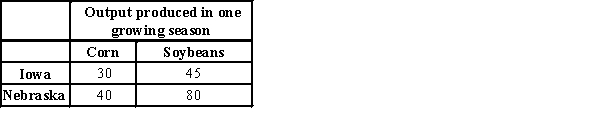 -Refer to Table 3-38. Iowa and Nebraska can both produce corn and soybeans, and can switch between the production of corn and soybeans at a constant rate. The table illustrates the amount of corn or soybeans each state can produce in one growing season. At which of the following prices would both Iowa and Nebraska be able to gain from trade with each other?
 (Multiple Choice)
4.9/5 (82)
(82) Figure 3-15
Perry's Production Possibilities Frontier
Jordan's Production Possibilities Frontier 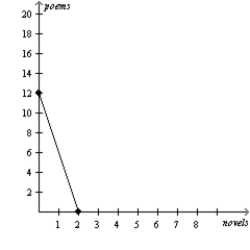
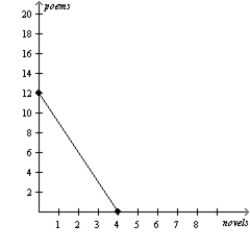 -Refer to Figure 3-15. Suppose Perry is willing to trade 4 poems to Jordan for each novel that Jordan writes and sends to Perry. Which of the following combinations of novels and poems could Jordan then consume, assuming Jordan specializes in novel production and Perry specializes in poem production?
 (Multiple Choice)
4.8/5 (67)
(67) Scenario 3-2
In country A a worker who works 40 hours can produce 200 pounds of rice or 100 pounds of broccoli. In country B a worker who works 40 hours can produce 160 pounds of rice or 120 pounds of broccoli.
-Refer to Scenario 3-2. Give a range of prices in terms of pounds of rice per pound of broccoli at which the two countries would be both be willing to trade.
(Essay)
4.8/5 (93)
(93) Henry can make a bird house in 3 hours and he can make a bird feeder in 1 hour. The opportunity cost to Henry of making a bird house is 1/3 bird feeder.
(True/False)
4.8/5 (83)
(83) Figure 3-17
Maxine's Production Possibilities Frontier
Daisy's Production Possibilities Frontier 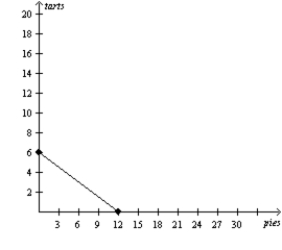
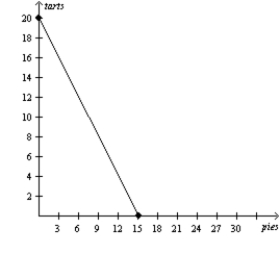 -Refer to Figure 3-17. Suppose Daisy is willing to trade 3/4 tart to Maxine for each pie that Maxine makes and sends to Daisy. Which of the following combinations of pies and tarts could Maxine not then consume, assuming Maxine specializes in making pies and Daisy specializes in making tarts?
 (Multiple Choice)
4.8/5 (78)
(78) Table 3-4
Assume that Andrea and Paul can switch between producing wheat and producing beef at a constant rate.
-Refer to Table 3-4. Which of the following combinations of wheat and beef could Paul not produce in one 8-hour day?
-Refer to Table 3-4. Which of the following combinations of wheat and beef could Paul not produce in one 8-hour day? (Multiple Choice)
4.9/5 (78)
(78) Figure 3-21
Uzbekistan's Production Possibilities Frontier
Azerbaijan's Production Possibilities Frontier 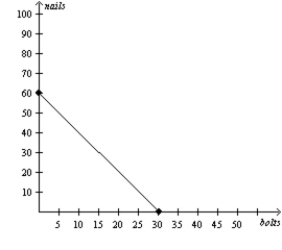
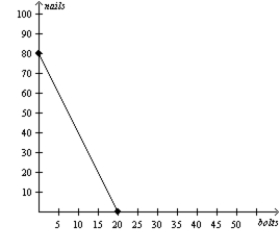 -Refer to Figure 3-21. Azerbaijan's opportunity cost of one nail is
 (Multiple Choice)
4.9/5 (76)
(76) 
Filters
- Essay(0)
- Multiple Choice(0)
- Short Answer(0)
- True False(0)
- Matching(0)