



 Chat with AI
Exam 3: Interdependence and the Gains From Trade

Exam 1: Ten Principles of Economics455 Questions
Exam 2: Thinking Like an Economist645 Questions
Exam 3: Interdependence and the Gains From Trade550 Questions
Exam 4: The Market Forces of Supply and Demand693 Questions
Exam 5: Elasticity and Its Application625 Questions
Exam 6: Supply, Demand, and Government Policies671 Questions
Exam 7: Consumers, Producers, and the Efficiency of Markets547 Questions
Exam 8: Application: The Costs of Taxation507 Questions
Exam 9: Application: International Trade521 Questions
Exam 10: Externalities543 Questions
Exam 11: Public Goods and Common Resources453 Questions
Exam 12: The Design of the Tax System563 Questions
Exam 13: The Costs of Production649 Questions
Exam 14: Firms in Competitive Markets608 Questions
Exam 15: Monopoly662 Questions
Exam 16: Monopolistic Competition649 Questions
Exam 17: Oligopoly522 Questions
Exam 18: The Markets for the Factors of Production592 Questions
Exam 19: Earnings and Discrimination511 Questions
Exam 20: Income Inequality and Poverty478 Questions
Exam 21: The Theory of Consumer Choice568 Questions
Exam 22: Frontiers in Microeconomics461 Questions
Select questions type


Zora can produce 4 quilts in a week and she can produce 1 corporate website in a week. Lou can produce 9 quilts in a week and he can produce 2 corporate websites in a week. Zora has the comparative advantage in quilts and the absolute advantage in neither good, while Lou has the comparative advantage in corporate websites and the absolute advantage in both goods.
(True/False)
4.9/5  (82)
(82) In which of the following cases should the United States produce more noodles than it wants for its own use and trade some of those noodles to Italy in exchange for wine?
(Multiple Choice)
4.8/5 (63)
(63) Table 3-35  -Refer to Table 3-35. Which good(s) does Denmark have an absolute advantage producing?
 (Multiple Choice)
4.7/5 (75)
(75) Table 3-32
US and French Production Opportunities  -Refer to Table 3-32 France has an absolute advantage in the production of
 (Multiple Choice)
4.9/5 (87)
(87) Table 3-14
Assume that Nick and Faldo can switch between producing wheat and producing cloth at a constant rate.  -Refer to Table 3-14. Assume that Nick and Faldo each has 2 hours available. If each person divides his time equally between the production of wheat and cloth, then total production is
 (Multiple Choice)
4.9/5 (73)
(73) Suppose that in one hour Dewey can produce either 10 bushels of corn or 20 yards of cloth. Dewey's opportunity cost of producing one bushel of corn is 1/2 yard of cloth.
(True/False)
4.8/5 (75)
(75) Figure 3-22
Alice and Betty's Production Possibilities in one 8-hour day.
Alice's Production Possibilities Frontier
Betty's Production Possibilities Frontier 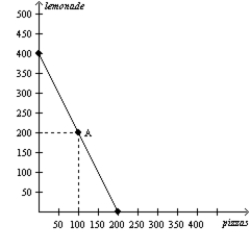
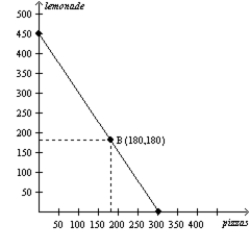 -Refer to Figure 3-22. What are Alice and Betty's opportunity costs of 1 pitcher of lemonade?
 (Multiple Choice)
4.9/5 (82)
(82) Figure 3-12
Argentina's Production Possibilities Frontier
Peru's Production Possibilities Frontier 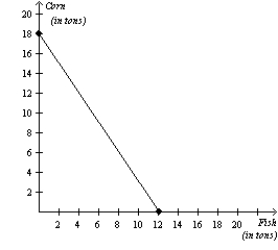
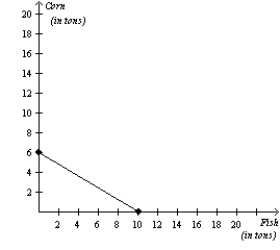 -A production possibilities frontier (PPF) is characterized by increasing opportunity costs when
 (Multiple Choice)
4.9/5 (86)
(86) Figure 3-14
Arturo's Production Possibilities Frontier
Dina's Production Possibilities Frontier 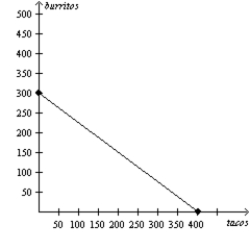
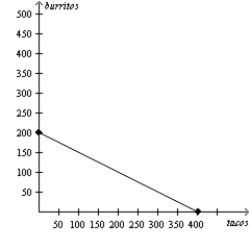 -Refer to Figure 3-14. Which of the following is not correct?
 (Multiple Choice)
4.8/5 (82)
(82) Figure 3-12
Argentina's Production Possibilities Frontier
Peru's Production Possibilities Frontier
-When an economist points out that you and millions of other people are interdependent, he or she is referring to the fact that we all
-When an economist points out that you and millions of other people are interdependent, he or she is referring to the fact that we all (Multiple Choice)
4.9/5 (72)
(72) Table 3-38
Assume that England and Spain can switch between producing cheese and producing bread at a constant rate.
 -Refer to Table 3-38. England should export
 (Multiple Choice)
4.9/5 (71)
(71) Figure 3-26
Mary's Production Possibilities Frontier Kate's Production Possibilities Frontier 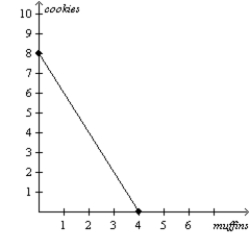
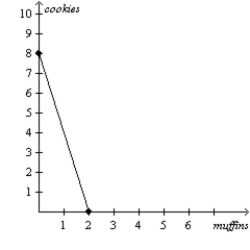 -Refer to Figure 3-26. What is Mary's opportunity cost of one cookie?
 (Short Answer)
4.8/5 (68)
(68) Scenario 3-1
The production possibilities frontiers below show how much Greg and Catherine can each produce in 8 hours of time.
Greg's Production Possibilities
Catherine's Production Possibilities 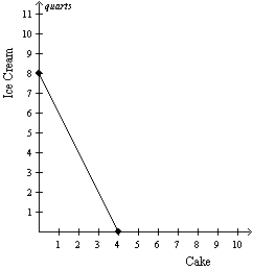
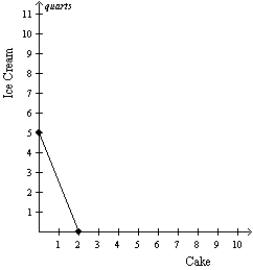 -Refer to Scenario 3-1. Is it possible for Greg and Catherine to gain from trade? Defend your answer.
 (Essay)
4.7/5 (72)
(72) Figure 3-5
Hosne's Production Possibilities Frontier
Merve's Production Possibilities Frontier 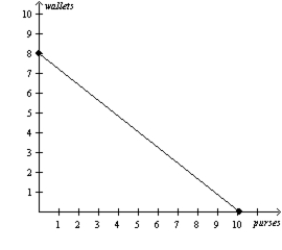
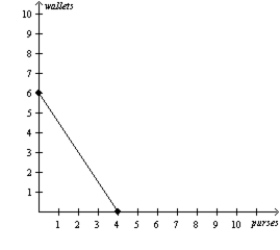 -Refer to Figure 3-5. If the production possibilities frontier shown for Merve is for 8 hours of work, then how long does it take Merve to make one purse?
 (Multiple Choice)
4.9/5 (81)
(81) Scenario 3-1
The production possibilities frontiers below show how much Greg and Catherine can each produce in 8 hours of time.
Greg's Production Possibilities
Catherine's Production Possibilities
-Refer to Scenario 3-1. What is Greg's opportunity cost of producing ice cream? Explain how you derived your answer.
-Refer to Scenario 3-1. What is Greg's opportunity cost of producing ice cream? Explain how you derived your answer. (Essay)
4.8/5 (91)
(91) Figure 3-16
Hosne's Production Possibilities Frontier
Merve's Production Possibilities Frontier 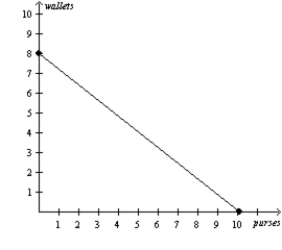
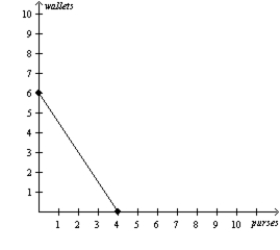 -Refer to Figure 3-16. If Hosne and Merve switch from each person dividing her time equally between the production of purses and wallets to each person spending all of her time producing the good in which she has a comparative advantage, then total production of purses will increase by
 (Multiple Choice)
4.9/5 (73)
(73) For a self-sufficient producer, the production possibilities frontier
(Multiple Choice)
4.7/5 (87)
(87) If one producer has the absolute advantage in the production of all goods, then that same producer will have the comparative advantage in the production of all goods as well.
(True/False)
4.9/5 (77)
(77) Figure 3-14
Arturo's Production Possibilities Frontier
Dina's Production Possibilities Frontier
-Refer to Figure 3-14. If Arturo and Dina switch from each person dividing their time equally between the production of tacos and burritos to each person spending all of their time producing the good in which they have a comparative advantage, then total production of burritos will increase by
-Refer to Figure 3-14. If Arturo and Dina switch from each person dividing their time equally between the production of tacos and burritos to each person spending all of their time producing the good in which they have a comparative advantage, then total production of burritos will increase by (Multiple Choice)
5.0/5 (85)
(85) If the U.S. could produce 5 televisions per hour of labor and China could produce 3 televisions per hour of labor, would it necessarily follow that the U.S. should specialize in television production?
Explain your answer using the concepts of comparative and or absolute advantage.
(Essay)
4.9/5 (86)
(86) 
Filters
- Essay(0)
- Multiple Choice(0)
- Short Answer(0)
- True False(0)
- Matching(0)