



 Chat with AI
Exam 3: Interdependence and the Gains From Trade

Exam 1: Ten Principles of Economics455 Questions
Exam 2: Thinking Like an Economist645 Questions
Exam 3: Interdependence and the Gains From Trade550 Questions
Exam 4: The Market Forces of Supply and Demand693 Questions
Exam 5: Elasticity and Its Application625 Questions
Exam 6: Supply, Demand, and Government Policies671 Questions
Exam 7: Consumers, Producers, and the Efficiency of Markets547 Questions
Exam 8: Application: The Costs of Taxation507 Questions
Exam 9: Application: International Trade521 Questions
Exam 10: Externalities543 Questions
Exam 11: Public Goods and Common Resources453 Questions
Exam 12: The Design of the Tax System563 Questions
Exam 13: The Costs of Production649 Questions
Exam 14: Firms in Competitive Markets608 Questions
Exam 15: Monopoly662 Questions
Exam 16: Monopolistic Competition649 Questions
Exam 17: Oligopoly522 Questions
Exam 18: The Markets for the Factors of Production592 Questions
Exam 19: Earnings and Discrimination511 Questions
Exam 20: Income Inequality and Poverty478 Questions
Exam 21: The Theory of Consumer Choice568 Questions
Exam 22: Frontiers in Microeconomics461 Questions
Select questions type


Figure 3-22
Alice and Betty's Production Possibilities in one 8-hour day.
Alice's Production Possibilities Frontier
Betty's Production Possibilities Frontier 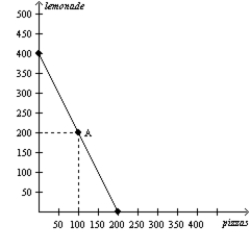
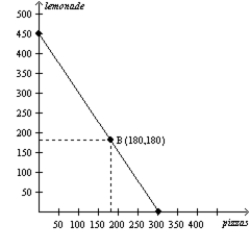 -Refer to Figure 3-22. Which of the following statements is correct regarding absolute advantage?
 (Multiple Choice)
4.9/5  (67)
(67) Figure 3-21
Uzbekistan's Production Possibilities Frontier
Azerbaijan's Production Possibilities Frontier 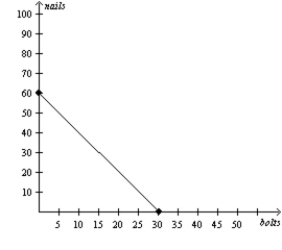
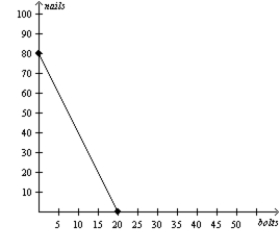 -Refer to Figure 3-21. Suppose Azerbaijan is willing to trade 3 nails to Uzbekistan for every bolt that Uzbekistan makes and sends to Azerbaijan. Which of the following combinations of bolts and nails could Azerbaijan then consume, assuming Uzbekistan specializes in making bolts and Azerbaijan specializes in making nails?
 (Multiple Choice)
4.9/5 (65)
(65) A country can have a comparative advantage in the production of a good, even if it does not have an absolute advantage in the production of that good.
(True/False)
4.8/5 (81)
(81) Figure 3-12
Argentina's Production Possibilities Frontier
Peru's Production Possibilities Frontier 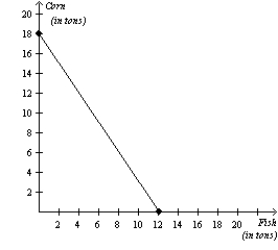
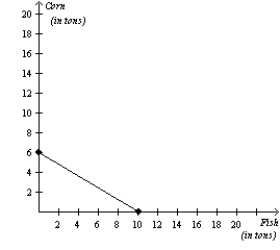 -People who provide you with goods and services
 (Multiple Choice)
4.9/5 (85)
(85) Table 3-31
 -Refer to Table 3-31. Relative to the rancher, the farmer has a comparative advantage in the production of
 (Multiple Choice)
4.7/5 (90)
(90) Serena Williams should probably not mow her own lawn because
(Multiple Choice)
4.7/5 (86)
(86) Scenario 3-2
In country A a worker who works 40 hours can produce 200 pounds of rice or 100 pounds of broccoli. In country B a worker who works 40 hours can produce 160 pounds of rice or 120 pounds of broccoli.
-Refer to Scenario 3-2. Which country, if either, has a comparative advantage producing broccoli? Defend your answer using the numbers given.
(Essay)
4.8/5 (77)
(77) Ellie and Brendan both produce apple pies and vanilla ice cream. If Ellie's opportunity cost of one apple pie is 1/2 gallon of ice cream and Brendan's opportunity cost of one apple pie is 1/4 gallon of ice cream, a mutually advantageous trade can be struck at a price of one apple pie for 1/3 gallon of ice cream.
(True/False)
4.8/5 (74)
(74) As a student, Anne spends 40 hours per week writing term papers and completing homework assignments. On one axis of her production possibilities frontier is measured the number of term papers written per week. On the other axis is measured the number of homework assignments completed per week. Anne's production possibilities frontier is a straight line if
(Multiple Choice)
4.8/5 (82)
(82) Table 3-27
Assume that Huang and Min can switch between producing parasols and producing porcelain plates at a constant rate.
 -Refer to Table 3-27. Assume that Huang and Min each has 36 labor hours available. Originally, each person divided his/her time equally between the production of parasols and plates. Now, each person spends all their time producing the good in which they have a comparative advantage. As a result, the total output of plates increased by
 (Multiple Choice)
4.9/5 (86)
(86) Table 3-9
Assume that Maya and Miguel can switch between producing mixers and producing toasters at a constant rate.
 -Refer to Table 3-9. We could use the information in the table to draw a production possibilities frontier for Maya and a second production possibilities frontier for Miguel. If we were to do this, measuring mixers along the horizontal axis, then
 (Multiple Choice)
4.8/5 (79)
(79) Table 3-11
Assume that Max and Min can switch between producing mittens and producing hats at a constant rate.
 -Refer to Table 3-11. Assume that Max and Min each has 36 labor hours available. If each person divides his/her time equally between the production of mittens and hats, then total production is
 (Multiple Choice)
4.7/5 (78)
(78) Table 3-1
Assume that John and Jane can switch between producing bread and wine at a constant rate.  -Refer to Table 3-1. Assume that John and Jane each work 24 hours. What happens to total production if instead of each person spending 12 hours producing each good, Jane spends 21 hours producing wine and 3 hours producing bread and John spends 3 hours producing wine and 21 hours producing bread?
 (Multiple Choice)
4.7/5 (84)
(84) Some countries win in international trade, while other countries lose.
(True/False)
4.9/5 (93)
(93) Table 3-3
Production Opportunities 
-Refer to Table 3-3. We could use the information in the table to draw a production possibilities frontier for England and a second production possibilities frontier for France. If we were to do this, measuring cheese along the horizontal axis, then
-Refer to Table 3-3. We could use the information in the table to draw a production possibilities frontier for England and a second production possibilities frontier for France. If we were to do this, measuring cheese along the horizontal axis, then (Multiple Choice)
4.9/5 (79)
(79) Table 3-24
Assume that England and Spain can switch between producing cheese and producing bread at a constant rate.

-Refer to Table 3-24. The opportunity cost of 1 unit of bread for England is
-Refer to Table 3-24. The opportunity cost of 1 unit of bread for England is (Multiple Choice)
4.9/5 (77)
(77) Absolute advantage is found by comparing different producers'
(Multiple Choice)
4.7/5 (77)
(77) Figure 3-15
Perry's Production Possibilities Frontier
Jordan's Production Possibilities Frontier 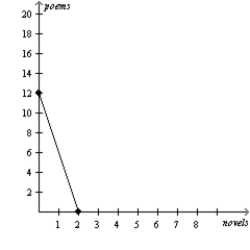
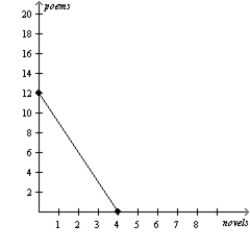 -Refer to Figure 3-15. Perry has a comparative advantage in the production of
 (Multiple Choice)
4.9/5 (84)
(84) Figure 3-8
Chile's Production Possibilities Frontier
Colombia's Production Possibilities Frontier 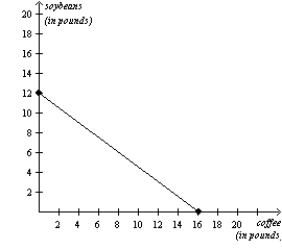
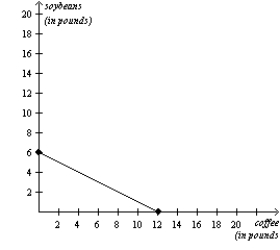 -Refer to Figure 3-8. If the production possibilities frontiers shown are each for one day of production, then which of the following combinations of pounds of coffee and pounds of soybeans could Chile and Colombia together not make in a given day?
 (Multiple Choice)
4.8/5 (88)
(88) Figure 3-3
Arturo's Production Possibilities Frontier
Dina's Production Possibilities Frontier 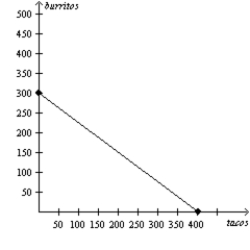
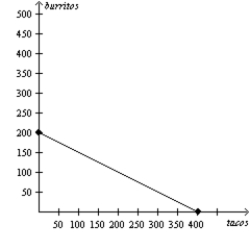 -Refer to Figure 3-3. If Dina must work 0.25 hour to produce each taco, then her production possibilities frontier is based on how many hours of work?
 (Multiple Choice)
4.9/5 (76)
(76) 
Filters
- Essay(0)
- Multiple Choice(0)
- Short Answer(0)
- True False(0)
- Matching(0)