



 Chat with AI
Exam 3: Interdependence and the Gains From Trade

Exam 1: Ten Principles of Economics455 Questions
Exam 2: Thinking Like an Economist645 Questions
Exam 3: Interdependence and the Gains From Trade550 Questions
Exam 4: The Market Forces of Supply and Demand693 Questions
Exam 5: Elasticity and Its Application625 Questions
Exam 6: Supply, Demand, and Government Policies671 Questions
Exam 7: Consumers, Producers, and the Efficiency of Markets547 Questions
Exam 8: Application: The Costs of Taxation507 Questions
Exam 9: Application: International Trade521 Questions
Exam 10: Externalities543 Questions
Exam 11: Public Goods and Common Resources453 Questions
Exam 12: The Design of the Tax System563 Questions
Exam 13: The Costs of Production649 Questions
Exam 14: Firms in Competitive Markets608 Questions
Exam 15: Monopoly662 Questions
Exam 16: Monopolistic Competition649 Questions
Exam 17: Oligopoly522 Questions
Exam 18: The Markets for the Factors of Production592 Questions
Exam 19: Earnings and Discrimination511 Questions
Exam 20: Income Inequality and Poverty478 Questions
Exam 21: The Theory of Consumer Choice568 Questions
Exam 22: Frontiers in Microeconomics461 Questions
Select questions type


Figure 3-2
Brazil's Production Possibilities Frontier 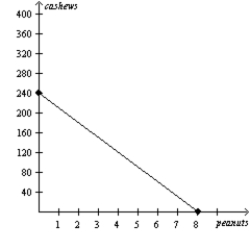 -Refer to Figure 3-2. The fact that the line slopes downward reflects the fact that
 (Multiple Choice)
4.8/5  (79)
(79) Figure 3-11
The graph below represents the various combinations of ham and cheese (in pounds) that the nation of Bonovia could produce in a given month. 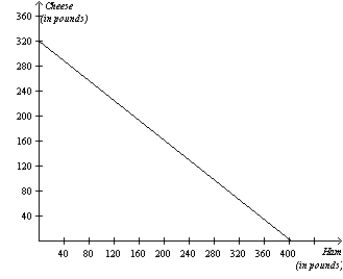 -Refer to Figure 3-11. If the production possibilities frontier shown is for 240 hours of production, then which of the following combinations of ham and cheese could Bonovia not produce in 240 hours?
 (Multiple Choice)
4.9/5 (71)
(71) Table 3-35  -Refer to Table 3-35. At which of the following prices, if any, could both Denmark and Finland gain from trade?
 (Multiple Choice)
4.9/5 (72)
(72) Figure 3-3
Arturo's Production Possibilities Frontier
Dina's Production Possibilities Frontier 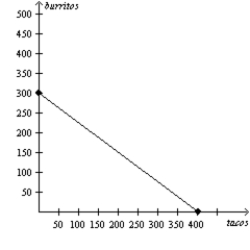
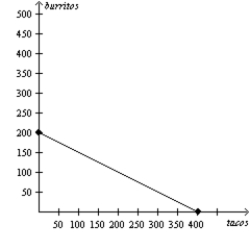 -Refer to Figure 3-3. If the production possibilities frontier shown for Arturo is for 100 hours of production, then how long does it take Arturo to make one burrito?
 (Multiple Choice)
4.8/5 (72)
(72) Table 3-26
Assume that Japan and Korea can switch between producing cars and producing airplanes at a constant rate.
 -Refer to Table 3-26. Assume that Japan and Korea each has 2400 hours available. Originally, each country divided its time equally between the production of cars and airplanes. Now, each country spends all its time producing the good in which it has a comparative advantage. As a result, the total output of cars increased by
 (Multiple Choice)
4.8/5 (80)
(80) Timmy can edit 2 pages in one minute and he can type 80 words in one minute. Olivia can edit 1 page in one minute and she can type 100 words in one minute. Timmy has an absolute advantage and a comparative advantage in editing, while Olivia has an absolute advantage and a comparative advantage in typing.
(True/False)
4.9/5 (77)
(77) If Iowa's opportunity cost of corn is lower than Oklahoma's opportunity cost of corn, then
(Multiple Choice)
4.8/5 (82)
(82) Opportunity cost refers to how many inputs a producer requires to produce a good.
(True/False)
4.8/5 (88)
(88) Table 3-20
Assume that Brad and Theresa can switch between producing wheat and producing beef at a constant rate.  -Refer to Table 3-20. Assume that Brad and Theresa each has 60 minutes available. If each person spends all his or her time producing the good in which he or she has a comparative advantage, then total production is
 (Multiple Choice)
4.9/5 (88)
(88) Figure 3-3
Arturo's Production Possibilities Frontier
Dina's Production Possibilities Frontier
-Refer to Figure 3-3. If the production possibilities frontiers shown are each for one day of production, then which of the following combinations of tacos and burritos could Arturo and Dina together not produce in a given day?
-Refer to Figure 3-3. If the production possibilities frontiers shown are each for one day of production, then which of the following combinations of tacos and burritos could Arturo and Dina together not produce in a given day? (Multiple Choice)
4.8/5 (82)
(82) Figure 3-10
Alice and Betty's Production Possibilities in one 8-hour day.
Alice's Production Possibilities Frontier
Betty's Production Possibilities Frontier 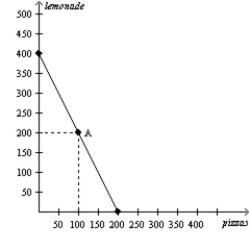
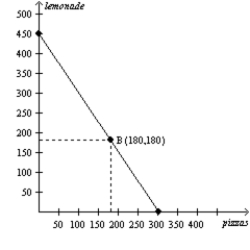 -Refer to Figure 3-10. If point A represents Alice's current production and point B represents Betty's current production, under what circumstances can both Alice and Betty benefit from specialization and trade?
 (Multiple Choice)
4.9/5 (85)
(85) If he devotes all of his available resources to cantaloupe production, a farmer can produce 120 cantaloupes. If he sacrifices 1.5 watermelons for each cantaloupe that he produces, it follows that
(Multiple Choice)
4.8/5 (73)
(73) Figure 3-13
Peru's Production Possibilities Frontier 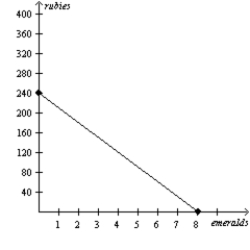 -Refer to Figure 3-13. Suppose Peru decides to increase its production of rubies by 30. What is the opportunity cost of this decision?
 (Multiple Choice)
4.9/5 (77)
(77) Sally can make 8 cups of soup per hour or 20 crackers per hour. Harry can make 10 cups of soup per hour or 30 crackers per hour. Can Sally and Harry gain from trade? If so, what is the range of prices of crackers for soup at which they would both find trade advantageous?
(Essay)
4.9/5 (74)
(74) Table 3-35
-Refer to Table 3-35. Denmark's opportunity cost of producing 1dozen eggs is
-Refer to Table 3-35. Denmark's opportunity cost of producing 1dozen eggs is (Multiple Choice)
4.8/5 (64)
(64) Table 3-26
Assume that Japan and Korea can switch between producing cars and producing airplanes at a constant rate.
-Refer to Table 3-26. Suppose Japan decides to increase its production of cars by 45. What is the opportunity cost of this decision?
-Refer to Table 3-26. Suppose Japan decides to increase its production of cars by 45. What is the opportunity cost of this decision? (Multiple Choice)
5.0/5 (77)
(77) A country that currently does not trade with other countries could benefit by
(Multiple Choice)
4.9/5 (94)
(94) Production possibilities frontiers cannot be used to illustrate tradeoffs.
(True/False)
4.8/5 (78)
(78) Figure 3-9
Uzbekistan's Production Possibilities Frontier
Azerbaijan's Production Possibilities Frontier 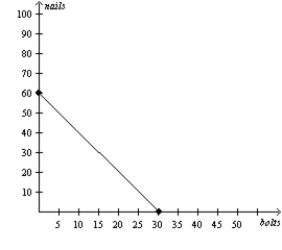
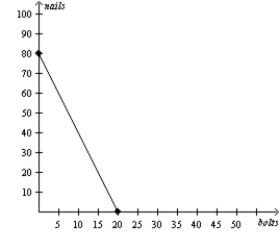 -Refer to Figure 3-9. If the production possibilities frontiers shown are each for two days of production, then which of the following combinations of bolts and nails could Uzbekistan and Azerbaijan together make in a given 2-day production period?
 (Multiple Choice)
4.8/5 (74)
(74) Kelly and David are both capable of repairing cars and cooking meals. Which of the following scenarios is not possible?
(Multiple Choice)
4.7/5 (78)
(78) 
Filters
- Essay(0)
- Multiple Choice(0)
- Short Answer(0)
- True False(0)
- Matching(0)