



 Chat with AI
Exam 2: Polar Covalent Bonds;acids and Bases

Exam 1: Structure and Bonding29 Questions
Exam 2: Polar Covalent Bonds;acids and Bases50 Questions
Exam 3: Organic Compounds: Alkanes and Their Stereochemistry37 Questions
Exam 4: Organic Compounds: Cycloalkanes and Their Stereochemistry37 Questions
Exam 5: Stereochemistry at Tetrahedral Centers43 Questions
Exam 6: An Overview of Organic Reactions42 Questions
Exam 6: Par 12 Questions
Exam 7: Alkenes: Structure and Reactivity37 Questions
Exam 8: Alkenes: Reactions and Synthesis42 Questions
Exam 9: Alkynes: an Introduction to Organic Synthesis31 Questions
Exam 10: Organohalides31 Questions
Exam 11: Reactions of Alkyl Halides: Nucleophilic Substitutions and Eliminations34 Questions
Exam 11: Par 22 Questions
Exam 12: Structure Determination: Mass Spectrometry and Infrared Spectroscopy42 Questions
Exam 13: Structure Determination: Nuclear Magnetic Resonance Spectroscopy46 Questions
Exam 14: Conjugated Compounds and Ultraviolet Spectroscopy40 Questions
Exam 14: Par 32 Questions
Exam 15: Benzene and Aromaticity47 Questions
Exam 16: Chemistry of Benzene: Electrophilic Aromatic Substitution30 Questions
Exam 17: Alcohols and Phenols44 Questions
Exam 18: Ethers and Epoxides;thiols and Sulfides33 Questions
Exam 19: Aldehydes and Ketones: Nucleophilic Addition Reactions48 Questions
Exam 19: Par 42 Questions
Exam 20: Carboxylic Acids and Nitriles32 Questions
Exam 21: Carboxylic Acid Derivatives: Nucleophilic Acyl Substitution Reactions44 Questions
Exam 22: Carbonyl Alpha-Substitution Reactions33 Questions
Exam 23: Carbonyl Condensation Reactions36 Questions
Exam 23: Par 52 Questions
Exam 24: Amines and Heterocycles41 Questions
Exam 25: Biomolecules: Carbohydrates63 Questions
Exam 26: Biomolecules: Amino Acids,peptides,and Proteins45 Questions
Exam 27: Par 72 Questions
Exam 27: Biomolecules: Lipids54 Questions
Exam 28: Biomolecules: Nucleic Acids44 Questions
Exam 29: The Organic Chemistry of Metabolic Pathways48 Questions
Exam 30: Orbitals and Organic Chemistry: Pericyclic Reactions44 Questions
Exam 31: Synthetic Polymers33 Questions
Exam 30: Par 12 Questions
Select questions type


Exhibit 2-2
Calculate the formal charges on the indicated atoms in each compound below. 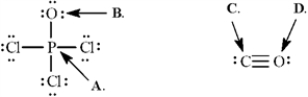 -Refer to Exhibit 2-2.The formal charge on phosphorous (A) is ______.
 (Short Answer)
4.9/5  (79)
(79) Exhibit 2-6
Refer to the following equation to answer the question(s) below.Place the letter corresponding to the correct answer in the blank.  -Refer to Exhibit 2-6.The strongest Brønsted-Lowry base in the equation is ______.
 (Short Answer)
4.8/5 (92)
(92) Exhibit 2-1
Give the corresponding letter of the term that best matches the given definition.
-_____ A compound that can donate a proton.
(Multiple Choice)
4.7/5 (87)
(87) Exhibit 2-1
Give the corresponding letter of the term that best matches the given definition.
-_____ A bond between two atoms differing in electronegativity by 0.5 − 2.
(Multiple Choice)
4.8/5 (74)
(74) Exhibit 2-2
Calculate the formal charges on the indicated atoms in each compound below.
-Refer to Exhibit 2-2.The formal charge on oxygen (B) is ______.
-Refer to Exhibit 2-2.The formal charge on oxygen (B) is ______. (Short Answer)
4.9/5 (77)
(77) The structure for Vitamin K which is involved in blood clotting is shown below. 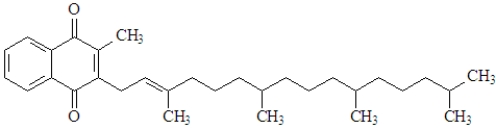 This vitamin would be:
 (Multiple Choice)
5.0/5 (79)
(79) Which of the following does not characterize the curved arrow formalism?
(Multiple Choice)
4.9/5 (95)
(95) The condensed structure for dimethyl ether looks symmetrical.However,dimethyl ether has a dipole moment.Draw a structure that explains this and indicate the expected direction of the molecular dipole moment. 
(Essay)
4.8/5 (77)
(77) Exhibit 2-2
Calculate the formal charges on the indicated atoms in each compound below.
-Refer to Exhibit 2-2.The formal charge on carbon (C) is ______.
-Refer to Exhibit 2-2.The formal charge on carbon (C) is ______. (Short Answer)
4.8/5 (81)
(81) Exhibit 2-1
Give the corresponding letter of the term that best matches the given definition.
-_____ Any species that donates electrons.
(Multiple Choice)
4.9/5 (69)
(69) 
Filters
- Essay(0)
- Multiple Choice(0)
- Short Answer(0)
- True False(0)
- Matching(0)