



 Chat with AI
Exam 31: Synthetic Polymers

Exam 1: Structure and Bonding29 Questions
Exam 2: Polar Covalent Bonds;acids and Bases50 Questions
Exam 3: Organic Compounds: Alkanes and Their Stereochemistry37 Questions
Exam 4: Organic Compounds: Cycloalkanes and Their Stereochemistry37 Questions
Exam 5: Stereochemistry at Tetrahedral Centers43 Questions
Exam 6: An Overview of Organic Reactions42 Questions
Exam 6: Par 12 Questions
Exam 7: Alkenes: Structure and Reactivity37 Questions
Exam 8: Alkenes: Reactions and Synthesis42 Questions
Exam 9: Alkynes: an Introduction to Organic Synthesis31 Questions
Exam 10: Organohalides31 Questions
Exam 11: Reactions of Alkyl Halides: Nucleophilic Substitutions and Eliminations34 Questions
Exam 11: Par 22 Questions
Exam 12: Structure Determination: Mass Spectrometry and Infrared Spectroscopy42 Questions
Exam 13: Structure Determination: Nuclear Magnetic Resonance Spectroscopy46 Questions
Exam 14: Conjugated Compounds and Ultraviolet Spectroscopy40 Questions
Exam 14: Par 32 Questions
Exam 15: Benzene and Aromaticity47 Questions
Exam 16: Chemistry of Benzene: Electrophilic Aromatic Substitution30 Questions
Exam 17: Alcohols and Phenols44 Questions
Exam 18: Ethers and Epoxides;thiols and Sulfides33 Questions
Exam 19: Aldehydes and Ketones: Nucleophilic Addition Reactions48 Questions
Exam 19: Par 42 Questions
Exam 20: Carboxylic Acids and Nitriles32 Questions
Exam 21: Carboxylic Acid Derivatives: Nucleophilic Acyl Substitution Reactions44 Questions
Exam 22: Carbonyl Alpha-Substitution Reactions33 Questions
Exam 23: Carbonyl Condensation Reactions36 Questions
Exam 23: Par 52 Questions
Exam 24: Amines and Heterocycles41 Questions
Exam 25: Biomolecules: Carbohydrates63 Questions
Exam 26: Biomolecules: Amino Acids,peptides,and Proteins45 Questions
Exam 27: Par 72 Questions
Exam 27: Biomolecules: Lipids54 Questions
Exam 28: Biomolecules: Nucleic Acids44 Questions
Exam 29: The Organic Chemistry of Metabolic Pathways48 Questions
Exam 30: Orbitals and Organic Chemistry: Pericyclic Reactions44 Questions
Exam 31: Synthetic Polymers33 Questions
Exam 30: Par 12 Questions
Select questions type


Exhibit 31-1
MATCH a term or structure from the list below to each of the following definitions or names. Place the letter of the term or structure in the blank to the left of the definition or name which it describes.
-_____ General structure: M=CHR

Free
(Multiple Choice)
4.9/5  (79)
(79) Correct Answer: Verified
M
Exhibit 31-1
MATCH a term or structure from the list below to each of the following definitions or names. Place the letter of the term or structure in the blank to the left of the definition or name which it describes.
-____ Isotactic propylene
Free
(Multiple Choice)
4.9/5 (85)
(85) Correct Answer:Verified
VerifiedE
Which type of polymer is characterized by irregular chain length,low Tg,and only a small degree of cross-linking?
Free
(Multiple Choice)
4.9/5 (76)
(76) Correct Answer:Verified
VerifiedC
Draw two repeating units of the polymer formed by the reaction of 1,3-butadiene with the following substance.Atoms other than carbon and hydrogen are labeled. 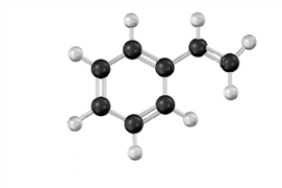
(Essay)
4.8/5 (93)
(93) Which of the following is not a property of a crystalline polymer?
(Multiple Choice)
4.9/5 (82)
(82) Exhibit 31-1
MATCH a term or structure from the list below to each of the following definitions or names. Place the letter of the term or structure in the blank to the left of the definition or name which it describes.
-____ a polyurethane
(Multiple Choice)
4.9/5 (84)
(84) Exhibit 31-1
MATCH a term or structure from the list below to each of the following definitions or names. Place the letter of the term or structure in the blank to the left of the definition or name which it describes.
-____ Amorphous polymers that have the ability to stretch out and spring back to their original shape.
(Multiple Choice)
4.8/5 (81)
(81) Draw the structure of the monomer used to produce the following polymer segment using the ROMP method. 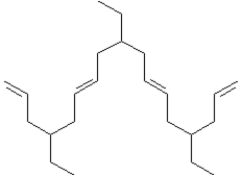
(Essay)
4.7/5 (66)
(66) In general,which of the following types of polymers would probably be the least crystalline?
(Multiple Choice)
4.8/5 (77)
(77) Draw the structure of the product produced by the acyclic diene metathesis (ADMET) of 1,6-heptadiene.
(Essay)
4.7/5 (93)
(93) 
Which type of polymer has a high glass transition temperature (Tg)?
(Multiple Choice)
4.9/5 (76)
(76) Exhibit 31-1
MATCH a term or structure from the list below to each of the following definitions or names. Place the letter of the term or structure in the blank to the left of the definition or name which it describes.
-______ four-membered metal containing intermediate
(Multiple Choice)
4.9/5 (76)
(76) Which of the following represents the general structure of a urethane?
(Multiple Choice)
4.9/5 (95)
(95) Rank the following monomers in order of increasing reactivity toward cationic polymerization (least reactive to most reactive). 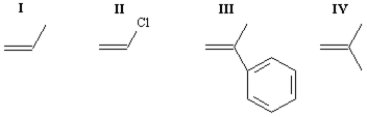
(Multiple Choice)
4.9/5 (70)
(70) Exhibit 31-2
Draw the structure(s) of the monomer(s) used to make each of the following polymers.
-Draw: 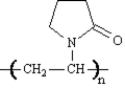
(Essay)
4.9/5 (78)
(78) Exhibit 31-1
MATCH a term or structure from the list below to each of the following definitions or names. Place the letter of the term or structure in the blank to the left of the definition or name which it describes.
-____ a Ziegler-Natta catalyst
(Multiple Choice)
5.0/5 (77)
(77) Exhibit 31-1
MATCH a term or structure from the list below to each of the following definitions or names. Place the letter of the term or structure in the blank to the left of the definition or name which it describes.
-____ Polymers obtained when two or more different monomers are allowed to polymerize together.
(Multiple Choice)
4.9/5 (77)
(77) Which of the following is not an advantage of olefinic metathesis polymerization?
(Multiple Choice)
4.7/5 (78)
(78) Do you expect nitroethylene to be more or less reactive than ethylene toward cationic polymerization? Explain. 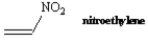
(Essay)
4.8/5 (68)
(68) 
Filters
- Essay(0)
- Multiple Choice(0)
- Short Answer(0)
- True False(0)
- Matching(0)