



 Chat with AI
Exam 17: Alcohols and Phenols

Exam 1: Structure and Bonding29 Questions
Exam 2: Polar Covalent Bonds;acids and Bases50 Questions
Exam 3: Organic Compounds: Alkanes and Their Stereochemistry37 Questions
Exam 4: Organic Compounds: Cycloalkanes and Their Stereochemistry37 Questions
Exam 5: Stereochemistry at Tetrahedral Centers43 Questions
Exam 6: An Overview of Organic Reactions42 Questions
Exam 6: Par 12 Questions
Exam 7: Alkenes: Structure and Reactivity37 Questions
Exam 8: Alkenes: Reactions and Synthesis42 Questions
Exam 9: Alkynes: an Introduction to Organic Synthesis31 Questions
Exam 10: Organohalides31 Questions
Exam 11: Reactions of Alkyl Halides: Nucleophilic Substitutions and Eliminations34 Questions
Exam 11: Par 22 Questions
Exam 12: Structure Determination: Mass Spectrometry and Infrared Spectroscopy42 Questions
Exam 13: Structure Determination: Nuclear Magnetic Resonance Spectroscopy46 Questions
Exam 14: Conjugated Compounds and Ultraviolet Spectroscopy40 Questions
Exam 14: Par 32 Questions
Exam 15: Benzene and Aromaticity47 Questions
Exam 16: Chemistry of Benzene: Electrophilic Aromatic Substitution30 Questions
Exam 17: Alcohols and Phenols44 Questions
Exam 18: Ethers and Epoxides;thiols and Sulfides33 Questions
Exam 19: Aldehydes and Ketones: Nucleophilic Addition Reactions48 Questions
Exam 19: Par 42 Questions
Exam 20: Carboxylic Acids and Nitriles32 Questions
Exam 21: Carboxylic Acid Derivatives: Nucleophilic Acyl Substitution Reactions44 Questions
Exam 22: Carbonyl Alpha-Substitution Reactions33 Questions
Exam 23: Carbonyl Condensation Reactions36 Questions
Exam 23: Par 52 Questions
Exam 24: Amines and Heterocycles41 Questions
Exam 25: Biomolecules: Carbohydrates63 Questions
Exam 26: Biomolecules: Amino Acids,peptides,and Proteins45 Questions
Exam 27: Par 72 Questions
Exam 27: Biomolecules: Lipids54 Questions
Exam 28: Biomolecules: Nucleic Acids44 Questions
Exam 29: The Organic Chemistry of Metabolic Pathways48 Questions
Exam 30: Orbitals and Organic Chemistry: Pericyclic Reactions44 Questions
Exam 31: Synthetic Polymers33 Questions
Exam 30: Par 12 Questions
Select questions type


Name: 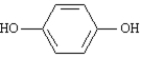

Free
(Short Answer)
4.9/5  (74)
(74) Correct Answer: Verified
hydroquinone or p-dihydroxybenzene or 1,4-benzenediol
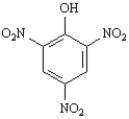
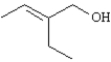
Exhibit 17-2
Refer to the data below to answer the following question(s).
pKas of Some Phenols 
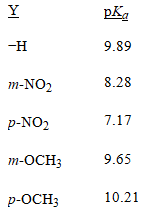 -Refer to Exhibit 17-2.Which of the acids in the Table has the weakest conjugate base?
 (Essay)
4.9/5 (84)
(84) 
Exhibit 17-3
To answer the following question(s), consider the reaction below:
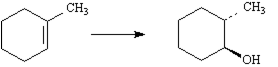 -Refer to Exhibit 17-3.Provide the IUPAC name for the product alcohol.
 (Short Answer)
4.8/5 (90)
(90) Exhibit 17-5
To answer the following question(s),consider the reaction below:  -Refer to Exhibit 17-5.The conversion of an alcohol into an alkyl chloride by reaction with SOC12 is an example of:
 (Multiple Choice)
4.9/5 (93)
(93) Exhibit 17-6
Consider the Grignard reaction below to answer the following question(s).  -Refer to Exhibit 17-6.The electrophile in this reaction is:
 (Essay)
4.9/5 (66)
(66) 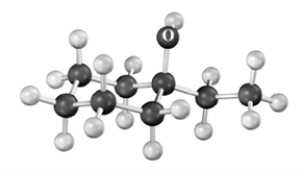
Explain why nonafluoro-2-methyl-2-propoxide is a much weaker base than tert-butoxide. 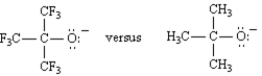
(Essay)
4.7/5 (73)
(73) What product is formed when the following substance is treated with CrO3 under appropriate conditions? 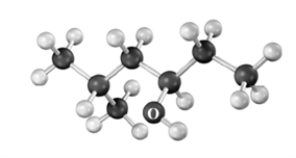
(Multiple Choice)
4.9/5 (81)
(81) Outline the synthetic steps necessary to carry out the conversion below.You may use any organic or inorganic reagents you need.Show the structures of all intermediate compounds that would probably be isolated during the course of your synthesis,and show all necessary reagents. 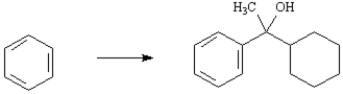
(Essay)
4.8/5 (84)
(84) Propose a synthesis of Dimestrol starting from p-methoxypropiophenone as the only source of carbon. 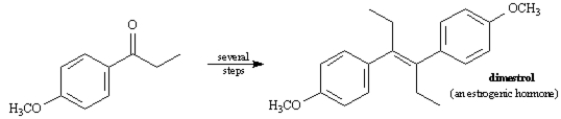
(Essay)
4.9/5 (74)
(74) Exhibit 17-4
To answer the following question(s),consider the reaction below:  -Refer to Exhibit 17-4.On the structures provided below,draw arrows which account for the complete stepwise mechanism for this reaction.

-Refer to Exhibit 17-4.On the structures provided below,draw arrows which account for the complete stepwise mechanism for this reaction. (Essay)
4.8/5 (86)
(86) Exhibit 17-5
To answer the following question(s),consider the reaction below:
-Refer to Exhibit 17-5.Provide the complete IUPAC name for the starting material in this reaction.
-Refer to Exhibit 17-5.Provide the complete IUPAC name for the starting material in this reaction. (Essay)
4.7/5 (83)
(83) Acid-catalyzed dehydration of 2,2-dimethylcyclohexanol yields 1,2-dimethylcyclohexene as one of the major products.Write the complete stepwise mechanism for this reaction.Show all electron flow with arrows and show all intermediate structures. 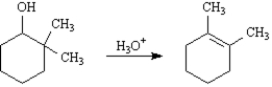
(Essay)
4.9/5 (87)
(87) Draw the mechanism of the E2 reaction involving the dehydration of 3-methyl-1-cyclohexanol,when reacting with POCl3 in pyridine.
(Essay)
4.9/5 (82)
(82) Exhibit 17-6
Consider the Grignard reaction below to answer the following question(s).
-Refer to Exhibit 17-6.The nucleophile in this reaction is:
-Refer to Exhibit 17-6.The nucleophile in this reaction is: (Essay)
4.9/5 (79)
(79) 
Filters
- Essay(0)
- Multiple Choice(0)
- Short Answer(0)
- True False(0)
- Matching(0)