



 Chat with AI
Exam 17: Alcohols and Phenols

Exam 1: Structure and Bonding29 Questions
Exam 2: Polar Covalent Bonds;acids and Bases50 Questions
Exam 3: Organic Compounds: Alkanes and Their Stereochemistry37 Questions
Exam 4: Organic Compounds: Cycloalkanes and Their Stereochemistry37 Questions
Exam 5: Stereochemistry at Tetrahedral Centers43 Questions
Exam 6: An Overview of Organic Reactions42 Questions
Exam 6: Par 12 Questions
Exam 7: Alkenes: Structure and Reactivity37 Questions
Exam 8: Alkenes: Reactions and Synthesis42 Questions
Exam 9: Alkynes: an Introduction to Organic Synthesis31 Questions
Exam 10: Organohalides31 Questions
Exam 11: Reactions of Alkyl Halides: Nucleophilic Substitutions and Eliminations34 Questions
Exam 11: Par 22 Questions
Exam 12: Structure Determination: Mass Spectrometry and Infrared Spectroscopy42 Questions
Exam 13: Structure Determination: Nuclear Magnetic Resonance Spectroscopy46 Questions
Exam 14: Conjugated Compounds and Ultraviolet Spectroscopy40 Questions
Exam 14: Par 32 Questions
Exam 15: Benzene and Aromaticity47 Questions
Exam 16: Chemistry of Benzene: Electrophilic Aromatic Substitution30 Questions
Exam 17: Alcohols and Phenols44 Questions
Exam 18: Ethers and Epoxides;thiols and Sulfides33 Questions
Exam 19: Aldehydes and Ketones: Nucleophilic Addition Reactions48 Questions
Exam 19: Par 42 Questions
Exam 20: Carboxylic Acids and Nitriles32 Questions
Exam 21: Carboxylic Acid Derivatives: Nucleophilic Acyl Substitution Reactions44 Questions
Exam 22: Carbonyl Alpha-Substitution Reactions33 Questions
Exam 23: Carbonyl Condensation Reactions36 Questions
Exam 23: Par 52 Questions
Exam 24: Amines and Heterocycles41 Questions
Exam 25: Biomolecules: Carbohydrates63 Questions
Exam 26: Biomolecules: Amino Acids,peptides,and Proteins45 Questions
Exam 27: Par 72 Questions
Exam 27: Biomolecules: Lipids54 Questions
Exam 28: Biomolecules: Nucleic Acids44 Questions
Exam 29: The Organic Chemistry of Metabolic Pathways48 Questions
Exam 30: Orbitals and Organic Chemistry: Pericyclic Reactions44 Questions
Exam 31: Synthetic Polymers33 Questions
Exam 30: Par 12 Questions
Select questions type


Exhibit 17-4
To answer the following question(s),consider the reaction below:  -Refer to Exhibit 17-4.The dehydration of secondary and tertiary alcohols by reaction with POCl3 in pyridine is an example of:
 (Multiple Choice)
4.9/5  (78)
(78) Exhibit 17-2
Refer to the data below to answer the following question(s).
pKas of Some Phenols 
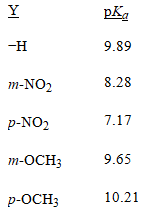 -Refer to Exhibit 17-2.How do you account for the difference in acidity between meta and para-nitrophenol?
 (Essay)
4.9/5 (77)
(77) Classify the following alcohol.Atoms other than carbon and hydrogen are labeled. 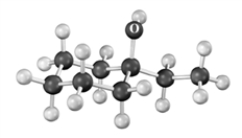
(Multiple Choice)
4.8/5 (69)
(69) Exhibit 17-6
Consider the Grignard reaction below to answer the following question(s).  -Refer to Exhibit 17-6.The alcohol product can be classified as a:
 (Multiple Choice)
4.9/5 (64)
(64) Exhibit 17-5
To answer the following question(s),consider the reaction below:  -Refer to Exhibit 17-5.Write the complete stepwise mechanism for the reaction.Show all intermediates and all electron flow with arrows.
 (Essay)
4.9/5 (85)
(85) Which of the peak in the IR spectrum shown is due to the C-O stretch in an alcohol? 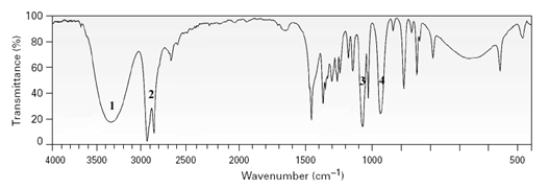
(Multiple Choice)
4.7/5 (71)
(71) Which signal in the following proton NMR is due to an alcohol proton? 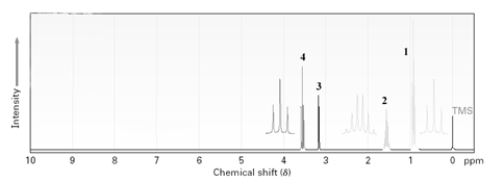
(Multiple Choice)
4.9/5 (72)
(72) Exhibit 17-3
To answer the following question(s), consider the reaction below:
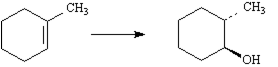 -Refer to Exhibit 17-3.The alcohol product is classified as a:
 (Multiple Choice)
4.8/5 (64)
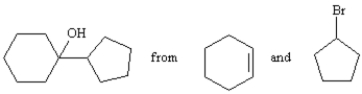
(64) Synthesize the following alcohol starting with cyclohexene and bromocylopentane as the only organic starting materials.Show all reagents and all intermediates in your synthesis.
(Essay)
4.9/5 (86)
(86) Exhibit 17-5
To answer the following question(s),consider the reaction below:
-Refer to Exhibit 17-5.The starting material can be classified as a:
-Refer to Exhibit 17-5.The starting material can be classified as a: (Multiple Choice)
4.8/5 (90)
(90) Exhibit 17-4
To answer the following question(s),consider the reaction below:
-Refer to Exhibit 17-4.Why is 3-methylcyclohexene the major product of this reaction instead of 1-methycyclohexene?
-Refer to Exhibit 17-4.Why is 3-methylcyclohexene the major product of this reaction instead of 1-methycyclohexene? (Essay)
4.8/5 (84)
(84) Which of the following would have the highest boiling point?
(Multiple Choice)
4.8/5 (73)
(73) Exhibit 17-3
To answer the following question(s), consider the reaction below:
-Refer to Exhibit 17-3.On the templates provided below,draw both conformations of the alcohol product.Circle the least stable conformation. 
-Refer to Exhibit 17-3.On the templates provided below,draw both conformations of the alcohol product.Circle the least stable conformation. (Essay)
4.9/5 (85)
(85) The mass spectrum for the following compound would have a peak at which m/z ratio due to dehydration? Atoms other than carbon and hydrogen are labeled. 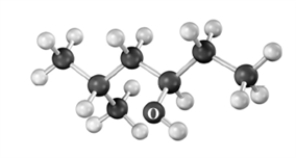
(Multiple Choice)
4.9/5 (88)
(88) 
Filters
- Essay(0)
- Multiple Choice(0)
- Short Answer(0)
- True False(0)
- Matching(0)