



 Chat with AI
Exam 27: Biomolecules: Lipids

Exam 1: Structure and Bonding29 Questions
Exam 2: Polar Covalent Bonds;acids and Bases50 Questions
Exam 3: Organic Compounds: Alkanes and Their Stereochemistry37 Questions
Exam 4: Organic Compounds: Cycloalkanes and Their Stereochemistry37 Questions
Exam 5: Stereochemistry at Tetrahedral Centers43 Questions
Exam 6: An Overview of Organic Reactions42 Questions
Exam 6: Par 12 Questions
Exam 7: Alkenes: Structure and Reactivity37 Questions
Exam 8: Alkenes: Reactions and Synthesis42 Questions
Exam 9: Alkynes: an Introduction to Organic Synthesis31 Questions
Exam 10: Organohalides31 Questions
Exam 11: Reactions of Alkyl Halides: Nucleophilic Substitutions and Eliminations34 Questions
Exam 11: Par 22 Questions
Exam 12: Structure Determination: Mass Spectrometry and Infrared Spectroscopy42 Questions
Exam 13: Structure Determination: Nuclear Magnetic Resonance Spectroscopy46 Questions
Exam 14: Conjugated Compounds and Ultraviolet Spectroscopy40 Questions
Exam 14: Par 32 Questions
Exam 15: Benzene and Aromaticity47 Questions
Exam 16: Chemistry of Benzene: Electrophilic Aromatic Substitution30 Questions
Exam 17: Alcohols and Phenols44 Questions
Exam 18: Ethers and Epoxides;thiols and Sulfides33 Questions
Exam 19: Aldehydes and Ketones: Nucleophilic Addition Reactions48 Questions
Exam 19: Par 42 Questions
Exam 20: Carboxylic Acids and Nitriles32 Questions
Exam 21: Carboxylic Acid Derivatives: Nucleophilic Acyl Substitution Reactions44 Questions
Exam 22: Carbonyl Alpha-Substitution Reactions33 Questions
Exam 23: Carbonyl Condensation Reactions36 Questions
Exam 23: Par 52 Questions
Exam 24: Amines and Heterocycles41 Questions
Exam 25: Biomolecules: Carbohydrates63 Questions
Exam 26: Biomolecules: Amino Acids,peptides,and Proteins45 Questions
Exam 27: Par 72 Questions
Exam 27: Biomolecules: Lipids54 Questions
Exam 28: Biomolecules: Nucleic Acids44 Questions
Exam 29: The Organic Chemistry of Metabolic Pathways48 Questions
Exam 30: Orbitals and Organic Chemistry: Pericyclic Reactions44 Questions
Exam 31: Synthetic Polymers33 Questions
Exam 30: Par 12 Questions
Select questions type


Exhibit 27-1
MATCH each of the following terms to a structure from the list below.There is only one correct structure for each term,and structures may be used more than once.Place the letter of the structure in the blank to the left of the corresponding term.
-_____ a soap

Free
(Multiple Choice)
4.8/5  (77)
(77) Correct Answer: Verified
H
Male sex hormones like testosterone are called:
Free
(Multiple Choice)
4.7/5 (69)
(69) Correct Answer:Verified
VerifiedA
Bolecic acid,C18H26O2,yields stearic acid,CH3(CH2)16COOH,on catalytic hydrogenation.Ozonolysis of bolecic acid yields the following products:
CH2O HOOC−COOH,HOOC(CH2)7COOH,and OHC(CH2)4COOH
Propose a structure for bolecic acid.
(Essay)
4.8/5 (80)
(80) Which of the following is common to both glycerophospholipids and sphingomyelins?
(Multiple Choice)
4.7/5 (76)
(76) Exhibit 27-1
MATCH each of the following terms to a structure from the list below.There is only one correct structure for each term,and structures may be used more than once.Place the letter of the structure in the blank to the left of the corresponding term.
-_____ a steroid
(Multiple Choice)
4.8/5 (78)
(78) Explain why soaps produce a scum when used in hard water (water containing divalent ions such as magnesium and calcium).
(Essay)
4.9/5 (79)
(79) Exhibit 27-1
MATCH each of the following terms to a structure from the list below.There is only one correct structure for each term,and structures may be used more than once.Place the letter of the structure in the blank to the left of the corresponding term.
-_____ a sesquiterpene
(Multiple Choice)
4.8/5 (65)
(65) Which of the following types/classes of compounds are derived from the following structure? 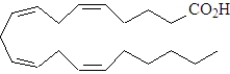
(Multiple Choice)
4.9/5 (70)
(70) Which of the following would have the highest melting point? Atoms other than carbon and hydrogen are labeled.
(Multiple Choice)
4.8/5 (85)
(85) Mixtures of esters of long-chain carboxylic acids with long-chain alcohols are called:
(Multiple Choice)
4.9/5 (83)
(83) Exhibit 27-3
Indicate by asterisks the stereogenic centers present in each of the indicated terpenes.  -lineatin
 (Essay)
4.8/5 (78)
(78) The following compound could be classified as all of the following except which one? 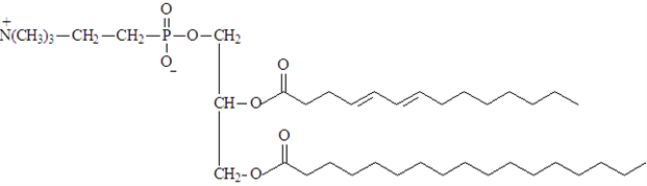
(Multiple Choice)
4.8/5 (77)
(77) Which of the following correctly does not correctly describe the composition of a phosphatidylethanolamine?
(Multiple Choice)
4.8/5 (77)
(77) When soaps disperse in water,the long hydrocarbon tails cluster together in a hydrophobic ball,while the ionic heads on the surface of the cluster stick out into the water.These spherical clusters are called:
(Multiple Choice)
4.8/5 (78)
(78) Write the saponification reaction of glyceryl monooleate distearate with aqueous NaOH.
(Essay)
4.8/5 (80)
(80) Exhibit 27-1
MATCH each of the following terms to a structure from the list below.There is only one correct structure for each term,and structures may be used more than once.Place the letter of the structure in the blank to the left of the corresponding term.
-_____ starting material for fatty acid biosynthesis.
(Multiple Choice)
4.9/5 (83)
(83) Exhibit 27-2
Refer to the structures of the terpenes below to answer the following question(s).
Show the positions of the isoprene units in each of the indicated terpenes.
 -linalool
 (Essay)
4.9/5 (79)
(79) Exhibit 27-1
MATCH each of the following terms to a structure from the list below.There is only one correct structure for each term,and structures may be used more than once.Place the letter of the structure in the blank to the left of the corresponding term.
-_____ a sphingomyelin
(Multiple Choice)
4.9/5 (86)
(86) 
Filters
- Essay(0)
- Multiple Choice(0)
- Short Answer(0)
- True False(0)
- Matching(0)