



 Chat with AI
Exam 10: Organohalides


Draw the mechanism of production of trans-3-decene from trans-1-fluoro-1-heptene.

 (97)
 Verified
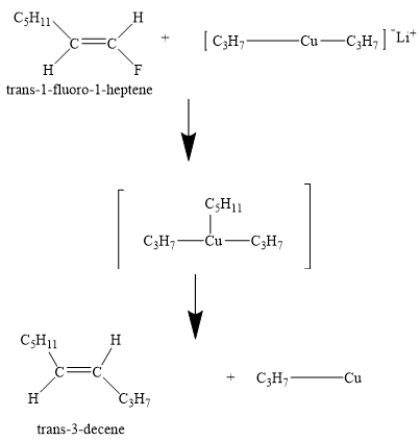
Exhibit 10-2
To answer the following question(s) consider the reaction below:
 -The original question has been combined with question #9 as part
c.This placeholder question is here to maintain the integrity of the numbering system between the printed copy and ExamView.Therefore,it has been marked "do not use on test" in ExamView's question information dialog.As a result,this placeholder question is automatically prevented from being chosen as a test question.
-The original question has been combined with question #9 as part
c.This placeholder question is here to maintain the integrity of the numbering system between the printed copy and ExamView.Therefore,it has been marked "do not use on test" in ExamView's question information dialog.As a result,this placeholder question is automatically prevented from being chosen as a test question. (92)  Answered by Examlex AI Copilot
It appears that you are referring to a specific question from a test or textbook related to a chemical reaction, and you've provided a reference code
().
However, without the actual content of the question or the details of the reaction, it is not possible to provide an answer.
The text you've provided also indicates that the question you're referring to is a placeholder and is not meant to be used on a test. It seems to be there to maintain the numbering system between different versions of the material, such as a printed copy and an electronic copy in ExamView.
If you have the actual content of the question or details about the chemical reaction, please provide them, and I would be happy to help with an answer. Otherwise, it is not possible to answer a question without knowing what the question is.
Exhibit 10-4
Consider the reaction below to answer the following question(s).  -Refer to Exhibit 10-4.Draw the resonance forms of the allylic radical intermediate that accounts for the formation of B and C.
 (91) Verified
Exhibit 10-4
Consider the reaction below to answer the following question(s).
-Refer to Exhibit 10-4.D and E,below,are minor products in this reaction.Explain why. 
-Refer to Exhibit 10-4.D and E,below,are minor products in this reaction.Explain why. (75) Exhibit 10-2
To answer the following question(s) consider the reaction below:
-Refer to Exhibit 10-2.Will the product mixture of this reaction display optical activity?
-Refer to Exhibit 10-2.Will the product mixture of this reaction display optical activity? (70) Exhibit 10-3
Consider the reaction below to answer the following question(s).  -Refer to Exhibit 10-3.Tell whether radical chlorination of methylcyclopentane is an oxidation or a reduction process.
 (82) Draw the condensed formula for the product formed when the following substance is treated with NBS using carbon tetrachloride as the solvent. 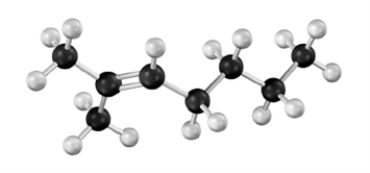
(69) Which of the following is a valid comparison of organocopper and organopalladium reagents?
(81) Exhibit 10-3
Consider the reaction below to answer the following question(s).
-Refer to Exhibit 10-3.Label the chirality centers in the monochlorination products of methylcyclopentane with an asterisk.
-Refer to Exhibit 10-3.Label the chirality centers in the monochlorination products of methylcyclopentane with an asterisk. (82) Consider the following reaction.  This reaction is classified as:
 (80) The following compound has been used as a less-ozone-depleting replacement for Freons.Name this compound.
CHF2CF3
(63) Which of the following pairs are not alternative reagents to prepare the indicated products?
(81) Rank the following compounds in order of increasing oxidation level.Place the number rank (1 = lowest;4 = highest) in the blank below the structure. 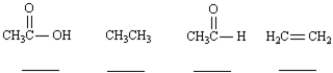
(72) In the discussion on relative reactivity of alkane hydrogens towards radical chlorination,we showed that the relative rate of 2° to 1° hydrogen atom abstraction is 3.5 : 1 for butane.Calculate the relative amounts of 1-chloropropane and 2-chloropropane obtained by the radical chlorination of propane,using this relative rate of reactivity. 
(91) Exhibit 10-2
To answer the following question(s) consider the reaction below:
-A)When propylbenzene reacts with tert-butylhypochlorite three monochlorinated products are formed in the ratios indicated.Calculate a reactivity order for each type of hydrogen atom in propylbenzene.
B)The reaction of propylbenzene with tert-butylhypochlorite proceeds by a radical substitution pathway.Draw the structure of the radical intermediate leading to each product.
C)Based on your answers to the two questions above explain why (1-chloropropyl)benzene is the major product of this reaction.
(72) 
Filters
- Essay(0)
- Multiple Choice(0)
- Short Answer(0)
- True False(0)
- Matching(0)