



 Chat with AI
Exam 10: Organohalides

Exam 1: Structure and Bonding29 Questions
Exam 2: Polar Covalent Bonds;acids and Bases50 Questions
Exam 3: Organic Compounds: Alkanes and Their Stereochemistry37 Questions
Exam 4: Organic Compounds: Cycloalkanes and Their Stereochemistry37 Questions
Exam 5: Stereochemistry at Tetrahedral Centers43 Questions
Exam 6: An Overview of Organic Reactions42 Questions
Exam 6: Par 12 Questions
Exam 7: Alkenes: Structure and Reactivity37 Questions
Exam 8: Alkenes: Reactions and Synthesis42 Questions
Exam 9: Alkynes: an Introduction to Organic Synthesis31 Questions
Exam 10: Organohalides31 Questions
Exam 11: Reactions of Alkyl Halides: Nucleophilic Substitutions and Eliminations34 Questions
Exam 11: Par 22 Questions
Exam 12: Structure Determination: Mass Spectrometry and Infrared Spectroscopy42 Questions
Exam 13: Structure Determination: Nuclear Magnetic Resonance Spectroscopy46 Questions
Exam 14: Conjugated Compounds and Ultraviolet Spectroscopy40 Questions
Exam 14: Par 32 Questions
Exam 15: Benzene and Aromaticity47 Questions
Exam 16: Chemistry of Benzene: Electrophilic Aromatic Substitution30 Questions
Exam 17: Alcohols and Phenols44 Questions
Exam 18: Ethers and Epoxides;thiols and Sulfides33 Questions
Exam 19: Aldehydes and Ketones: Nucleophilic Addition Reactions48 Questions
Exam 19: Par 42 Questions
Exam 20: Carboxylic Acids and Nitriles32 Questions
Exam 21: Carboxylic Acid Derivatives: Nucleophilic Acyl Substitution Reactions44 Questions
Exam 22: Carbonyl Alpha-Substitution Reactions33 Questions
Exam 23: Carbonyl Condensation Reactions36 Questions
Exam 23: Par 52 Questions
Exam 24: Amines and Heterocycles41 Questions
Exam 25: Biomolecules: Carbohydrates63 Questions
Exam 26: Biomolecules: Amino Acids,peptides,and Proteins45 Questions
Exam 27: Par 72 Questions
Exam 27: Biomolecules: Lipids54 Questions
Exam 28: Biomolecules: Nucleic Acids44 Questions
Exam 29: The Organic Chemistry of Metabolic Pathways48 Questions
Exam 30: Orbitals and Organic Chemistry: Pericyclic Reactions44 Questions
Exam 31: Synthetic Polymers33 Questions
Exam 30: Par 12 Questions
Select questions type


Which of the following is the least likely to form a Grignard reagent?
(Multiple Choice)
4.8/5  (90)
(90) Exhibit 10-2
To answer the following question(s) consider the reaction below:
 -The original question has been combined with question #9 as part
b.This placeholder question is here to maintain the integrity of the numbering system between the printed copy and ExamView.Therefore,it has been marked "do not use on test" in ExamView's question information dialog.As a result,this placeholder question is automatically prevented from being chosen as a test question.
-The original question has been combined with question #9 as part
b.This placeholder question is here to maintain the integrity of the numbering system between the printed copy and ExamView.Therefore,it has been marked "do not use on test" in ExamView's question information dialog.As a result,this placeholder question is automatically prevented from being chosen as a test question. (Essay)
5.0/5 (95)
(95) Consider the following reaction.  This reaction is classified as:
 (Multiple Choice)
4.9/5 (88)
(88) Draw the mechanism of the coupling reaction between lithium diethylcopper and cis-1-chloro-1-octene.
(Essay)
4.8/5 (80)
(80) The following product is a simplified penicillin analog.Draw the structure of the missing reactant represented by the "?" when the reaction is carried out in the presence of a palladium catalyst. 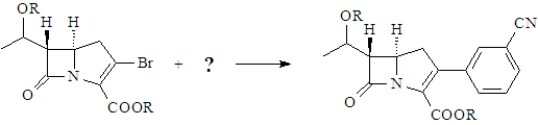
(Essay)
4.9/5 (91)
(91) Exhibit 10-2
To answer the following question(s) consider the reaction below:
-Refer to Exhibit 10-2.Are any of the products of this reaction chiral? If so draw them and label the chirality center with an asterisk.
-Refer to Exhibit 10-2.Are any of the products of this reaction chiral? If so draw them and label the chirality center with an asterisk. (Essay)
4.9/5 (77)
(77) Exhibit 10-3
Consider the reaction below to answer the following question(s).  -Refer to Exhibit 10-3.Draw all the monochlorination products of methylcyclopentane (ignore stereoisomers).
 (Essay)
4.8/5 (92)
(92) Exhibit 10-4
Consider the reaction below to answer the following question(s).  -Refer to Exhibit 10-4.Place asterisks(*) at all allylic positions in compound A.
 (Essay)
4.9/5 (73)
(73) Draw the skeletal structure of the product if the following alcohol were treated with HF in pyridine.Atoms other than carbon and hydrogen are labeled. 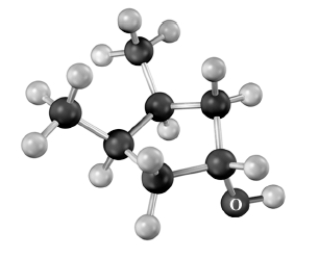
(Essay)
5.0/5 (73)
(73) 

Filters
- Essay(0)
- Multiple Choice(0)
- Short Answer(0)
- True False(0)
- Matching(0)