



 Chat with AI
Exam 14: Conjugated Compounds and Ultraviolet Spectroscopy

Exam 1: Structure and Bonding29 Questions
Exam 2: Polar Covalent Bonds;acids and Bases50 Questions
Exam 3: Organic Compounds: Alkanes and Their Stereochemistry37 Questions
Exam 4: Organic Compounds: Cycloalkanes and Their Stereochemistry37 Questions
Exam 5: Stereochemistry at Tetrahedral Centers43 Questions
Exam 6: An Overview of Organic Reactions42 Questions
Exam 6: Par 12 Questions
Exam 7: Alkenes: Structure and Reactivity37 Questions
Exam 8: Alkenes: Reactions and Synthesis42 Questions
Exam 9: Alkynes: an Introduction to Organic Synthesis31 Questions
Exam 10: Organohalides31 Questions
Exam 11: Reactions of Alkyl Halides: Nucleophilic Substitutions and Eliminations34 Questions
Exam 11: Par 22 Questions
Exam 12: Structure Determination: Mass Spectrometry and Infrared Spectroscopy42 Questions
Exam 13: Structure Determination: Nuclear Magnetic Resonance Spectroscopy46 Questions
Exam 14: Conjugated Compounds and Ultraviolet Spectroscopy40 Questions
Exam 14: Par 32 Questions
Exam 15: Benzene and Aromaticity47 Questions
Exam 16: Chemistry of Benzene: Electrophilic Aromatic Substitution30 Questions
Exam 17: Alcohols and Phenols44 Questions
Exam 18: Ethers and Epoxides;thiols and Sulfides33 Questions
Exam 19: Aldehydes and Ketones: Nucleophilic Addition Reactions48 Questions
Exam 19: Par 42 Questions
Exam 20: Carboxylic Acids and Nitriles32 Questions
Exam 21: Carboxylic Acid Derivatives: Nucleophilic Acyl Substitution Reactions44 Questions
Exam 22: Carbonyl Alpha-Substitution Reactions33 Questions
Exam 23: Carbonyl Condensation Reactions36 Questions
Exam 23: Par 52 Questions
Exam 24: Amines and Heterocycles41 Questions
Exam 25: Biomolecules: Carbohydrates63 Questions
Exam 26: Biomolecules: Amino Acids,peptides,and Proteins45 Questions
Exam 27: Par 72 Questions
Exam 27: Biomolecules: Lipids54 Questions
Exam 28: Biomolecules: Nucleic Acids44 Questions
Exam 29: The Organic Chemistry of Metabolic Pathways48 Questions
Exam 30: Orbitals and Organic Chemistry: Pericyclic Reactions44 Questions
Exam 31: Synthetic Polymers33 Questions
Exam 30: Par 12 Questions
Select questions type


Based on the following spectrum,what is the energy in kilojoules per mole of photons that corresponds to the λmax? 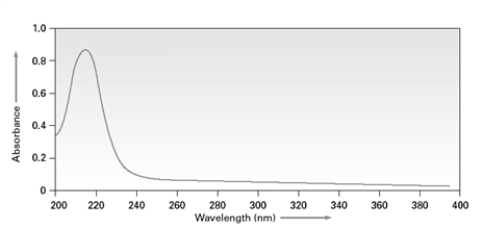

Free
(Multiple Choice)
4.9/5  (79)
(79) Correct Answer: Verified
D

Draw the mechanism of the bromination of 2-ethyl-1,3-pentadiene.
Free
(Essay)
4.8/5 (86)
(86) Correct Answer:Verified
Verified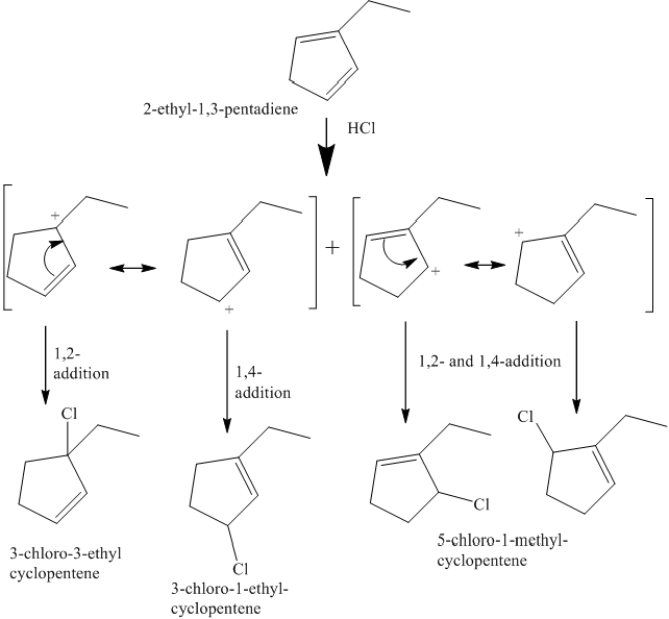
Exhibit 14-7
Consider the reaction below to answer the following question(s).  -Refer to Exhibit 14-7.The diene in the reaction is ____.
 (Short Answer)
4.8/5 (78)
(78) What is the concentration of a solution of a plant pigment (ε = 37,500) if an Absorbance of 0.751 were obtained in a cell with a 5.00 cm path length?
(Multiple Choice)
4.7/5 (78)
(78) Electrophilic addition reaction of conjugated dienes that occur at high temperature and/or long reaction times (reversible conditions) are said to be under:
(Multiple Choice)
4.9/5 (81)
(81) Calculate the concentration of β-carotene in a sample which is placed in a cell with a pathlength of 1.0 cm and the UV absorbance reads 0.56.The molar absorbtivity of β-carotene is found to be 138,000 L mol-1 cm-1.
(Essay)
4.8/5 (75)
(75) A physical constant that is the quantitative measure of the amount of UV light absorbed by a compound.
(Multiple Choice)
4.9/5 (77)
(77) Exhibit 14-2
Consider the reaction below to answer the following question(s):  -Refer to Exhibit 14-2.The nucleophile in this reaction is ____.
 (Short Answer)
4.8/5 (80)
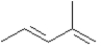
(80) 
Consider the following spectrum for a conjugated diene. 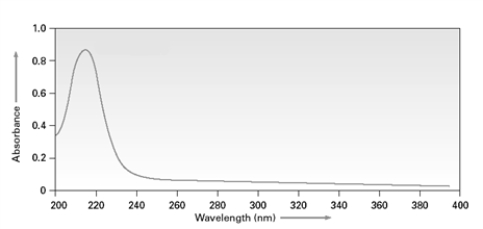 If a similar spectrum were taken for a conjugated tetraene,the λmax would be:
 (Multiple Choice)
4.8/5 (71)
(71) Draw the mechanism of the bromination of 1,3-pentadiene and indicate the major and minor products.
(Essay)
4.7/5 (83)
(83) In 1839,Charles Goodyear discovered a process by which both natural and synthetic rubbers are hardened.This process is called:
(Multiple Choice)
4.8/5 (80)
(80) For Diels-Alder cycloaddition reactions to take place most rapidly and in highest yield the dienophile must:
(Multiple Choice)
4.9/5 (82)
(82) Which of the following compounds will react as a diene in a Diels-Alder reaction?
(Multiple Choice)
4.8/5 (77)
(77) 
The amount of energy in electromagnetic radiation is related to the frequency and wavelength of the radiation.High energy radiation like gamma rays is of:
(Multiple Choice)
4.9/5 (80)
(80) 
Filters
- Essay(0)
- Multiple Choice(0)
- Short Answer(0)
- True False(0)
- Matching(0)