



 Chat with AI
Exam 30: Orbitals and Organic Chemistry: Pericyclic Reactions

Exam 1: Structure and Bonding29 Questions
Exam 2: Polar Covalent Bonds;acids and Bases50 Questions
Exam 3: Organic Compounds: Alkanes and Their Stereochemistry37 Questions
Exam 4: Organic Compounds: Cycloalkanes and Their Stereochemistry37 Questions
Exam 5: Stereochemistry at Tetrahedral Centers43 Questions
Exam 6: An Overview of Organic Reactions42 Questions
Exam 6: Par 12 Questions
Exam 7: Alkenes: Structure and Reactivity37 Questions
Exam 8: Alkenes: Reactions and Synthesis42 Questions
Exam 9: Alkynes: an Introduction to Organic Synthesis31 Questions
Exam 10: Organohalides31 Questions
Exam 11: Reactions of Alkyl Halides: Nucleophilic Substitutions and Eliminations34 Questions
Exam 11: Par 22 Questions
Exam 12: Structure Determination: Mass Spectrometry and Infrared Spectroscopy42 Questions
Exam 13: Structure Determination: Nuclear Magnetic Resonance Spectroscopy46 Questions
Exam 14: Conjugated Compounds and Ultraviolet Spectroscopy40 Questions
Exam 14: Par 32 Questions
Exam 15: Benzene and Aromaticity47 Questions
Exam 16: Chemistry of Benzene: Electrophilic Aromatic Substitution30 Questions
Exam 17: Alcohols and Phenols44 Questions
Exam 18: Ethers and Epoxides;thiols and Sulfides33 Questions
Exam 19: Aldehydes and Ketones: Nucleophilic Addition Reactions48 Questions
Exam 19: Par 42 Questions
Exam 20: Carboxylic Acids and Nitriles32 Questions
Exam 21: Carboxylic Acid Derivatives: Nucleophilic Acyl Substitution Reactions44 Questions
Exam 22: Carbonyl Alpha-Substitution Reactions33 Questions
Exam 23: Carbonyl Condensation Reactions36 Questions
Exam 23: Par 52 Questions
Exam 24: Amines and Heterocycles41 Questions
Exam 25: Biomolecules: Carbohydrates63 Questions
Exam 26: Biomolecules: Amino Acids,peptides,and Proteins45 Questions
Exam 27: Par 72 Questions
Exam 27: Biomolecules: Lipids54 Questions
Exam 28: Biomolecules: Nucleic Acids44 Questions
Exam 29: The Organic Chemistry of Metabolic Pathways48 Questions
Exam 30: Orbitals and Organic Chemistry: Pericyclic Reactions44 Questions
Exam 31: Synthetic Polymers33 Questions
Exam 30: Par 12 Questions
Select questions type


Under thermal conditions,the following substance will undergo: 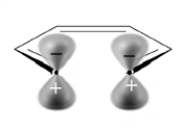

Free
(Multiple Choice)
4.8/5  (80)
(80) Correct Answer: Verified
A
Exhibit 30-7
Consider the Sommelet-Hauser rearrangement below to answer the following question(s): 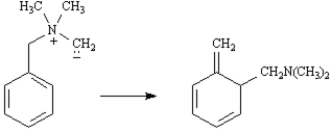 -Refer to Exhibit 30-7.The Sommelet-Hauser rearrangement is an example of a [2,3] sigmatropic rearrangement.How many pairs of electrons are involved in this reaction?
Free
(Multiple Choice)
4.8/5 (73)
(73) Correct Answer:Verified
VerifiedB
The photochemical cycloaddition of the structure below is related to DNA mutations causing skin cancer.Draw the structure of this dimer.Atoms other than carbon and hydrogen are labeled. 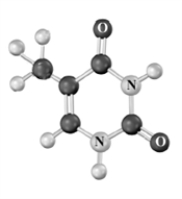
Free
(Essay)
4.7/5 (87)
(87) Correct Answer:Verified
Verified[2+2] cycloaddition occurs due to photochemical conditions. 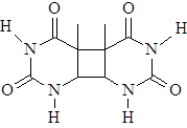
Exhibit 30-9
Vitamin D3,cholecalciferol,is synthesized under the skin by the photochemical pericyclic process shown below.Answer the following question(s) about these reactions. 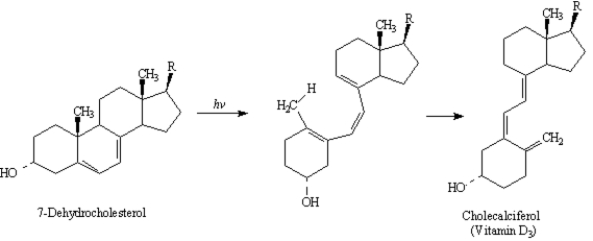 -Refer to Exhibit 30-9.The first step in this process is a(n):
 (Multiple Choice)
4.8/5 (83)
(83) Exhibit 30-2
Consider the reaction below to answer the following question(s): 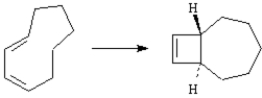 -Refer to Exhibit 30-2.Has this reaction taken place in a conrotatory manner or in a disrotatory manner?
 (Essay)
4.7/5 (67)
(67) Exhibit 30-5
To answer the following question(s),consider the reaction below:  -Refer to Exhibit 30-5.Propose a mechanism for the reaction that fully accounts for the formation of both products.
 (Essay)
4.8/5 (84)
(84) 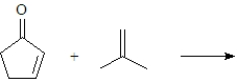
Exhibit 30-3
To answer the following question(s),consider the reaction below:  -Refer to Exhibit 30-3.Two pericyclic reactions are involved in this synthesis of compound Y.Draw the structure of intermediate X and name it using IUPAC nomenclature.
 (Essay)
5.0/5 (95)
(95) Exhibit 30-4
Consider the reaction below to answer the following question(s):  -Refer to Exhibit 30-4.How many pairs of electrons are involved in this pericyclic reaction?
 (Multiple Choice)
4.8/5 (83)
(83) The mnemonic phrase "The Electrons Circle Around",TECA,assists in predicting stereochemistry of pericyclic reactions.Describe application of this mnemonic.
(Essay)
4.7/5 (84)
(84) In which type of pericyclic reaction is a σ bond broken and a new σ bond formed?
(Multiple Choice)
4.7/5 (91)
(91) Exhibit 30-6
Consider the reaction sequence below to answer the following question(s):  -Refer to Exhibit 30-6.Show how C is formed from B.
 (Essay)
4.8/5 (77)
(77) Under photochemical conditions,the following substance will undergo: 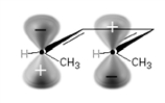
(Multiple Choice)
4.8/5 (70)
(70) Exhibit 30-2
Consider the reaction below to answer the following question(s):
-Refer to Exhibit 30-2.Under what conditions,thermal or photochemical,would you carry out this reaction? Explain.
-Refer to Exhibit 30-2.Under what conditions,thermal or photochemical,would you carry out this reaction? Explain. (Essay)
4.8/5 (76)
(76) Exhibit 30-6
Consider the reaction sequence below to answer the following question(s):
-Refer to Exhibit 30-6.Step 2 is an example of:
-Refer to Exhibit 30-6.Step 2 is an example of: (Multiple Choice)
4.8/5 (83)
(83) Exhibit 30-4
Consider the reaction below to answer the following question(s):
-Refer to Exhibit 30-4.Explain the stereochemistry of this reaction.
-Refer to Exhibit 30-4.Explain the stereochemistry of this reaction. (Essay)
4.9/5 (86)
(86) Exhibit 30-3
To answer the following question(s),consider the reaction below:
-Refer to Exhibit 30-3.Explain the stereochemistry of compound Y.
-Refer to Exhibit 30-3.Explain the stereochemistry of compound Y. (Essay)
4.9/5 (85)
(85) For an even number of electron pairs (double bonds),which of the following rules is correct?:
(Multiple Choice)
4.7/5 (81)
(81) Exhibit 30-6
Consider the reaction sequence below to answer the following question(s):
-Refer to Exhibit 30-6.Step 1 is an example of:
-Refer to Exhibit 30-6.Step 1 is an example of: (Multiple Choice)
4.8/5 (84)
(84) 
Filters
- Essay(0)
- Multiple Choice(0)
- Short Answer(0)
- True False(0)
- Matching(0)