



 Chat with AI
Exam 16: Chemistry of Benzene: Electrophilic Aromatic Substitution

Exam 1: Structure and Bonding29 Questions
Exam 2: Polar Covalent Bonds;acids and Bases50 Questions
Exam 3: Organic Compounds: Alkanes and Their Stereochemistry37 Questions
Exam 4: Organic Compounds: Cycloalkanes and Their Stereochemistry37 Questions
Exam 5: Stereochemistry at Tetrahedral Centers43 Questions
Exam 6: An Overview of Organic Reactions42 Questions
Exam 6: Par 12 Questions
Exam 7: Alkenes: Structure and Reactivity37 Questions
Exam 8: Alkenes: Reactions and Synthesis42 Questions
Exam 9: Alkynes: an Introduction to Organic Synthesis31 Questions
Exam 10: Organohalides31 Questions
Exam 11: Reactions of Alkyl Halides: Nucleophilic Substitutions and Eliminations34 Questions
Exam 11: Par 22 Questions
Exam 12: Structure Determination: Mass Spectrometry and Infrared Spectroscopy42 Questions
Exam 13: Structure Determination: Nuclear Magnetic Resonance Spectroscopy46 Questions
Exam 14: Conjugated Compounds and Ultraviolet Spectroscopy40 Questions
Exam 14: Par 32 Questions
Exam 15: Benzene and Aromaticity47 Questions
Exam 16: Chemistry of Benzene: Electrophilic Aromatic Substitution30 Questions
Exam 17: Alcohols and Phenols44 Questions
Exam 18: Ethers and Epoxides;thiols and Sulfides33 Questions
Exam 19: Aldehydes and Ketones: Nucleophilic Addition Reactions48 Questions
Exam 19: Par 42 Questions
Exam 20: Carboxylic Acids and Nitriles32 Questions
Exam 21: Carboxylic Acid Derivatives: Nucleophilic Acyl Substitution Reactions44 Questions
Exam 22: Carbonyl Alpha-Substitution Reactions33 Questions
Exam 23: Carbonyl Condensation Reactions36 Questions
Exam 23: Par 52 Questions
Exam 24: Amines and Heterocycles41 Questions
Exam 25: Biomolecules: Carbohydrates63 Questions
Exam 26: Biomolecules: Amino Acids,peptides,and Proteins45 Questions
Exam 27: Par 72 Questions
Exam 27: Biomolecules: Lipids54 Questions
Exam 28: Biomolecules: Nucleic Acids44 Questions
Exam 29: The Organic Chemistry of Metabolic Pathways48 Questions
Exam 30: Orbitals and Organic Chemistry: Pericyclic Reactions44 Questions
Exam 31: Synthetic Polymers33 Questions
Exam 30: Par 12 Questions
Select questions type


Exhibit 16-2
Consider the Friedel-Crafts alkylation reaction below to answer the following question(s):  -Refer to Exhibit 16-2.Write the complete stepwise mechanism for this reaction.Show all electron flow with arrows and include all intermediate structures.
Free
(Essay)
4.8/5  (79)
(79) Correct Answer: Verified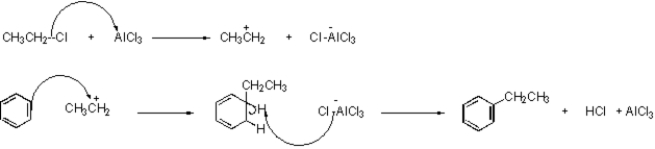
Which of the following is an ortho- and para- director and a deactivator?
Free
(Multiple Choice)
4.8/5 (72)
(72) Correct Answer:Verified
VerifiedB
Exhibit 16-7
Consider the reaction below to answer the following question(s).  -Refer to Exhibit 16-7.The Lewis acid catalyst in the reaction is:
Free
(Short Answer)
4.9/5 (76)
(76) Correct Answer:Verified
VerifiedC
Which of the following could successfully undergo a Friedel-Crafts alkylation? Assume an appropriate catalyst.
(Multiple Choice)
4.8/5 (84)
(84) Exhibit 16-7
Consider the reaction below to answer the following question(s).
-Refer to Exhibit 16-7.The nucleophile in the reaction is:
-Refer to Exhibit 16-7.The nucleophile in the reaction is: (Short Answer)
4.8/5 (95)
(95) Exhibit 16-1
MATCH a structure or term from the following list with each description below.Place the letter of the structure or term in the blank to the left of the description.
-______ Groups which activate aromatic rings towards nucleophilic substitution.
(Multiple Choice)
4.8/5 (78)
(78) Exhibit 16-1
MATCH a structure or term from the following list with each description below.Place the letter of the structure or term in the blank to the left of the description.
-__________Source of F+ in fluorination reactions.
(Multiple Choice)
4.8/5 (72)
(72) The following reaction proceeds by an intramolecular nucleophilic aromatic substitution mechanism.Write the complete stepwise mechanism,showing all intermediate structures and all electron flow with arrows. 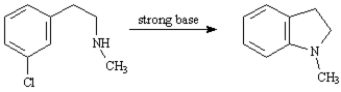
(Essay)
4.8/5 (65)
(65) Exhibit 16-3
Consider the data below to answer the following question(s).
The −NH2 group is listed in our textbook as the strongest o,p-directing activator in electrophilic aromatic substitution reactions.However,when aniline is subjected to standard nitration conditions poor yields of m-nitroaniline result. 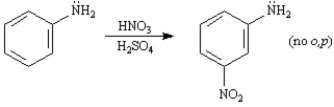 -Refer to Exhibit 16-3.Clearly,the reaction conditions are influencing the directing effect of the −NH2 group.Explain why this occurs,using both words and structures.
 (Essay)
4.8/5 (90)
(90) Tetracyclone is often used to trap benzynes as Diels-Alder adducts.What is the structure of the Diels-Alder adduct that results when benzyne is trapped by tetracyclone? 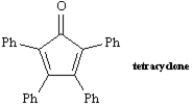
(Essay)
4.9/5 (85)
(85) Exhibit 16-6
To answer the following question(s),refer to the data below:
Isobutylbenzene is the starting material for the industrial synthesis of the NSAID,ibuprofen. 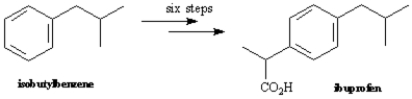 -Refer to Exhibit 16-6.Propose a synthesis for isobutylbenzene which avoids the problems of direct Friedel-Crafts alkylation.
 (Essay)
4.8/5 (85)
(85) Exhibit 16-1
MATCH a structure or term from the following list with each description below.Place the letter of the structure or term in the blank to the left of the description.
-______ Intermediate in the elimination-addition mechanism of nucleophilic aromatic substitution.
(Multiple Choice)
5.0/5 (87)
(87) Arrange the following compounds in order of increasing reactivity to electrophilic aromatic substitution. bromobenzene nitrobenzene benzene phenol
(Multiple Choice)
4.9/5 (80)
(80) Exhibit 16-3
Consider the data below to answer the following question(s).
The −NH2 group is listed in our textbook as the strongest o,p-directing activator in electrophilic aromatic substitution reactions.However,when aniline is subjected to standard nitration conditions poor yields of m-nitroaniline result.
-Refer to Exhibit 16-3.Draw all the resonance forms of aniline showing the electron-donating effect of the −NH2 substituent.
-Refer to Exhibit 16-3.Draw all the resonance forms of aniline showing the electron-donating effect of the −NH2 substituent. (Essay)
4.9/5 (87)
(87) Exhibit 16-4
Consider the reaction below to answer the following question(s).  -Refer to Exhibit 16-4.Write the complete stepwise mechanism for the formation of the ortho product.Show all intermediate structures and show all electron flow with arrows.
 (Essay)
4.9/5 (75)
(75) Exhibit 16-1
MATCH a structure or term from the following list with each description below.Place the letter of the structure or term in the blank to the left of the description.
-______ The reactive electrophile in Friedel-Crafts acylation reactions.
(Multiple Choice)
4.7/5 (85)
(85) Would you expect (nitromethyl)benzene to be more reactive or less reactive than toluene toward electrophilic substitution? Explain. 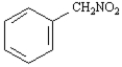
(Essay)
4.9/5 (88)
(88) Exhibit 16-4
Consider the reaction below to answer the following question(s).
-Refer to Exhibit 16-4.Draw resonance structures for the intermediate carbocation that explain the directing effect of the −Br.
-Refer to Exhibit 16-4.Draw resonance structures for the intermediate carbocation that explain the directing effect of the −Br. (Essay)
4.8/5 (65)
(65) Aniline reacts with nitrous acid,HNO2,to yield a stable diazonium salt.This diazonium salt undergoes electrophilic aromatic substitution on activated aromatic rings to yield brightly colored azo compounds that are widely used as dyes.The intermediate structures for the mechanism of this reaction are given below.Show all electron flow with arrows for this mechanism on the structures provided. 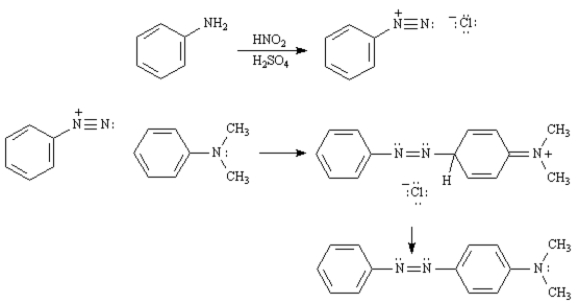
(Essay)
4.8/5 (81)
(81) 
Filters
- Essay(0)
- Multiple Choice(0)
- Short Answer(0)
- True False(0)
- Matching(0)