



 Chat with AI
Exam 26: Biomolecules: Amino Acids,peptides,and Proteins

Exam 1: Structure and Bonding29 Questions
Exam 2: Polar Covalent Bonds;acids and Bases50 Questions
Exam 3: Organic Compounds: Alkanes and Their Stereochemistry37 Questions
Exam 4: Organic Compounds: Cycloalkanes and Their Stereochemistry37 Questions
Exam 5: Stereochemistry at Tetrahedral Centers43 Questions
Exam 6: An Overview of Organic Reactions42 Questions
Exam 6: Par 12 Questions
Exam 7: Alkenes: Structure and Reactivity37 Questions
Exam 8: Alkenes: Reactions and Synthesis42 Questions
Exam 9: Alkynes: an Introduction to Organic Synthesis31 Questions
Exam 10: Organohalides31 Questions
Exam 11: Reactions of Alkyl Halides: Nucleophilic Substitutions and Eliminations34 Questions
Exam 11: Par 22 Questions
Exam 12: Structure Determination: Mass Spectrometry and Infrared Spectroscopy42 Questions
Exam 13: Structure Determination: Nuclear Magnetic Resonance Spectroscopy46 Questions
Exam 14: Conjugated Compounds and Ultraviolet Spectroscopy40 Questions
Exam 14: Par 32 Questions
Exam 15: Benzene and Aromaticity47 Questions
Exam 16: Chemistry of Benzene: Electrophilic Aromatic Substitution30 Questions
Exam 17: Alcohols and Phenols44 Questions
Exam 18: Ethers and Epoxides;thiols and Sulfides33 Questions
Exam 19: Aldehydes and Ketones: Nucleophilic Addition Reactions48 Questions
Exam 19: Par 42 Questions
Exam 20: Carboxylic Acids and Nitriles32 Questions
Exam 21: Carboxylic Acid Derivatives: Nucleophilic Acyl Substitution Reactions44 Questions
Exam 22: Carbonyl Alpha-Substitution Reactions33 Questions
Exam 23: Carbonyl Condensation Reactions36 Questions
Exam 23: Par 52 Questions
Exam 24: Amines and Heterocycles41 Questions
Exam 25: Biomolecules: Carbohydrates63 Questions
Exam 26: Biomolecules: Amino Acids,peptides,and Proteins45 Questions
Exam 27: Par 72 Questions
Exam 27: Biomolecules: Lipids54 Questions
Exam 28: Biomolecules: Nucleic Acids44 Questions
Exam 29: The Organic Chemistry of Metabolic Pathways48 Questions
Exam 30: Orbitals and Organic Chemistry: Pericyclic Reactions44 Questions
Exam 31: Synthetic Polymers33 Questions
Exam 30: Par 12 Questions
Select questions type


Exhibit 26-2
MATCH a structure from the list below to each of the following terms.Place the letter of the structure in the blank to the left of the term which it describes.
-_____ an octapeptide with a C-terminal valine.

Free
(Multiple Choice)
4.8/5  (78)
(78) Correct Answer: Verified
F
Exhibit 26-4
Refer to the data below to answer the following question(s):
Porcine dynorphin is a neuropeptide having 17 amino acid residues.Its structure is shown below.
Tyr−Gly−Gly−Phe−Leu−Arg−Arg−Ile−Arg−Pro−Lys−Leu−Lys−Trp−Asp−Asn−Gln
-Refer to Exhibit 26-4.What fragments would result if dynorphin were cleaved by chymotropsin?
Free
(Essay)
4.8/5 (88)
(88) Correct Answer:Verified
VerifiedChymotropsin catalyzes the hydrolysis of peptides at the carboxyl side of the aryl-substituted amino acids phenylalanine,tyrosine,and tryptophan.Thus,the fragments resulting from chymotropsin hydrolysis of dynorphin are:
Tyr
Gly−Gly−Phe
Leu−Arg−Arg−Ile−Arg−Pro−Lys−Leu−Lys−Trp
Asp−Asn−Gln
Exhibit 26-1
Refer to the data below to answer the following question(s):
Leucine is an essential amino acid with the systematic name 2-amino-3-methylpentanoic acid.It has pKa1 = 2.36 and pKa2 = 9.60.
-Refer to Exhibit 26-1.Show the alkyl halide you would use to prepare leucine by the amidomalonate method.
Free
(Essay)
4.9/5 (81)
(81) Correct Answer:Verified
Verified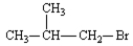
Exhibit 26-1
Refer to the data below to answer the following question(s):
Leucine is an essential amino acid with the systematic name 2-amino-3-methylpentanoic acid.It has pKa1 = 2.36 and pKa2 = 9.60.
-Refer to Exhibit 26-1.What is the pI of leucine?
(Essay)
4.9/5 (90)
(90) Draw and name the structure of the tripeptide formed from the following amino acids.Use B as the N-terminal acid and A as the C-terminal end.Atoms other than carbon and hydrogen are labeled. 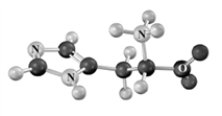
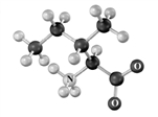
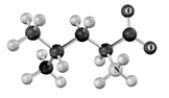 A B C
A B C (Essay)
4.9/5 (77)
(77) Exhibit 26-1
Refer to the data below to answer the following question(s):
Leucine is an essential amino acid with the systematic name 2-amino-3-methylpentanoic acid.It has pKa1 = 2.36 and pKa2 = 9.60.
-Refer to Exhibit 26-1.How many possible stereoisomers of leucine are there?
(Essay)
4.7/5 (78)
(78) Consider the image below. 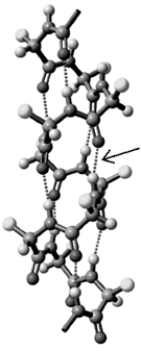 What type of interaction is indicated by the arrow?
 (Multiple Choice)
4.9/5 (74)
(74) What alkyl halide should be used to prepare the following amino acid by the amidomalonate method? Atoms other than carbon and hydrogen are labeled. 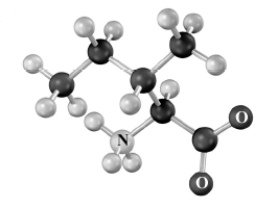
(Essay)
4.7/5 (84)
(84) The enzyme that would catalyze the following reaction  would belong in which classification?
 (Multiple Choice)
4.8/5 (71)
(71) Consider the following titration curve for an amino acid. 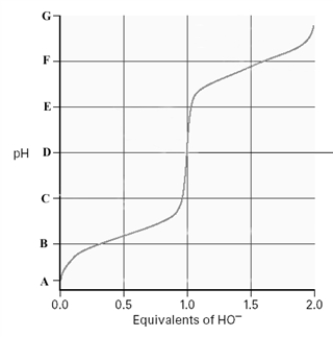 What is the pI of this amino acid?
 (Multiple Choice)
4.7/5 (83)
(83) The following amino acid: (Atoms other than carbon and hydrogen are labeled. ) 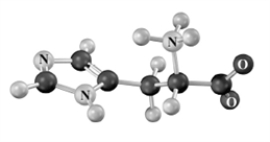
(Multiple Choice)
4.8/5 (81)
(81) Exhibit 26-1
Refer to the data below to answer the following question(s):
Leucine is an essential amino acid with the systematic name 2-amino-3-methylpentanoic acid.It has pKa1 = 2.36 and pKa2 = 9.60.
-Refer to Exhibit 26-1.Draw a Fischer projection of L-leucine and label the chirality center(s) as R or S.
(Essay)
4.9/5 (89)
(89) Consider the following titration curve for an amino acid. 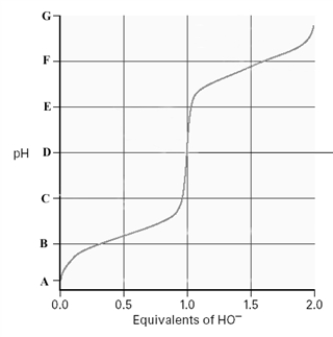 At which of the following "pH" values would the amino acid have a net charge of zero?
 (Multiple Choice)
4.9/5 (78)
(78) Exhibit 26-5
Refer to the data below to answer the following question(s):
The octapeptide saralasin is a specific antagonist of angiotensin II.A derivative of saralasin is used therapeutically as an antihypertensive.Amino acid analysis of saralasin show the presence of the following amino acids:
Ala,Arg,His,Pro,Sar,Tyr,Val,Val
-Refer to Exhibit 26-5.Sar is the abbreviation for sarcosine,N-methyl aminoethanoic acid.Draw the structure of sarcosine.
(Essay)
4.8/5 (87)
(87) On the titration curve for an amino acid.In terms of the letters on the graph,label the isoelectric point,the pKa of the amino group and the pKa of the carboxyl group. 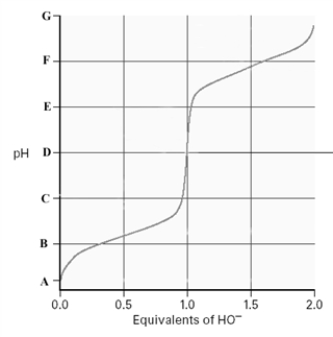
(Essay)
4.8/5 (82)
(82) Exhibit 26-1
Refer to the data below to answer the following question(s):
Leucine is an essential amino acid with the systematic name 2-amino-3-methylpentanoic acid.It has pKa1 = 2.36 and pKa2 = 9.60.
-Refer to Exhibit 26-1.Draw the condensed structure for leucine,and label all chirality centers with an asterisk.
(Essay)
4.7/5 (72)
(72) 
Filters
- Essay(0)
- Multiple Choice(0)
- Short Answer(0)
- True False(0)
- Matching(0)