



 Chat with AI
Exam 26: Biomolecules: Amino Acids,peptides,and Proteins

Exam 1: Structure and Bonding29 Questions
Exam 2: Polar Covalent Bonds;acids and Bases50 Questions
Exam 3: Organic Compounds: Alkanes and Their Stereochemistry37 Questions
Exam 4: Organic Compounds: Cycloalkanes and Their Stereochemistry37 Questions
Exam 5: Stereochemistry at Tetrahedral Centers43 Questions
Exam 6: An Overview of Organic Reactions42 Questions
Exam 6: Par 12 Questions
Exam 7: Alkenes: Structure and Reactivity37 Questions
Exam 8: Alkenes: Reactions and Synthesis42 Questions
Exam 9: Alkynes: an Introduction to Organic Synthesis31 Questions
Exam 10: Organohalides31 Questions
Exam 11: Reactions of Alkyl Halides: Nucleophilic Substitutions and Eliminations34 Questions
Exam 11: Par 22 Questions
Exam 12: Structure Determination: Mass Spectrometry and Infrared Spectroscopy42 Questions
Exam 13: Structure Determination: Nuclear Magnetic Resonance Spectroscopy46 Questions
Exam 14: Conjugated Compounds and Ultraviolet Spectroscopy40 Questions
Exam 14: Par 32 Questions
Exam 15: Benzene and Aromaticity47 Questions
Exam 16: Chemistry of Benzene: Electrophilic Aromatic Substitution30 Questions
Exam 17: Alcohols and Phenols44 Questions
Exam 18: Ethers and Epoxides;thiols and Sulfides33 Questions
Exam 19: Aldehydes and Ketones: Nucleophilic Addition Reactions48 Questions
Exam 19: Par 42 Questions
Exam 20: Carboxylic Acids and Nitriles32 Questions
Exam 21: Carboxylic Acid Derivatives: Nucleophilic Acyl Substitution Reactions44 Questions
Exam 22: Carbonyl Alpha-Substitution Reactions33 Questions
Exam 23: Carbonyl Condensation Reactions36 Questions
Exam 23: Par 52 Questions
Exam 24: Amines and Heterocycles41 Questions
Exam 25: Biomolecules: Carbohydrates63 Questions
Exam 26: Biomolecules: Amino Acids,peptides,and Proteins45 Questions
Exam 27: Par 72 Questions
Exam 27: Biomolecules: Lipids54 Questions
Exam 28: Biomolecules: Nucleic Acids44 Questions
Exam 29: The Organic Chemistry of Metabolic Pathways48 Questions
Exam 30: Orbitals and Organic Chemistry: Pericyclic Reactions44 Questions
Exam 31: Synthetic Polymers33 Questions
Exam 30: Par 12 Questions
Select questions type


Exhibit 26-1
Refer to the data below to answer the following question(s):
Leucine is an essential amino acid with the systematic name 2-amino-3-methylpentanoic acid.It has pKa1 = 2.36 and pKa2 = 9.60.
-Refer to Exhibit 26-1.Draw the structure of the predominant form of leucine at pH = 1.50.
(Essay)
4.9/5  (78)
(78) Exhibit 26-2
MATCH a structure from the list below to each of the following terms.Place the letter of the structure in the blank to the left of the term which it describes.
-_____ a carboxyl-protected amino acid.
(Multiple Choice)
4.8/5 (70)
(70) Which of the following is a correct representation of the amino acid below? Atoms other than carbon and hydrogen are labeled. 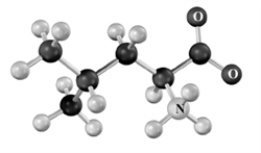
(Multiple Choice)
4.8/5 (91)
(91) Exhibit 26-1
Refer to the data below to answer the following question(s):
Leucine is an essential amino acid with the systematic name 2-amino-3-methylpentanoic acid.It has pKa1 = 2.36 and pKa2 = 9.60.
-Refer to Exhibit 26-1.Draw the structure of the predominant form of leucine at pH = 10.00.
(Essay)
4.9/5 (87)
(87) Which of the following contributes most substantially to rate acceleration produced by an enzyme?
(Multiple Choice)
4.7/5 (77)
(77) Consider the following data for a hypothetical basic amino acid. pKa
3)15
8)22
10)93
What is the pI of this substance?
(Multiple Choice)
4.9/5 (83)
(83) Consider the following image. 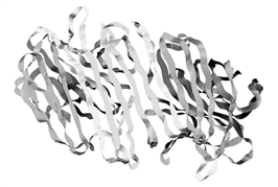 Which level of protein structure is shown here?
 (Multiple Choice)
4.8/5 (70)
(70) Exhibit 26-4
Refer to the data below to answer the following question(s):
Porcine dynorphin is a neuropeptide having 17 amino acid residues.Its structure is shown below.
Tyr−Gly−Gly−Phe−Leu−Arg−Arg−Ile−Arg−Pro−Lys−Leu−Lys−Trp−Asp−Asn−Gln
-Refer to Exhibit 26-4.Leu5-enkephalin is a pentapeptide contained as the N-terminal sequence of dynorphin.Write the structure of Leu5-enkephalin using both the three letter and one letter abbreviations for the amino acids.
(Essay)
4.9/5 (80)
(80) Exhibit 26-2
MATCH a structure from the list below to each of the following terms.Place the letter of the structure in the blank to the left of the term which it describes.
-_____ a polypeptide which gives four fragments on treatment with chymotrypsin.
(Multiple Choice)
4.9/5 (83)
(83) Exhibit 26-2
MATCH a structure from the list below to each of the following terms.Place the letter of the structure in the blank to the left of the term which it describes.
-_____ an amino acid in its zwitterionic form.
(Multiple Choice)
4.9/5 (86)
(86) Show how you could prepare the following amino acid starting with the appropriate carboxylic acid.Atoms other than carbon and hydrogen are labeled. 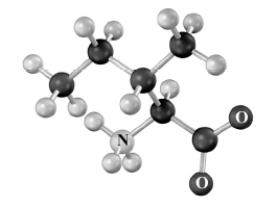
(Essay)
4.7/5 (88)
(88) Exhibit 26-2
MATCH a structure from the list below to each of the following terms.Place the letter of the structure in the blank to the left of the term which it describes.
-_____ the product of an Edman degradation.
(Multiple Choice)
4.8/5 (86)
(86) Exhibit 26-2
MATCH a structure from the list below to each of the following terms.Place the letter of the structure in the blank to the left of the term which it describes.
-_____ a peptide coupling reagent.
(Multiple Choice)
4.8/5 (82)
(82) Exhibit 26-1
Refer to the data below to answer the following question(s):
Leucine is an essential amino acid with the systematic name 2-amino-3-methylpentanoic acid.It has pKa1 = 2.36 and pKa2 = 9.60.
-Refer to Exhibit 26-1.Show how leucine might be synthesized using the Knowles enantioselective synthesis.
(Essay)
4.8/5 (67)
(67) Exhibit 26-4
Refer to the data below to answer the following question(s):
Porcine dynorphin is a neuropeptide having 17 amino acid residues.Its structure is shown below.
Tyr−Gly−Gly−Phe−Leu−Arg−Arg−Ile−Arg−Pro−Lys−Leu−Lys−Trp−Asp−Asn−Gln
-Refer to Exhibit 26-4.What fragments would result if dynorphin were cleaved by trypsin?
(Essay)
4.9/5 (83)
(83) Classify the following amino acid.Atoms other than carbon and hydrogen are labeled. 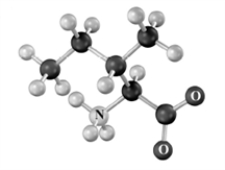
(Multiple Choice)
4.9/5 (63)
(63) Consider the following image. 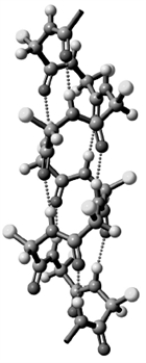 Which level of protein structure is shown here?
 (Multiple Choice)
4.9/5 (84)
(84) Exhibit 26-5
Refer to the data below to answer the following question(s):
The octapeptide saralasin is a specific antagonist of angiotensin II.A derivative of saralasin is used therapeutically as an antihypertensive.Amino acid analysis of saralasin show the presence of the following amino acids:
Ala,Arg,His,Pro,Sar,Tyr,Val,Val
-Refer to Exhibit 26-5.N-Terminal analysis by the Edman method shows saralasin contains sarcosine at the N-terminus.Partial hydrolysis of saralasin with dilute hydrochloric acid yields the following fragments:
Tyr−Val−His
Sar−Arg−Val
His−Pro−Ala
Val−Tyr−Val
Arg−Val−Tyr
What is the structure of saralasin?
(Essay)
4.8/5 (77)
(77) Show the steps involved in a synthesis of the peptide "F-G-I" using the Merrifield procedure.
(Essay)
4.8/5 (70)
(70) Which level of protein structure is disrupted upon mild heating or alteration in pH?
(Multiple Choice)
4.8/5 (91)
(91) 
Filters
- Essay(0)
- Multiple Choice(0)
- Short Answer(0)
- True False(0)
- Matching(0)