



 Chat with AI
Exam 28: Biomolecules: Nucleic Acids

Exam 1: Structure and Bonding29 Questions
Exam 2: Polar Covalent Bonds;acids and Bases50 Questions
Exam 3: Organic Compounds: Alkanes and Their Stereochemistry37 Questions
Exam 4: Organic Compounds: Cycloalkanes and Their Stereochemistry37 Questions
Exam 5: Stereochemistry at Tetrahedral Centers43 Questions
Exam 6: An Overview of Organic Reactions42 Questions
Exam 6: Par 12 Questions
Exam 7: Alkenes: Structure and Reactivity37 Questions
Exam 8: Alkenes: Reactions and Synthesis42 Questions
Exam 9: Alkynes: an Introduction to Organic Synthesis31 Questions
Exam 10: Organohalides31 Questions
Exam 11: Reactions of Alkyl Halides: Nucleophilic Substitutions and Eliminations34 Questions
Exam 11: Par 22 Questions
Exam 12: Structure Determination: Mass Spectrometry and Infrared Spectroscopy42 Questions
Exam 13: Structure Determination: Nuclear Magnetic Resonance Spectroscopy46 Questions
Exam 14: Conjugated Compounds and Ultraviolet Spectroscopy40 Questions
Exam 14: Par 32 Questions
Exam 15: Benzene and Aromaticity47 Questions
Exam 16: Chemistry of Benzene: Electrophilic Aromatic Substitution30 Questions
Exam 17: Alcohols and Phenols44 Questions
Exam 18: Ethers and Epoxides;thiols and Sulfides33 Questions
Exam 19: Aldehydes and Ketones: Nucleophilic Addition Reactions48 Questions
Exam 19: Par 42 Questions
Exam 20: Carboxylic Acids and Nitriles32 Questions
Exam 21: Carboxylic Acid Derivatives: Nucleophilic Acyl Substitution Reactions44 Questions
Exam 22: Carbonyl Alpha-Substitution Reactions33 Questions
Exam 23: Carbonyl Condensation Reactions36 Questions
Exam 23: Par 52 Questions
Exam 24: Amines and Heterocycles41 Questions
Exam 25: Biomolecules: Carbohydrates63 Questions
Exam 26: Biomolecules: Amino Acids,peptides,and Proteins45 Questions
Exam 27: Par 72 Questions
Exam 27: Biomolecules: Lipids54 Questions
Exam 28: Biomolecules: Nucleic Acids44 Questions
Exam 29: The Organic Chemistry of Metabolic Pathways48 Questions
Exam 30: Orbitals and Organic Chemistry: Pericyclic Reactions44 Questions
Exam 31: Synthetic Polymers33 Questions
Exam 30: Par 12 Questions
Select questions type


Consider the following molecular model.Atoms other than carbon and hydrogen are labeled. 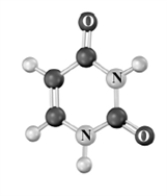 Which of the following is a characteristic of this compound?
Free
(Multiple Choice)
4.8/5  (93)
(93) Correct Answer: Verified
C
While the Watson-Crick G-C and A-T base pairs are the most common,other non-standard base pairs are encountered.Draw and label a G-U base pair.Indicate all hydrogen bonds with a dashed line.
Free
(Essay)
4.8/5 (93)
(93) Correct Answer:Verified
Verified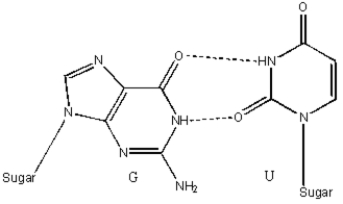
Give a one sentence definition of replication.
Free
(Essay)
4.9/5 (76)
(76) Correct Answer:Verified
VerifiedReplication is the process by which identical copies of DNA are made.
Draw and label a G-C base pair.Indicate all hydrogen bonds with a dashed line.
(Essay)
4.8/5 (74)
(74) On the diagram of DNA, identify:
1) major groove
2) minor groove
3) position of the sugar-phosphate backbone
4) site of possible intercalation 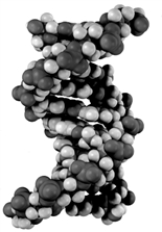
(Essay)
4.8/5 (65)
(65) Consider the DNA polymerase chain reaction.After 5 cycles have been completed,how many copies of the original DNA are present?
(Multiple Choice)
4.8/5 (72)
(72) Draw and label an A-T base pair.Indicate all hydrogen bonds with a dashed line.
(Essay)
4.8/5 (72)
(72) Draw and label an A-U base pair.Indicate all hydrogen bonds with a dashed line.
(Essay)
4.8/5 (75)
(75) Describe,in general terms,the steps involved in the automated synthesis of the DNA sequence GCT.
(Essay)
4.9/5 (79)
(79) 1) Label the anticodon
2) Label the position of attachment of the amino acid
3) Draw the structure of the amino acid that would be attached
4) Indicate the corresponding mRNA codon
(Essay)
4.8/5 (78)
(78) During DNA synthesis,the free amino group does not need to be protected for which base?
(Multiple Choice)
4.8/5 (85)
(85) In the diagram below,fill in the terms in the appropriate places indicated by a letter. 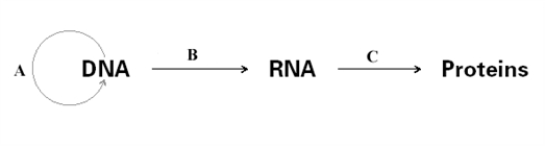
(Multiple Choice)
4.9/5 (76)
(76) Of the two sets of DNA base pairs,which would you expect to be stronger and why?
(Essay)
4.8/5 (68)
(68) What is the purpose of the addition of aqueous ammonia during the synthesis of DNA?
(Multiple Choice)
4.8/5 (75)
(75) Consider the following diagram. 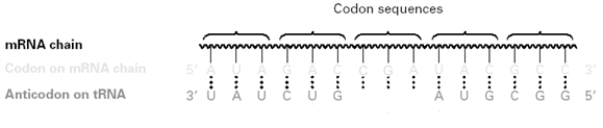
What DNA sequence (5' to 3') would correspond to the third codon?
What DNA sequence (5' to 3') would correspond to the third codon? (Multiple Choice)
4.8/5 (63)
(63) What is the primary structural difference between RNA nucleotides and DNA nucleotides?
(Essay)
5.0/5 (76)
(76) 
Filters
- Essay(0)
- Multiple Choice(0)
- Short Answer(0)
- True False(0)
- Matching(0)