



 Chat with AI
Exam 28: Biomolecules: Nucleic Acids

Exam 1: Structure and Bonding29 Questions
Exam 2: Polar Covalent Bonds;acids and Bases50 Questions
Exam 3: Organic Compounds: Alkanes and Their Stereochemistry37 Questions
Exam 4: Organic Compounds: Cycloalkanes and Their Stereochemistry37 Questions
Exam 5: Stereochemistry at Tetrahedral Centers43 Questions
Exam 6: An Overview of Organic Reactions42 Questions
Exam 6: Par 12 Questions
Exam 7: Alkenes: Structure and Reactivity37 Questions
Exam 8: Alkenes: Reactions and Synthesis42 Questions
Exam 9: Alkynes: an Introduction to Organic Synthesis31 Questions
Exam 10: Organohalides31 Questions
Exam 11: Reactions of Alkyl Halides: Nucleophilic Substitutions and Eliminations34 Questions
Exam 11: Par 22 Questions
Exam 12: Structure Determination: Mass Spectrometry and Infrared Spectroscopy42 Questions
Exam 13: Structure Determination: Nuclear Magnetic Resonance Spectroscopy46 Questions
Exam 14: Conjugated Compounds and Ultraviolet Spectroscopy40 Questions
Exam 14: Par 32 Questions
Exam 15: Benzene and Aromaticity47 Questions
Exam 16: Chemistry of Benzene: Electrophilic Aromatic Substitution30 Questions
Exam 17: Alcohols and Phenols44 Questions
Exam 18: Ethers and Epoxides;thiols and Sulfides33 Questions
Exam 19: Aldehydes and Ketones: Nucleophilic Addition Reactions48 Questions
Exam 19: Par 42 Questions
Exam 20: Carboxylic Acids and Nitriles32 Questions
Exam 21: Carboxylic Acid Derivatives: Nucleophilic Acyl Substitution Reactions44 Questions
Exam 22: Carbonyl Alpha-Substitution Reactions33 Questions
Exam 23: Carbonyl Condensation Reactions36 Questions
Exam 23: Par 52 Questions
Exam 24: Amines and Heterocycles41 Questions
Exam 25: Biomolecules: Carbohydrates63 Questions
Exam 26: Biomolecules: Amino Acids,peptides,and Proteins45 Questions
Exam 27: Par 72 Questions
Exam 27: Biomolecules: Lipids54 Questions
Exam 28: Biomolecules: Nucleic Acids44 Questions
Exam 29: The Organic Chemistry of Metabolic Pathways48 Questions
Exam 30: Orbitals and Organic Chemistry: Pericyclic Reactions44 Questions
Exam 31: Synthetic Polymers33 Questions
Exam 30: Par 12 Questions
Select questions type


When the β-cyanoethyl group is removed during DNA synthesis,H2CCHCN is produced as a product.This reaction is likely to be:
(Multiple Choice)
4.7/5  (76)
(76) Using the PCR method for synthesizing DNA,why don't the two DNA strands recombine during the cooling phase?
(Multiple Choice)
4.9/5 (94)
(94) Because of the structure of the RNA sugar-phosphate backbone,RNA is subject to base-promoted hydrolysis,as shown below.Suggest a mechanism for base-promoted RNA hydrolysis. 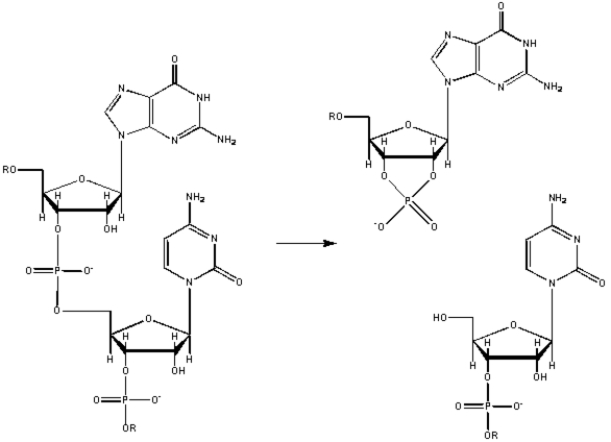
(Essay)
4.8/5 (74)
(74) In determining DNA sequencing using the Sanger dideoxy method,how many colors will appear in the resulting data display?
(Multiple Choice)
4.8/5 (70)
(70) Consider the following molecular model.Atoms other than carbon and hydrogen are labeled. 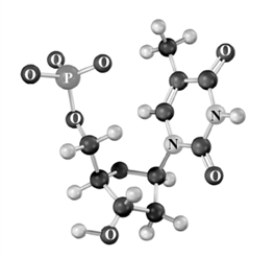 Which of the following is a characteristic of this structure?
 (Multiple Choice)
4.8/5 (73)
(73) During DNA synthesis,how is the 5' -OH of deoxyribose protected?
(Multiple Choice)
4.8/5 (74)
(74) Consider the following diagram. 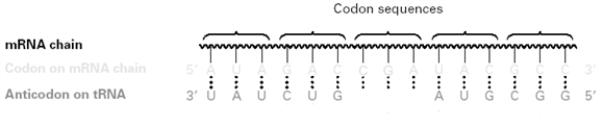 Which letter should be filled in on the bottom line?
 (Multiple Choice)
4.8/5 (77)
(77) Consider the following diagram. 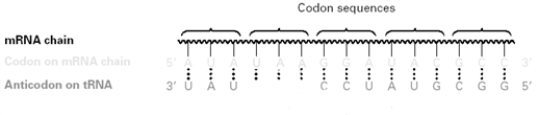 What amino acid corresponds to the second codon from the left?
 (Multiple Choice)
4.9/5 (77)
(77) When DNA is replicated,the new chain is synthesized in what direction?
(Essay)
4.8/5 (85)
(85) Which of the following statement correctly describes DNA replication?
(Multiple Choice)
4.9/5 (75)
(75) 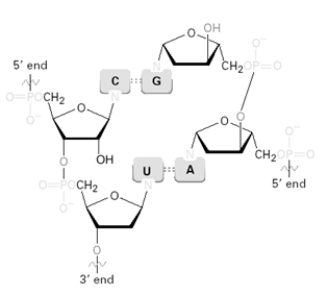
Give the single letter amino acid sequence that is coded for by the following segment of DNA coding strand (sense strand)?
(5') GCA-TTT-CTA-ACT-TGA-GGG (3')
(Essay)
4.8/5 (86)
(86) 
Filters
- Essay(0)
- Multiple Choice(0)
- Short Answer(0)
- True False(0)
- Matching(0)