



 Chat with AI
Exam 24: Amines and Heterocycles

Exam 1: Structure and Bonding29 Questions
Exam 2: Polar Covalent Bonds;acids and Bases50 Questions
Exam 3: Organic Compounds: Alkanes and Their Stereochemistry37 Questions
Exam 4: Organic Compounds: Cycloalkanes and Their Stereochemistry37 Questions
Exam 5: Stereochemistry at Tetrahedral Centers43 Questions
Exam 6: An Overview of Organic Reactions42 Questions
Exam 6: Par 12 Questions
Exam 7: Alkenes: Structure and Reactivity37 Questions
Exam 8: Alkenes: Reactions and Synthesis42 Questions
Exam 9: Alkynes: an Introduction to Organic Synthesis31 Questions
Exam 10: Organohalides31 Questions
Exam 11: Reactions of Alkyl Halides: Nucleophilic Substitutions and Eliminations34 Questions
Exam 11: Par 22 Questions
Exam 12: Structure Determination: Mass Spectrometry and Infrared Spectroscopy42 Questions
Exam 13: Structure Determination: Nuclear Magnetic Resonance Spectroscopy46 Questions
Exam 14: Conjugated Compounds and Ultraviolet Spectroscopy40 Questions
Exam 14: Par 32 Questions
Exam 15: Benzene and Aromaticity47 Questions
Exam 16: Chemistry of Benzene: Electrophilic Aromatic Substitution30 Questions
Exam 17: Alcohols and Phenols44 Questions
Exam 18: Ethers and Epoxides;thiols and Sulfides33 Questions
Exam 19: Aldehydes and Ketones: Nucleophilic Addition Reactions48 Questions
Exam 19: Par 42 Questions
Exam 20: Carboxylic Acids and Nitriles32 Questions
Exam 21: Carboxylic Acid Derivatives: Nucleophilic Acyl Substitution Reactions44 Questions
Exam 22: Carbonyl Alpha-Substitution Reactions33 Questions
Exam 23: Carbonyl Condensation Reactions36 Questions
Exam 23: Par 52 Questions
Exam 24: Amines and Heterocycles41 Questions
Exam 25: Biomolecules: Carbohydrates63 Questions
Exam 26: Biomolecules: Amino Acids,peptides,and Proteins45 Questions
Exam 27: Par 72 Questions
Exam 27: Biomolecules: Lipids54 Questions
Exam 28: Biomolecules: Nucleic Acids44 Questions
Exam 29: The Organic Chemistry of Metabolic Pathways48 Questions
Exam 30: Orbitals and Organic Chemistry: Pericyclic Reactions44 Questions
Exam 31: Synthetic Polymers33 Questions
Exam 30: Par 12 Questions
Select questions type


Which of the following would best represent the form of ethylamine (pKa) at physiological pH?

Free
(Multiple Choice)
4.9/5  (72)
(72) Correct Answer: Verified
A
Exhibit 24-4
Refer to the reaction below to answer the following question(s): 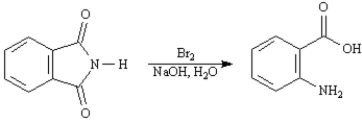 -Refer to Exhibit 24-4.Draw arrows on the structures provided below which show electron flow in the complete stepwise mechanism for the reaction above.
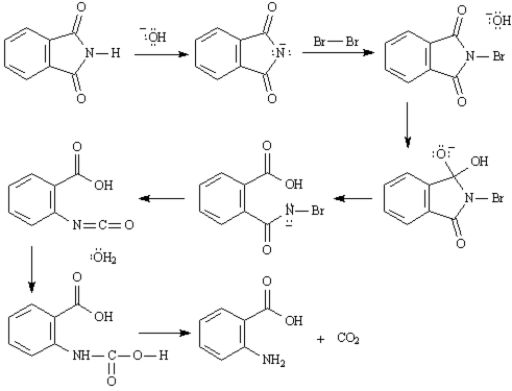
-Refer to Exhibit 24-4.Draw arrows on the structures provided below which show electron flow in the complete stepwise mechanism for the reaction above. Free
(Essay)
4.8/5 (75)
(75) Correct Answer:Verified
Verified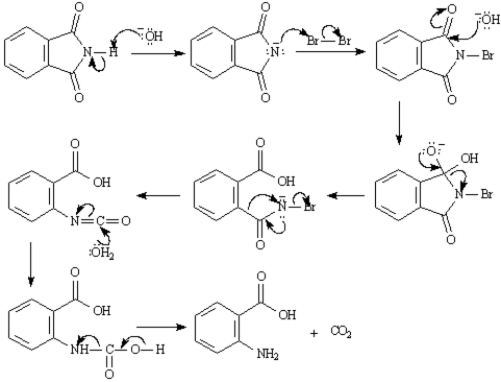
Name:
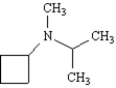
Free
(Short Answer)
4.8/5 (88)
(88) Correct Answer:Verified
VerifiedN-isopropyl-N-methylcyclobutylamine
The amino acid phenylalanine has the structure below. 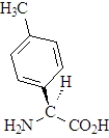 Which of the following is the best representation of this acid at pH 7.3?
 (Multiple Choice)
4.9/5 (85)
(85) Draw the product of the reaction of the following substance with 1) LiAlH4 in ether,2) H2O.From what alkyl bromide could this substance be produced when reacted with NaCN? Atoms other than carbon and hydrogen are labeled. 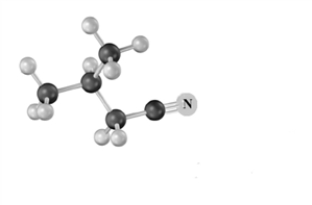
(Essay)
4.8/5 (77)
(77) Exhibit 24-8
Refer to the data below to answer the following question(s):
Triclocarban is a disinfectant prepared from 3,4-dichloroaniline and 4-chlorophenylisocyanate.  -Refer to Exhibit 24-8.Propose a mechanism for the reaction of 3,4-dichloroaniline and 4-chlorophenylisocyanate to yield Triclocarban.
 (Essay)
4.9/5 (79)
(79) Exhibit 24-8
Refer to the data below to answer the following question(s):
Triclocarban is a disinfectant prepared from 3,4-dichloroaniline and 4-chlorophenylisocyanate.
-Refer to Exhibit 24-8.Prepare 4-chlorophenylisocyanate from toluene. 
-Refer to Exhibit 24-8.Prepare 4-chlorophenylisocyanate from toluene. (Essay)
4.8/5 (82)
(82) Rank the following compounds in order of increasing basicity.Label the least basic compound "1" and the most basic compound "4".Place the number corresponding to the compound's rank in the blank below the compound. 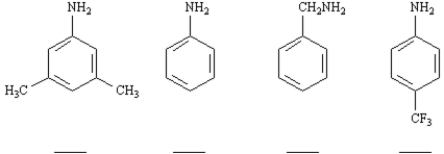
(Short Answer)
4.9/5 (84)
(84) Which of the following methods of preparation of amines can be used to prepare primary,secondary,and tertiary amines?
(Multiple Choice)
4.9/5 (87)
(87) An unknown substance produced the following spectrum. 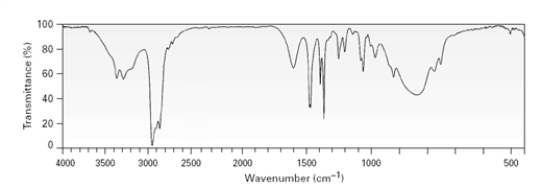 This unknown is likely to be a:
 (Multiple Choice)
4.8/5 (80)
(80) Draw the mechanism for the Hofmann rearrangement of acetamide to acetamine.
(Essay)
4.7/5 (74)
(74) Draw the mechanism of the Sandmeyer reaction that converts o-methyl aniline to o-bromotoluene.
(Essay)
4.8/5 (69)
(69) Propose a structure that is consistent with the following spectral data:
MS:
M+ at 73
IR:
3350 cm−1 (weak,single band)
1H NMR:
δ1.05 (br s,1H),δ1.15 (t,6H),δ2.65 (q,4H)
(Short Answer)
4.9/5 (75)
(75) Exhibit 24-3
Refer to the Table of pKas below to answer the following question(s):
pKas of Some Arylammonium Ions 
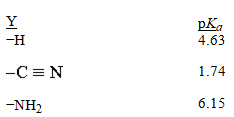 -Refer to Exhibit 24-3.Explain the difference in acidity between p-cyanoanilinium ion and anilinium ion.Use both words and structures.
 (Essay)
4.8/5 (87)
(87) Which of the following is not a valid comparison of the spectral data for alkyl amines and alkyl alcohols?
(Multiple Choice)
4.8/5 (71)
(71) Write the equation for the reaction represented by the pKa of methyl amine.
(Essay)
4.7/5 (70)
(70) 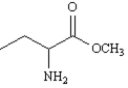
What is the percentage of neutral species in a 0.00500 M solution of pyridine at pH 9.50? pKa of pyridine is 5.25.
(Multiple Choice)
4.8/5 (84)
(84) 
Filters
- Essay(0)
- Multiple Choice(0)
- Short Answer(0)
- True False(0)
- Matching(0)