



 Chat with AI
Exam 14: Conjugated Compounds and Ultraviolet Spectroscopy

Exam 1: Structure and Bonding29 Questions
Exam 2: Polar Covalent Bonds;acids and Bases50 Questions
Exam 3: Organic Compounds: Alkanes and Their Stereochemistry37 Questions
Exam 4: Organic Compounds: Cycloalkanes and Their Stereochemistry37 Questions
Exam 5: Stereochemistry at Tetrahedral Centers43 Questions
Exam 6: An Overview of Organic Reactions42 Questions
Exam 6: Par 12 Questions
Exam 7: Alkenes: Structure and Reactivity37 Questions
Exam 8: Alkenes: Reactions and Synthesis42 Questions
Exam 9: Alkynes: an Introduction to Organic Synthesis31 Questions
Exam 10: Organohalides31 Questions
Exam 11: Reactions of Alkyl Halides: Nucleophilic Substitutions and Eliminations34 Questions
Exam 11: Par 22 Questions
Exam 12: Structure Determination: Mass Spectrometry and Infrared Spectroscopy42 Questions
Exam 13: Structure Determination: Nuclear Magnetic Resonance Spectroscopy46 Questions
Exam 14: Conjugated Compounds and Ultraviolet Spectroscopy40 Questions
Exam 14: Par 32 Questions
Exam 15: Benzene and Aromaticity47 Questions
Exam 16: Chemistry of Benzene: Electrophilic Aromatic Substitution30 Questions
Exam 17: Alcohols and Phenols44 Questions
Exam 18: Ethers and Epoxides;thiols and Sulfides33 Questions
Exam 19: Aldehydes and Ketones: Nucleophilic Addition Reactions48 Questions
Exam 19: Par 42 Questions
Exam 20: Carboxylic Acids and Nitriles32 Questions
Exam 21: Carboxylic Acid Derivatives: Nucleophilic Acyl Substitution Reactions44 Questions
Exam 22: Carbonyl Alpha-Substitution Reactions33 Questions
Exam 23: Carbonyl Condensation Reactions36 Questions
Exam 23: Par 52 Questions
Exam 24: Amines and Heterocycles41 Questions
Exam 25: Biomolecules: Carbohydrates63 Questions
Exam 26: Biomolecules: Amino Acids,peptides,and Proteins45 Questions
Exam 27: Par 72 Questions
Exam 27: Biomolecules: Lipids54 Questions
Exam 28: Biomolecules: Nucleic Acids44 Questions
Exam 29: The Organic Chemistry of Metabolic Pathways48 Questions
Exam 30: Orbitals and Organic Chemistry: Pericyclic Reactions44 Questions
Exam 31: Synthetic Polymers33 Questions
Exam 30: Par 12 Questions
Select questions type


Exhibit 14-2
Consider the reaction below to answer the following question(s):  -Refer to Exhibit 14-2.The electrophile in this reaction is ____.
 (Short Answer)
4.8/5  (78)
(78) Which of the following is the most likely to happen when a conjugated diene is irradiated with ultraviolet light?
(Multiple Choice)
4.9/5 (69)
(69) Draw the skeletal formulas for the product of the reaction of the following with HBr. 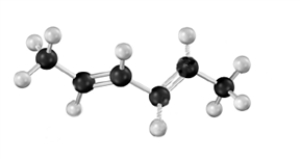
(Essay)
4.9/5 (77)
(77) Which of the following compounds would show the longest wavelength λmax in its UV spectrum?
(Multiple Choice)
4.9/5 (71)
(71) Exhibit 14-7
Consider the reaction below to answer the following question(s).  -Refer to Exhibit 14-7.This is an example of a(n) ____________ reaction.
 (Multiple Choice)
4.8/5 (67)
(67) Based on the following table,in which compound is the energy difference between the HOMO and LUMO the largest? 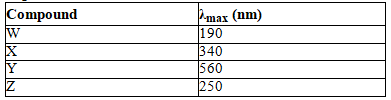
(Multiple Choice)
4.8/5 (87)
(87) When an organic molecule is irradiated with ultraviolet radiation,the energy absorbed by the molecule corresponds to:
(Multiple Choice)
4.9/5 (69)
(69) Draw the mechanism of the Diels-Alder reaction between propenal and 2-methyl-1,3-butadiene.
(Essay)
4.8/5 (81)
(81) Which of the following has the highest degree of conjugation? Atoms other than carbon and hydrogen are labeled.
(Multiple Choice)
4.8/5 (90)
(90) Exhibit 14-7
Consider the reaction below to answer the following question(s).
-Refer to Exhibit 14-7.The dienophile in the reaction is ____.
-Refer to Exhibit 14-7.The dienophile in the reaction is ____. (Short Answer)
4.7/5 (84)
(84) What would be the stereochemistry of the product of the following reaction? 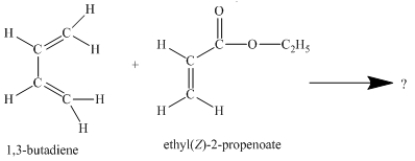
(Essay)
4.9/5 (64)
(64) If ΔH°hydrog for a monosubstituted alkene is 126 kJ/mol,which of the following systems is most likely to be a conjugated system?
(Multiple Choice)
4.9/5 (76)
(76) Exhibit 14-2
Consider the reaction below to answer the following question(s):
-Refer to Exhibit 14-2.The product that results from 1,4-addition is _____.
-Refer to Exhibit 14-2.The product that results from 1,4-addition is _____. (Short Answer)
4.9/5 (72)
(72) Exhibit 14-2
Consider the reaction below to answer the following question(s):
-Refer to Exhibit 14-2.The kinetically controlled product in this reaction is _____.
-Refer to Exhibit 14-2.The kinetically controlled product in this reaction is _____. (Short Answer)
4.8/5 (72)
(72) Exhibit 14-2
Consider the reaction below to answer the following question(s):
-Refer to Exhibit 14-2.Write a stepwise mechanism that accounts for both of the products shown.Show all intermediate structures and electron flow with arrows.
-Refer to Exhibit 14-2.Write a stepwise mechanism that accounts for both of the products shown.Show all intermediate structures and electron flow with arrows. (Essay)
4.9/5 (68)
(68) Consider the following data for a series of hypothetical plant pigments. Pigment
Ε
QT7
15,300
XR4
41,000
B78
30,800
L99
10,600
The Absorbance of a 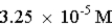 solution containing one of these pigments,measured in a 1.00 cm cell,was 0.345.Which pigment was in the solution?
 (Multiple Choice)
4.8/5 (83)
(83) Exhibit 14-2
Consider the reaction below to answer the following question(s):
-Refer to Exhibit 14-2.This reaction shows the preferred electrophilic addition of HBr to this unsymmetrical alkene.Draw the products of electrophilic addition to the opposite end of the conjugated diene.
-Refer to Exhibit 14-2.This reaction shows the preferred electrophilic addition of HBr to this unsymmetrical alkene.Draw the products of electrophilic addition to the opposite end of the conjugated diene. (Essay)
4.9/5 (88)
(88) 2-Chloro-1,3-butadiene is polymerized to yield an excellent,expensive synthetic rubber with good weather resistance called:
(Multiple Choice)
4.7/5 (73)
(73) 
Filters
- Essay(0)
- Multiple Choice(0)
- Short Answer(0)
- True False(0)
- Matching(0)