



 Chat with AI
Exam 31: Synthetic Polymers

Exam 1: Structure and Bonding29 Questions
Exam 2: Polar Covalent Bonds;acids and Bases50 Questions
Exam 3: Organic Compounds: Alkanes and Their Stereochemistry37 Questions
Exam 4: Organic Compounds: Cycloalkanes and Their Stereochemistry37 Questions
Exam 5: Stereochemistry at Tetrahedral Centers43 Questions
Exam 6: An Overview of Organic Reactions42 Questions
Exam 6: Par 12 Questions
Exam 7: Alkenes: Structure and Reactivity37 Questions
Exam 8: Alkenes: Reactions and Synthesis42 Questions
Exam 9: Alkynes: an Introduction to Organic Synthesis31 Questions
Exam 10: Organohalides31 Questions
Exam 11: Reactions of Alkyl Halides: Nucleophilic Substitutions and Eliminations34 Questions
Exam 11: Par 22 Questions
Exam 12: Structure Determination: Mass Spectrometry and Infrared Spectroscopy42 Questions
Exam 13: Structure Determination: Nuclear Magnetic Resonance Spectroscopy46 Questions
Exam 14: Conjugated Compounds and Ultraviolet Spectroscopy40 Questions
Exam 14: Par 32 Questions
Exam 15: Benzene and Aromaticity47 Questions
Exam 16: Chemistry of Benzene: Electrophilic Aromatic Substitution30 Questions
Exam 17: Alcohols and Phenols44 Questions
Exam 18: Ethers and Epoxides;thiols and Sulfides33 Questions
Exam 19: Aldehydes and Ketones: Nucleophilic Addition Reactions48 Questions
Exam 19: Par 42 Questions
Exam 20: Carboxylic Acids and Nitriles32 Questions
Exam 21: Carboxylic Acid Derivatives: Nucleophilic Acyl Substitution Reactions44 Questions
Exam 22: Carbonyl Alpha-Substitution Reactions33 Questions
Exam 23: Carbonyl Condensation Reactions36 Questions
Exam 23: Par 52 Questions
Exam 24: Amines and Heterocycles41 Questions
Exam 25: Biomolecules: Carbohydrates63 Questions
Exam 26: Biomolecules: Amino Acids,peptides,and Proteins45 Questions
Exam 27: Par 72 Questions
Exam 27: Biomolecules: Lipids54 Questions
Exam 28: Biomolecules: Nucleic Acids44 Questions
Exam 29: The Organic Chemistry of Metabolic Pathways48 Questions
Exam 30: Orbitals and Organic Chemistry: Pericyclic Reactions44 Questions
Exam 31: Synthetic Polymers33 Questions
Exam 30: Par 12 Questions
Select questions type


Which of the following monomers could produce atactic,isotactic,and syndiotactic polymers?
(Multiple Choice)
4.8/5  (85)
(85) Consider the following diagram representing crystallites.  Which type of polymer is represented?
 (Multiple Choice)
4.8/5 (66)
(66) Within a crystallite,the polymer chains are held together by:
(Multiple Choice)
4.8/5 (78)
(78) Exhibit 31-2
Draw the structure(s) of the monomer(s) used to make each of the following polymers.
-Draw: 
(Essay)
4.9/5 (89)
(89) Exhibit 31-1
MATCH a term or structure from the list below to each of the following definitions or names. Place the letter of the term or structure in the blank to the left of the definition or name which it describes.
-____ Small organic molecules that act as lubricants between polymer chains.
(Multiple Choice)
4.9/5 (82)
(82) Do you expect nitroethylene to be more or less reactive than ethylene toward anionic polymerization? Explain. 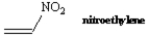
(Essay)
4.9/5 (80)
(80) Exhibit 31-2
Draw the structure(s) of the monomer(s) used to make each of the following polymers.
-Draw: 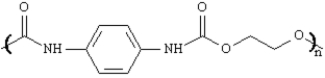
(Essay)
4.8/5 (75)
(75) Exhibit 31-2
Draw the structure(s) of the monomer(s) used to make each of the following polymers.
-Draw: 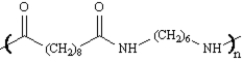
(Essay)
4.8/5 (77)
(77) Exhibit 31-1
MATCH a term or structure from the list below to each of the following definitions or names. Place the letter of the term or structure in the blank to the left of the definition or name which it describes.
-____ Bakelite is this type of polymer.
(Multiple Choice)
4.8/5 (69)
(69) 
Monomer A is copolymerized with Monomer B and is found to have the following structure:  The type of copolymer formed is:
 (Multiple Choice)
4.9/5 (84)
(84) Exhibit 31-1
MATCH a term or structure from the list below to each of the following definitions or names. Place the letter of the term or structure in the blank to the left of the definition or name which it describes.
-____ Produced by reactions in which each bond in the polymer is formed independently of the others.
(Multiple Choice)
4.8/5 (81)
(81) Rank the following monomers in order of increasing reactivity toward anionic polymerization (least reactive to most reactive). 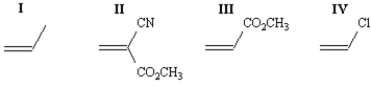
(Multiple Choice)
4.7/5 (83)
(83) 
Filters
- Essay(0)
- Multiple Choice(0)
- Short Answer(0)
- True False(0)
- Matching(0)