



 Chat with AI
Exam 15: Benzene and Aromaticity

Exam 1: Structure and Bonding29 Questions
Exam 2: Polar Covalent Bonds;acids and Bases50 Questions
Exam 3: Organic Compounds: Alkanes and Their Stereochemistry37 Questions
Exam 4: Organic Compounds: Cycloalkanes and Their Stereochemistry37 Questions
Exam 5: Stereochemistry at Tetrahedral Centers43 Questions
Exam 6: An Overview of Organic Reactions42 Questions
Exam 6: Par 12 Questions
Exam 7: Alkenes: Structure and Reactivity37 Questions
Exam 8: Alkenes: Reactions and Synthesis42 Questions
Exam 9: Alkynes: an Introduction to Organic Synthesis31 Questions
Exam 10: Organohalides31 Questions
Exam 11: Reactions of Alkyl Halides: Nucleophilic Substitutions and Eliminations34 Questions
Exam 11: Par 22 Questions
Exam 12: Structure Determination: Mass Spectrometry and Infrared Spectroscopy42 Questions
Exam 13: Structure Determination: Nuclear Magnetic Resonance Spectroscopy46 Questions
Exam 14: Conjugated Compounds and Ultraviolet Spectroscopy40 Questions
Exam 14: Par 32 Questions
Exam 15: Benzene and Aromaticity47 Questions
Exam 16: Chemistry of Benzene: Electrophilic Aromatic Substitution30 Questions
Exam 17: Alcohols and Phenols44 Questions
Exam 18: Ethers and Epoxides;thiols and Sulfides33 Questions
Exam 19: Aldehydes and Ketones: Nucleophilic Addition Reactions48 Questions
Exam 19: Par 42 Questions
Exam 20: Carboxylic Acids and Nitriles32 Questions
Exam 21: Carboxylic Acid Derivatives: Nucleophilic Acyl Substitution Reactions44 Questions
Exam 22: Carbonyl Alpha-Substitution Reactions33 Questions
Exam 23: Carbonyl Condensation Reactions36 Questions
Exam 23: Par 52 Questions
Exam 24: Amines and Heterocycles41 Questions
Exam 25: Biomolecules: Carbohydrates63 Questions
Exam 26: Biomolecules: Amino Acids,peptides,and Proteins45 Questions
Exam 27: Par 72 Questions
Exam 27: Biomolecules: Lipids54 Questions
Exam 28: Biomolecules: Nucleic Acids44 Questions
Exam 29: The Organic Chemistry of Metabolic Pathways48 Questions
Exam 30: Orbitals and Organic Chemistry: Pericyclic Reactions44 Questions
Exam 31: Synthetic Polymers33 Questions
Exam 30: Par 12 Questions
Select questions type


Which of the choices arranges numbered protons in the following substance in order of increasing downfield chemical shift in a proton NMR? Atoms other than carbon and hydrogen are labeled. 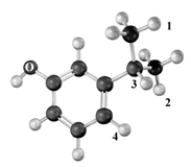
(Multiple Choice)
4.9/5  (77)
(77) Exhibit 15-6
Consider the data below to answer the following question(s).
C9H12;1H NMR:
6.65 δ (singlet,3H)
2.25 δ (singlet,9H)
-Refer to Exhibit 15-6.Describe the signal at 6.65 δ in terms of its splitting,integration and chemical shift.
(Essay)
4.7/5 (67)
(67) Most alkyl halides are nonpolar covalent compounds and,therefore,are soluble in nonpolar solvents and insoluble in water.Cycloheptatrienyl bromide is an unusual alkyl halide in that it is insoluble in nonpolar solvents,but is readily soluble in water! This behavior is consistent with cycloheptatrienyl bromide being an ionic compound.Why does cycloheptatrienyl bromide exist as an ionic compound? Explain by comparing the covalent structure to the ionic structure. 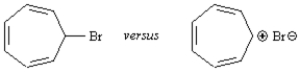
(Essay)
4.8/5 (68)
(68) Draw the MO energy diagram for the cycloheptatrienyl anion and classify the anion as aromatic or antiaromatic.
(Essay)
4.9/5 (78)
(78) 
Filters
- Essay(0)
- Multiple Choice(0)
- Short Answer(0)
- True False(0)
- Matching(0)