



 Chat with AI
Exam 15: Benzene and Aromaticity

Exam 1: Structure and Bonding29 Questions
Exam 2: Polar Covalent Bonds;acids and Bases50 Questions
Exam 3: Organic Compounds: Alkanes and Their Stereochemistry37 Questions
Exam 4: Organic Compounds: Cycloalkanes and Their Stereochemistry37 Questions
Exam 5: Stereochemistry at Tetrahedral Centers43 Questions
Exam 6: An Overview of Organic Reactions42 Questions
Exam 6: Par 12 Questions
Exam 7: Alkenes: Structure and Reactivity37 Questions
Exam 8: Alkenes: Reactions and Synthesis42 Questions
Exam 9: Alkynes: an Introduction to Organic Synthesis31 Questions
Exam 10: Organohalides31 Questions
Exam 11: Reactions of Alkyl Halides: Nucleophilic Substitutions and Eliminations34 Questions
Exam 11: Par 22 Questions
Exam 12: Structure Determination: Mass Spectrometry and Infrared Spectroscopy42 Questions
Exam 13: Structure Determination: Nuclear Magnetic Resonance Spectroscopy46 Questions
Exam 14: Conjugated Compounds and Ultraviolet Spectroscopy40 Questions
Exam 14: Par 32 Questions
Exam 15: Benzene and Aromaticity47 Questions
Exam 16: Chemistry of Benzene: Electrophilic Aromatic Substitution30 Questions
Exam 17: Alcohols and Phenols44 Questions
Exam 18: Ethers and Epoxides;thiols and Sulfides33 Questions
Exam 19: Aldehydes and Ketones: Nucleophilic Addition Reactions48 Questions
Exam 19: Par 42 Questions
Exam 20: Carboxylic Acids and Nitriles32 Questions
Exam 21: Carboxylic Acid Derivatives: Nucleophilic Acyl Substitution Reactions44 Questions
Exam 22: Carbonyl Alpha-Substitution Reactions33 Questions
Exam 23: Carbonyl Condensation Reactions36 Questions
Exam 23: Par 52 Questions
Exam 24: Amines and Heterocycles41 Questions
Exam 25: Biomolecules: Carbohydrates63 Questions
Exam 26: Biomolecules: Amino Acids,peptides,and Proteins45 Questions
Exam 27: Par 72 Questions
Exam 27: Biomolecules: Lipids54 Questions
Exam 28: Biomolecules: Nucleic Acids44 Questions
Exam 29: The Organic Chemistry of Metabolic Pathways48 Questions
Exam 30: Orbitals and Organic Chemistry: Pericyclic Reactions44 Questions
Exam 31: Synthetic Polymers33 Questions
Exam 30: Par 12 Questions
Select questions type


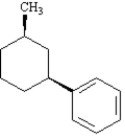

Consider the following compound.Atoms other than carbon and hydrogen are labeled. 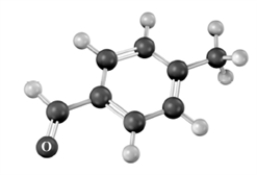 Which of the following is not valid?
 (Multiple Choice)
4.9/5  (73)
(73) Which of the following aromatic compounds will have largest number of signals in a 13CNMR?
(Multiple Choice)
4.9/5 (100)
(100) Exhibit 15-2
Answer the following question(s) concerning sulfathiazole,below.  -Refer to Exhibit 15-2.Assuming that the sulfur atom is sp2-hybridized,how many π-electrons are there in the sulfathiazole ring?
 (Essay)
4.7/5 (78)
(78) Exhibit 15-2
Answer the following question(s) concerning sulfathiazole,below.
-Refer to Exhibit 15-2.What reactivity do you predict for sulfathiazole?
-Refer to Exhibit 15-2.What reactivity do you predict for sulfathiazole? (Essay)
4.8/5 (94)
(94) Exhibit 15-2
Answer the following question(s) concerning sulfathiazole,below.
-Refer to Exhibit 15-2.What is the hybridization of the nitrogen atom in sulfathiazole?
-Refer to Exhibit 15-2.What is the hybridization of the nitrogen atom in sulfathiazole? (Essay)
4.9/5 (89)
(89) How many monosubstituted products would you expect for the bromination of naphthalene?
(Multiple Choice)
4.8/5 (86)
(86) Exhibit 15-4
Consider the data below to answer the following question(s). 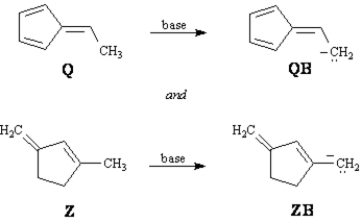 -Refer to Exhibit 15-4.Conjugate bases QB and ZB are both resonance stabilized.Draw the indicated number of resonance forms for QB and ZB.
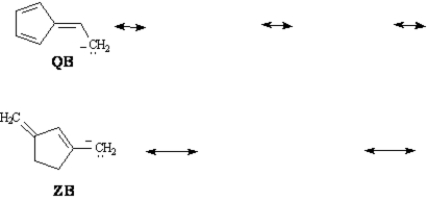
-Refer to Exhibit 15-4.Conjugate bases QB and ZB are both resonance stabilized.Draw the indicated number of resonance forms for QB and ZB. (Essay)
5.0/5 (83)
(83) Exhibit 15-6
Consider the data below to answer the following question(s).
C9H12;1H NMR:
6.65 δ (singlet,3H)
2.25 δ (singlet,9H)
-Refer to Exhibit 15-6.Describe the signal at 2.25 δ in terms of its splitting,integration and chemical shift.
(Essay)
4.7/5 (62)
(62) Exhibit 15-5
Consider the data below to answer the following question(s).
C9H12;1H NMR:
7.18 δ (broad singlet,5H)
2.55 δ (triplet,2H)
1.70 δ (sextet,2H)
0.9 δ (triplet,3H)
-Refer to Exhibit 15-5.Describe the signal at 0.9 δ in terms of its splitting,integration and chemical shift.
(Essay)
4.8/5 (87)
(87) What is the structure of a hydrocarbon that shows a molecular ion at m/z = 182 in the mass spectrum and has the following 1H NMR spectrum?
7.2 δ,singlet,5H
2.9 δ,singlet,2H
(Essay)
5.0/5 (83)
(83) 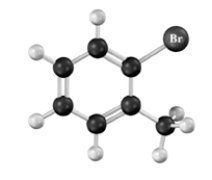
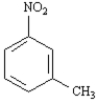
What m/z ratio range might be common to many substituted benzene compounds?
(Multiple Choice)
4.7/5 (70)
(70) Exhibit 15-5
Consider the data below to answer the following question(s).
C9H12;1H NMR:
7.18 δ (broad singlet,5H)
2.55 δ (triplet,2H)
1.70 δ (sextet,2H)
0.9 δ (triplet,3H)
-Refer to Exhibit 15-5.Describe the signal at 1.70 δ in terms of its splitting,integration and chemical shift.
(Essay)
4.9/5 (87)
(87) Exhibit 15-7
Consider the data below to answer the following question(s).
C7H7ClO;IR absorption at 810 cm−1  Spectrum obtained from: SDBSWeb: http://www.aist.go.jp/RIODB/SDBS/
-Refer to Exhibit 15-7.What is the significance of an IR absorption at 810 cm−1?
Spectrum obtained from: SDBSWeb: http://www.aist.go.jp/RIODB/SDBS/
-Refer to Exhibit 15-7.What is the significance of an IR absorption at 810 cm−1? (Essay)
4.9/5 (92)
(92) Exhibit 15-4
Consider the data below to answer the following question(s).
-Refer to Exhibit 15-4.Which of the compounds above,Q or Z,would you predict to be most acidic? Explain your answer.
-Refer to Exhibit 15-4.Which of the compounds above,Q or Z,would you predict to be most acidic? Explain your answer. (Essay)
4.8/5 (85)
(85) 
Filters
- Essay(0)
- Multiple Choice(0)
- Short Answer(0)
- True False(0)
- Matching(0)