



 Chat with AI
Exam 29: The Organic Chemistry of Metabolic Pathways

Exam 1: Structure and Bonding29 Questions
Exam 2: Polar Covalent Bonds;acids and Bases50 Questions
Exam 3: Organic Compounds: Alkanes and Their Stereochemistry37 Questions
Exam 4: Organic Compounds: Cycloalkanes and Their Stereochemistry37 Questions
Exam 5: Stereochemistry at Tetrahedral Centers43 Questions
Exam 6: An Overview of Organic Reactions42 Questions
Exam 6: Par 12 Questions
Exam 7: Alkenes: Structure and Reactivity37 Questions
Exam 8: Alkenes: Reactions and Synthesis42 Questions
Exam 9: Alkynes: an Introduction to Organic Synthesis31 Questions
Exam 10: Organohalides31 Questions
Exam 11: Reactions of Alkyl Halides: Nucleophilic Substitutions and Eliminations34 Questions
Exam 11: Par 22 Questions
Exam 12: Structure Determination: Mass Spectrometry and Infrared Spectroscopy42 Questions
Exam 13: Structure Determination: Nuclear Magnetic Resonance Spectroscopy46 Questions
Exam 14: Conjugated Compounds and Ultraviolet Spectroscopy40 Questions
Exam 14: Par 32 Questions
Exam 15: Benzene and Aromaticity47 Questions
Exam 16: Chemistry of Benzene: Electrophilic Aromatic Substitution30 Questions
Exam 17: Alcohols and Phenols44 Questions
Exam 18: Ethers and Epoxides;thiols and Sulfides33 Questions
Exam 19: Aldehydes and Ketones: Nucleophilic Addition Reactions48 Questions
Exam 19: Par 42 Questions
Exam 20: Carboxylic Acids and Nitriles32 Questions
Exam 21: Carboxylic Acid Derivatives: Nucleophilic Acyl Substitution Reactions44 Questions
Exam 22: Carbonyl Alpha-Substitution Reactions33 Questions
Exam 23: Carbonyl Condensation Reactions36 Questions
Exam 23: Par 52 Questions
Exam 24: Amines and Heterocycles41 Questions
Exam 25: Biomolecules: Carbohydrates63 Questions
Exam 26: Biomolecules: Amino Acids,peptides,and Proteins45 Questions
Exam 27: Par 72 Questions
Exam 27: Biomolecules: Lipids54 Questions
Exam 28: Biomolecules: Nucleic Acids44 Questions
Exam 29: The Organic Chemistry of Metabolic Pathways48 Questions
Exam 30: Orbitals and Organic Chemistry: Pericyclic Reactions44 Questions
Exam 31: Synthetic Polymers33 Questions
Exam 30: Par 12 Questions
Select questions type


Exhibit 29-5
Consider the reaction below to answer the following question(s): 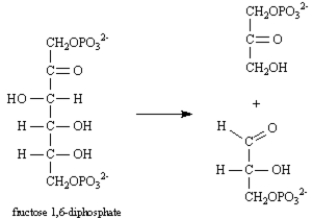 -Refer to Exhibit 29-5.This reaction is an example of:
 (Multiple Choice)
4.9/5  (64)
(64) Draw the structure of the product formed on the transamination of the following substance.Atoms other than carbon and hydrogen are labeled. 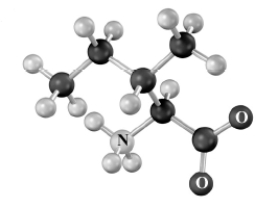
(Essay)
4.8/5 (75)
(75) Exhibit 29-1
MATCH a term or structure from the list below to each of the following definitions or names.Place the letter of the term or structure in the blank to the left of the definition or name which it describes.
-_____ The pathway by which organisms make glucose from simple precursors.
(Multiple Choice)
4.7/5 (63)
(63) During β-oxidation the following reaction occurs.  How many times will this reaction occur for the following acid? Atoms other than carbon and hydrogen are labeled.
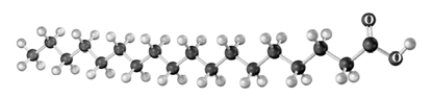
How many times will this reaction occur for the following acid? Atoms other than carbon and hydrogen are labeled. (Multiple Choice)
4.9/5 (96)
(96) Exhibit 29-1
MATCH a term or structure from the list below to each of the following definitions or names.Place the letter of the term or structure in the blank to the left of the definition or name which it describes.
-_____ Acetyl groups are oxidized to yield carbon dioxide and water.
(Multiple Choice)
4.8/5 (86)
(86) Exhibit 29-1
MATCH a term or structure from the list below to each of the following definitions or names.Place the letter of the term or structure in the blank to the left of the definition or name which it describes.
-_____ The product of the citric acid cycle,which is a reactant in the first step.
(Multiple Choice)
4.8/5 (89)
(89) Which of the following does not represent a correct relationship in catabolism?
(Multiple Choice)
4.8/5 (84)
(84) Exhibit 29-1
MATCH a term or structure from the list below to each of the following definitions or names.Place the letter of the term or structure in the blank to the left of the definition or name which it describes.
-_____ The "energy currency" of the cell.
(Multiple Choice)
4.9/5 (92)
(92) The following reaction occurs in the citric acid cycle. 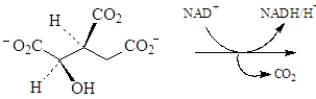 Draw the structure of the product.
 (Essay)
4.8/5 (86)
(86) Phosphoenolpyruvate could undergo hydrolysis to form pyruvate and hydrogen phosphate.This reaction could be represented as shown below.(ΔG°' = -61.9 kJ/mol)  This reaction can be used to phosphorylate ADP.Write the net reaction when this reaction is coupled with ADP phosphorylation and calculate ΔG°' for the reaction.
 (Essay)
4.7/5 (73)
(73) Exhibit 29-2
Use the data below to answer the following question(s):
Under certain metabolic conditions associated with a high rate of fatty acid oxidation,the liver produces considerable quantities of acetoacetate and β-hydroxybutyrate.Acetoacetate continually undergoes spontaneous decarboxylation to yield acetone.The interrelationship of these compounds is shown below.  -Refer to Exhibit 29-2.The reduction of acetoacetate to β-hydroxybutyrate is analogous to the hydride reductions of ketones studied in Chapter 9.Write the mechanism of this reduction.
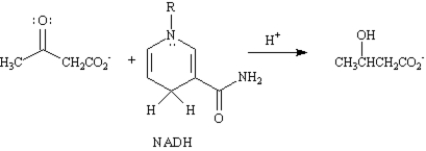
-Refer to Exhibit 29-2.The reduction of acetoacetate to β-hydroxybutyrate is analogous to the hydride reductions of ketones studied in Chapter 9.Write the mechanism of this reduction. (Essay)
4.7/5 (84)
(84) Which of the following does not correctly describe a stage of metabolism in humans?
(Multiple Choice)
5.0/5 (83)
(83) Exhibit 29-3
Use the data below to answer the following question(s).
Mevalonate is an important intermediate in the biosynthesis of cholesterol.This six-carbon compound can be formed from acetyl CoA utilizing two separate pathways.The most significant one involves the intermediate β-hydroxy-β-methylglutaryl-CoA.  -Refer to Exhibit 29-3.Propose a mechanism for step 2 of the mevalonate biosynthesis.
 (Essay)
4.9/5 (71)
(71) Exhibit 29-4
Consider the reaction below to answer the following question(s): 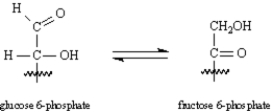 -Refer to Exhibit 29-4.Write the mechanism for this isomerization.
 (Essay)
4.7/5 (84)
(84) Exhibit 29-4
Consider the reaction below to answer the following question(s):
-Refer to Exhibit 29-4.This reaction proceeds through a common enol structure.Draw the structure of the glucose/fructose enol.
-Refer to Exhibit 29-4.This reaction proceeds through a common enol structure.Draw the structure of the glucose/fructose enol. (Essay)
4.7/5 (76)
(76) Consider the following conversion that occurs in the citric acid cycle.  What formula should be placed at the tail of the arrow?
 (Multiple Choice)
4.8/5 (84)
(84) During the synthesis of fatty acids,the following substance is formed by two pathways. 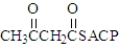 Draw the structure(s) of the starting material(s) for each path?
 (Essay)
4.9/5 (86)
(86) Consider the following reaction:  Which of the following reactions per mole could not be driven by the hydrolysis of ATP?
 (Multiple Choice)
4.8/5 (95)
(95) 
Filters
- Essay(0)
- Multiple Choice(0)
- Short Answer(0)
- True False(0)
- Matching(0)