



 Chat with AI
Exam 17: Oligopoly

Exam 1: Ten Principles of Economics439 Questions
Exam 2: Thinking Like an Economist617 Questions
Exam 3: Interdependence and the Gains From Trade527 Questions
Exam 4: The Market Forces of Supply and Demand697 Questions
Exam 5: Elasticity and Its Application594 Questions
Exam 6: Supply, Demand, and Government Policies645 Questions
Exam 7: Consumers, Producers, and the Efficiency of Markets549 Questions
Exam 8: Application: the Costs of Taxation513 Questions
Exam 9: Application: International Trade492 Questions
Exam 10: Externalities524 Questions
Exam 11: Public Goods and Common Resources433 Questions
Exam 12: The Design of the Tax System549 Questions
Exam 13: The Costs of Production420 Questions
Exam 14: Firms in Competitive Markets543 Questions
Exam 15: Monopoly637 Questions
Exam 16: Monopolistic Competition580 Questions
Exam 17: Oligopoly488 Questions
Exam 18: The Markets for the Factors of Production564 Questions
Exam 19: Earnings and Discrimination490 Questions
Exam 20: Income Inequality and Poverty455 Questions
Exam 21: The Theory of Consumer Choice431 Questions
Exam 22: Frontiers of Microeconomics440 Questions
Exam 23: Measuring a Nations Income520 Questions
Exam 24: Measuring the Cost of Living529 Questions
Exam 25: Production and Growth505 Questions
Exam 26: Saving, Investment, and the Financial System564 Questions
Exam 27: The Basic Tools of Finance500 Questions
Exam 28: Unemployment678 Questions
Exam 29: The Monetary System515 Questions
Exam 30: Money Growth and Inflation481 Questions
Exam 31: Open-Economy Macroeconomics: Basic Concepts522 Questions
Exam 32: A Macroeconomic Theory of the Open Economy475 Questions
Exam 33: Aggregate Demand and Aggregate Supply562 Questions
Exam 34: The Influence of Monetary and Fiscal Policy on Aggregate Demand508 Questions
Exam 35: The Short-Run Trade-Off Between Inflation and Unemployment491 Questions
Exam 36: Six Debates Over Macroeconomic Policy372 Questions
Select questions type


Which potentially anti-competitive business practice is often justified on the grounds that it corrects for the free rider problem?
(Short Answer)
4.8/5  (82)
(82) Scenario 17-2.
Imagine that two oil companies, BQ and Exxoff, own adjacent oil fields. Under the fields is a common pool of oil worth $144 million. Drilling a well to recover oil costs $5 million per well. If each company drills one well, each will get half of the oil and earn a $67 million profit ($72 million in revenue - $5 million in costs). Assume that having X percent of the total wells means that a company will collect X percent of the total revenue.
-Refer to Scenario 17-2. If BQ were to drill a second well and Exxoff also drilled a second well, what would BQ's profit be?
(Multiple Choice)
4.9/5 (65)
(65) When individuals are damaged by an illegal arrangement to restrain trade, which law allows them to pursue civil action and recover up to three times the damages sustained?
(Multiple Choice)
4.9/5 (84)
(84) Table 17-33
Suppose that Robert and Howard own the only two movie studios in California. Each producer must choose between a low budget and a high budget strategy for his next film. The economic profit from each strategy is indicated in the table below:
Howard
Low budget High budget  -Refer to Table 17-33. Does Robert have a dominant strategy? If so, describe it.
 (Essay)
4.9/5 (75)
(75) Table 17-32
Suppose that Angelina and Brad own the only two professional photography stores in town. Each must choose between a low price and a high price for senior photo packages. The annual economic profit from each strategy is indicated in the table below:
Angelina
Low price High price  -Refer to Table 17-32. Is there a Nash equilibrium? If so, describe it.
 (Essay)
4.9/5 (84)
(84) Suppose a market is initially perfectly competitive with many firms selling an identical product. Over time, however, suppose the merging of firms results in the market being served by only three or four firms selling this same product. As a result, we would expect
(Multiple Choice)
4.9/5 (79)
(79) As the number of firms in an oligopoly industry decreases, the market moves closer to a _________ market.
(Short Answer)
4.9/5 (96)
(96) When the prisoners' dilemma game is generalized to describe situations other than those that literally involve two prisoners, we see that cooperation between the players of the game
(Multiple Choice)
4.8/5 (82)
(82) Table 17-13
Two home-improvement stores (Lopes and HomeMax) in a growing urban area are interested in expanding their market share. Both are interested in expanding the size of their store and parking lot to accommodate potential growth in their customer base. The following game depicts the strategic outcomes that result from the game. Increases in annual profits of the two home-improvement stores are shown in the table below.  14.
-Refer to Table 17-13. Pursuing its own best interest, HomeMax will
14.
-Refer to Table 17-13. Pursuing its own best interest, HomeMax will (Multiple Choice)
4.8/5 (68)
(68) Table 17-10
The table shows the demand schedule for a particular product. 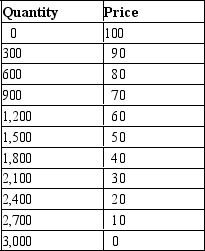 -Refer to Table 17-10. Suppose the market for this product is served by two firms who have formed a cartel and are colluding to set the price and quantity in this market. If the marginal cost to produce this product is constant at $40 per unit and there is no fixed cost, then what will the combined profit of the cartel be?
 (Multiple Choice)
4.8/5 (76)
(76) Figure 17-5. Two companies, ABC and QRS, are sellers in the same market. Each company decides whether to charge a high price or a low price. In the figure, the dollar amounts are payoffs and they represent annual profits for the two companies.  -Refer to Figure 17-5. If the two companies make their pricing decisions independently, then it is likely that ABC will
 (Multiple Choice)
4.9/5 (73)
(73) Scenario 17-5
Assume that a local restaurant sells two items, salads and steaks. The restaurant's only two customers on a particular day are Mr. Carnivore and Ms. Leafygreens. Mr. Carnivore is willing to pay $20 for a steak and $7 for a salad. Ms. Leafygreens is willing to pay only $8 for a steak, but is willing to pay $12 for a salad. Assume that the restaurant can provide each of these items at zero marginal cost.
-Refer to Scenario 17-5. If the restaurant is unable to use tying, what is the profit-maximizing price to charge for a steak?
(Multiple Choice)
4.7/5 (89)
(89) Table 17-13
Two home-improvement stores (Lopes and HomeMax) in a growing urban area are interested in expanding their market share. Both are interested in expanding the size of their store and parking lot to accommodate potential growth in their customer base. The following game depicts the strategic outcomes that result from the game. Increases in annual profits of the two home-improvement stores are shown in the table below. 14.
-Refer to Table 17-13. If both stores follow a dominant strategy, HomeMax's annual profit will grow by
14.
-Refer to Table 17-13. If both stores follow a dominant strategy, HomeMax's annual profit will grow by (Multiple Choice)
4.9/5 (80)
(80) Scenario 17-3.
Consider two countries, Kinglandia and Rovinastan, that are engaged in an arms race. Each country must decide whether to build new weapons or to disarm existing weapons. Each country prefers to have more arms than the other because a large arsenal gives it more influence in world affairs. But each country also prefers to live in a world safe from the other country's weapons. The following table shows the possible outcomes for each decision combination. The numbers in each cell represent the country's ranking of the outcome (10 = best outcome, 1 = worst outcome).  -Refer to Scenario 17-3. Building new weapons is a dominant strategy for
 (Multiple Choice)
5.0/5 (92)
(92) Figure 17-2. Two companies, Acme and Pinnacle, each decide whether to produce a good quality product or a poor quality product. In the figure, the dollar amounts are payoffs and they represent annual profits for the two companies.  -Refer to Figure 17-2. Which of the following statements is correct?
 (Multiple Choice)
4.7/5 (83)
(83) If Levi Strauss & Co. were to require every retailer that carried its clothing to charge customers $42 for each pair of jeans, Levi Strauss & Co. would be practicing
(Multiple Choice)
4.8/5 (90)
(90) Two CEOs from different firms in the same market collude to fix the price in the market. This action violates the
(Multiple Choice)
4.8/5 (80)
(80) 
Filters
- Essay(0)
- Multiple Choice(0)
- Short Answer(0)
- True False(0)
- Matching(0)