



 Chat with AI
Exam 17: Oligopoly

Exam 1: Ten Principles of Economics439 Questions
Exam 2: Thinking Like an Economist617 Questions
Exam 3: Interdependence and the Gains From Trade527 Questions
Exam 4: The Market Forces of Supply and Demand697 Questions
Exam 5: Elasticity and Its Application594 Questions
Exam 6: Supply, Demand, and Government Policies645 Questions
Exam 7: Consumers, Producers, and the Efficiency of Markets549 Questions
Exam 8: Application: the Costs of Taxation513 Questions
Exam 9: Application: International Trade492 Questions
Exam 10: Externalities524 Questions
Exam 11: Public Goods and Common Resources433 Questions
Exam 12: The Design of the Tax System549 Questions
Exam 13: The Costs of Production420 Questions
Exam 14: Firms in Competitive Markets543 Questions
Exam 15: Monopoly637 Questions
Exam 16: Monopolistic Competition580 Questions
Exam 17: Oligopoly488 Questions
Exam 18: The Markets for the Factors of Production564 Questions
Exam 19: Earnings and Discrimination490 Questions
Exam 20: Income Inequality and Poverty455 Questions
Exam 21: The Theory of Consumer Choice431 Questions
Exam 22: Frontiers of Microeconomics440 Questions
Exam 23: Measuring a Nations Income520 Questions
Exam 24: Measuring the Cost of Living529 Questions
Exam 25: Production and Growth505 Questions
Exam 26: Saving, Investment, and the Financial System564 Questions
Exam 27: The Basic Tools of Finance500 Questions
Exam 28: Unemployment678 Questions
Exam 29: The Monetary System515 Questions
Exam 30: Money Growth and Inflation481 Questions
Exam 31: Open-Economy Macroeconomics: Basic Concepts522 Questions
Exam 32: A Macroeconomic Theory of the Open Economy475 Questions
Exam 33: Aggregate Demand and Aggregate Supply562 Questions
Exam 34: The Influence of Monetary and Fiscal Policy on Aggregate Demand508 Questions
Exam 35: The Short-Run Trade-Off Between Inflation and Unemployment491 Questions
Exam 36: Six Debates Over Macroeconomic Policy372 Questions
Select questions type


Because each oligopolist cares about its own profit rather than the collective profit of all the oligopolists together,
(Multiple Choice)
4.8/5  (92)
(92) Figure 17-2. Two companies, Acme and Pinnacle, each decide whether to produce a good quality product or a poor quality product. In the figure, the dollar amounts are payoffs and they represent annual profits for the two companies.  -Refer to Figure 17-2. Acme and Pinnacle agree to cooperate so as to maximize total profit. If this game is played repeatedly and Acme uses a tit-for-tat strategy, it will choose a
 (Multiple Choice)
4.8/5 (74)
(74) Figure 17-4. Aaron and Ed are roommates. After a big snowstorm, their driveway needs to be shoveled. Each person has to decide whether to take part in shoveling the driveway. At the end of the day, either the driveway will be shoveled (if one or both roommates take part in shoveling), or it will remain unshoveled (if neither roommate shovels). With happiness measured on a scale of 1 (very unhappy) to 10 (very happy), the possible outcomes are as follows:  -Refer to Figure 17-4. In pursuing his own self-interest, Ed will
 (Multiple Choice)
4.8/5 (72)
(72) Table 17-35
Suppose that two coal mining companies - Allied and Barclay - own adjacent land suitable for excavating coal mines. The profits that each firm earns depends on both the number of mines it excavates and the number of mines excavated by the other firm. The table below lists each firm's individual profits:
Allied
Excavate one mine Excavate two mines  -Refer to Table 17-35. Does Barclay have a dominant strategy? If so, describe it.
 (Essay)
4.8/5 (83)
(83) If two firms comprise the entire soft drink market, the market would be a(n)
(Multiple Choice)
4.9/5 (75)
(75) Table 17-33
Suppose that Robert and Howard own the only two movie studios in California. Each producer must choose between a low budget and a high budget strategy for his next film. The economic profit from each strategy is indicated in the table below:
Howard
Low budget High budget  -Refer to Table 17-33. Does Howard have a dominant strategy? If so, describe it.
 (Essay)
4.8/5 (84)
(84) The Sherman Antitrust Act prohibits price-fixing in the sense that
(Multiple Choice)
4.8/5 (74)
(74) An agreement between two duopolists to function as a monopolist usually breaks down because
(Multiple Choice)
4.7/5 (77)
(77) Which of the following examples illustrates an oligopoly market?
(Multiple Choice)
4.9/5 (84)
(84) Table 17-15
This table shows a game played between two players, A and B. The payoffs in the table are shown as (Payoff to A, Payoff to B).  -Refer to Table 17-15. Which of the following outcomes represents a Nash equilibrium in the game?
 (Multiple Choice)
4.9/5 (79)
(79) Table 17-2
Imagine a small town in which only two residents, Abby and Brad, own wells that produce safe drinking water. Each week Abby and Brad work together to decide how many gallons of water to pump. They bring water to town and sell it at whatever price the market will bear. To keep things simple, suppose that Abby and Brad can pump as much water as they want without cost so that the marginal cost is zero. The weekly town demand schedule and total revenue schedule for water is shown in the table below: 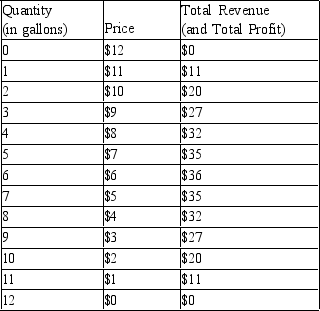 -Refer to Table 17-2. Suppose the town enacts new antitrust laws that prohibit Abby and Brad from operating as a monopoly. How much profit will Abby and Brad each earn once they reach a Nash equilibrium?
 (Multiple Choice)
4.9/5 (81)
(81) Which of the following prohibits executives of competing firms from even talking about fixing prices?
(Multiple Choice)
4.9/5 (89)
(89) Table 17-11
Only two firms, ABC and XYZ, sell a particular product. The table below shows the demand curve for their product. Each firm has the same constant marginal cost of $8 and zero fixed cost.  -Refer to Table 17-11. If this market were perfectly competitive instead of oligopolistic, what would the price be?
(Multiple Choice)
4.9/5 (80)
(80) Figure 17-2. Two companies, Acme and Pinnacle, each decide whether to produce a good quality product or a poor quality product. In the figure, the dollar amounts are payoffs and they represent annual profits for the two companies.
-Refer to Figure 17-2. If this game is played only once, then the most likely outcome is that
-Refer to Figure 17-2. If this game is played only once, then the most likely outcome is that (Multiple Choice)
4.7/5 (75)
(75) Figure 17-5. Two companies, ABC and QRS, are sellers in the same market. Each company decides whether to charge a high price or a low price. In the figure, the dollar amounts are payoffs and they represent annual profits for the two companies.  -Refer to Figure 17-5. The situation faced by ABC and QRS is
 (Multiple Choice)
4.8/5 (87)
(87) Scenario 17-6
Assume that a local telecommunications company sells high speed internet access and cable television. The company's only two customers are Taylor and Tim. Taylor is willing to pay $50 per month for high speed internet access and $50 per month for cable television. Tim is willing to pay only $20 per month for high speed internet access, but is willing to pay $70 per month for cable television. Assume that the telecommunications company can provide each of these products at zero marginal cost.
-Refer to Scenario 17-6. If the telecommunications company is unable to use tying, what is the profit-maximizing price to charge for high speed internet access?
(Short Answer)
4.7/5 (73)
(73) 
Filters
- Essay(0)
- Multiple Choice(0)
- Short Answer(0)
- True False(0)
- Matching(0)