



 Chat with AI
Exam 17: Oligopoly

Exam 1: Ten Principles of Economics439 Questions
Exam 2: Thinking Like an Economist617 Questions
Exam 3: Interdependence and the Gains From Trade527 Questions
Exam 4: The Market Forces of Supply and Demand697 Questions
Exam 5: Elasticity and Its Application594 Questions
Exam 6: Supply, Demand, and Government Policies645 Questions
Exam 7: Consumers, Producers, and the Efficiency of Markets549 Questions
Exam 8: Application: the Costs of Taxation513 Questions
Exam 9: Application: International Trade492 Questions
Exam 10: Externalities524 Questions
Exam 11: Public Goods and Common Resources433 Questions
Exam 12: The Design of the Tax System549 Questions
Exam 13: The Costs of Production420 Questions
Exam 14: Firms in Competitive Markets543 Questions
Exam 15: Monopoly637 Questions
Exam 16: Monopolistic Competition580 Questions
Exam 17: Oligopoly488 Questions
Exam 18: The Markets for the Factors of Production564 Questions
Exam 19: Earnings and Discrimination490 Questions
Exam 20: Income Inequality and Poverty455 Questions
Exam 21: The Theory of Consumer Choice431 Questions
Exam 22: Frontiers of Microeconomics440 Questions
Exam 23: Measuring a Nations Income520 Questions
Exam 24: Measuring the Cost of Living529 Questions
Exam 25: Production and Growth505 Questions
Exam 26: Saving, Investment, and the Financial System564 Questions
Exam 27: The Basic Tools of Finance500 Questions
Exam 28: Unemployment678 Questions
Exam 29: The Monetary System515 Questions
Exam 30: Money Growth and Inflation481 Questions
Exam 31: Open-Economy Macroeconomics: Basic Concepts522 Questions
Exam 32: A Macroeconomic Theory of the Open Economy475 Questions
Exam 33: Aggregate Demand and Aggregate Supply562 Questions
Exam 34: The Influence of Monetary and Fiscal Policy on Aggregate Demand508 Questions
Exam 35: The Short-Run Trade-Off Between Inflation and Unemployment491 Questions
Exam 36: Six Debates Over Macroeconomic Policy372 Questions
Select questions type


Table 17-30
Imagine a small town in which only two residents, Abby and Brad, own wells that produce safe drinking water. Each week Abby and Brad work together to decide how many gallons of water to pump. They bring water to town and sell it at whatever price the market will bear. To keep things simple, suppose that Abby and Brad can pump as much water as they want without cost so that the marginal cost is zero. The weekly town demand schedule and total revenue schedule for water is shown in the table below: 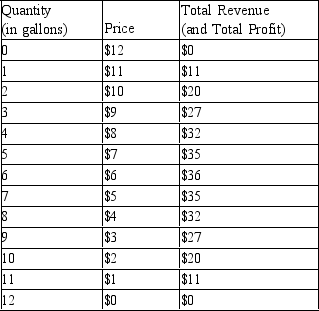 -Refer to Table 17-30. Discuss the difference between the monopoly outcome and the Nash equilibrium.
 (Essay)
4.8/5  (79)
(79) In a duopoly situation, the logic of self-interest results in a total output level that
(Multiple Choice)
4.9/5 (72)
(72) Table 17-13
Two home-improvement stores (Lopes and HomeMax) in a growing urban area are interested in expanding their market share. Both are interested in expanding the size of their store and parking lot to accommodate potential growth in their customer base. The following game depicts the strategic outcomes that result from the game. Increases in annual profits of the two home-improvement stores are shown in the table below.  14.
-Refer to Table 17-13. If both stores follow a dominant strategy, Lopes's annual profit will grow by
14.
-Refer to Table 17-13. If both stores follow a dominant strategy, Lopes's annual profit will grow by (Multiple Choice)
4.8/5 (78)
(78) Government regulators might suspect a firm of engaging in predatory pricing if it charges prices that seem to be too
__________.
(Short Answer)
4.9/5 (70)
(70) Which of the controversial business practices, resale price maintenance, predatory pricing, or tying, was a part of a long-running antitrust lawsuit against Microsoft and why?
(Essay)
4.8/5 (77)
(77) The decisions of the US and Soviet Union to build nuclear weapons is much like the prisoners' dilemma.
(True/False)
4.9/5 (79)
(79) In which of the following games is it clearly the case that the cooperative outcome of the game is good for the two players and good for society?
(Multiple Choice)
4.9/5 (94)
(94) As the number of firms in an oligopoly increases, the price approaches
(Multiple Choice)
4.8/5 (75)
(75) The practice of selling a product to retailers and requiring the retailers to charge a specific price for the product is called
(Multiple Choice)
4.9/5 (82)
(82) Table 17-20
Nadia and Maddie are two college roommates who both prefer a clean common space in their dorm room, but neither enjoys cleaning. The roommates must each make a decision to either clean or not clean the dorm room's common space. The payoff table for this situation is provided below, where the higher a player's payoff number, the better off that player is. The payoffs in each cell are shown as (payoff for Nadia, payoff for Maddie).  -Refer to Table 17-20. If Maddie chooses to clean, then Nadia will
 (Multiple Choice)
4.9/5 (84)
(84) Table 17-32
Suppose that Angelina and Brad own the only two professional photography stores in town. Each must choose between a low price and a high price for senior photo packages. The annual economic profit from each strategy is indicated in the table below:
Angelina
Low price High price  -Refer to Table 17-32. Does Brad have a dominant strategy? If so, describe it.
 (Essay)
4.8/5 (83)
(83) Table 17-32
Suppose that Angelina and Brad own the only two professional photography stores in town. Each must choose between a low price and a high price for senior photo packages. The annual economic profit from each strategy is indicated in the table below:
Angelina
Low price High price
-Refer to Table 17-32. Does Angelina have a dominant strategy? If so, describe it.
-Refer to Table 17-32. Does Angelina have a dominant strategy? If so, describe it. (Essay)
4.8/5 (85)
(85) Antitrust laws tend to target restraint of trade as characterized by .
(Essay)
4.9/5 (71)
(71) Once a cartel is formed, the market is in effect served by
(Multiple Choice)
4.9/5 (74)
(74) The Clayton Act of 1914 allows those harmed by illegal arrangements to restrain trade to
(Multiple Choice)
4.9/5 (64)
(64) 
Filters
- Essay(0)
- Multiple Choice(0)
- Short Answer(0)
- True False(0)
- Matching(0)