



 Chat with AI
Exam 17: Oligopoly

Exam 1: Ten Principles of Economics439 Questions
Exam 2: Thinking Like an Economist617 Questions
Exam 3: Interdependence and the Gains From Trade527 Questions
Exam 4: The Market Forces of Supply and Demand697 Questions
Exam 5: Elasticity and Its Application594 Questions
Exam 6: Supply, Demand, and Government Policies645 Questions
Exam 7: Consumers, Producers, and the Efficiency of Markets549 Questions
Exam 8: Application: the Costs of Taxation513 Questions
Exam 9: Application: International Trade492 Questions
Exam 10: Externalities524 Questions
Exam 11: Public Goods and Common Resources433 Questions
Exam 12: The Design of the Tax System549 Questions
Exam 13: The Costs of Production420 Questions
Exam 14: Firms in Competitive Markets543 Questions
Exam 15: Monopoly637 Questions
Exam 16: Monopolistic Competition580 Questions
Exam 17: Oligopoly488 Questions
Exam 18: The Markets for the Factors of Production564 Questions
Exam 19: Earnings and Discrimination490 Questions
Exam 20: Income Inequality and Poverty455 Questions
Exam 21: The Theory of Consumer Choice431 Questions
Exam 22: Frontiers of Microeconomics440 Questions
Exam 23: Measuring a Nations Income520 Questions
Exam 24: Measuring the Cost of Living529 Questions
Exam 25: Production and Growth505 Questions
Exam 26: Saving, Investment, and the Financial System564 Questions
Exam 27: The Basic Tools of Finance500 Questions
Exam 28: Unemployment678 Questions
Exam 29: The Monetary System515 Questions
Exam 30: Money Growth and Inflation481 Questions
Exam 31: Open-Economy Macroeconomics: Basic Concepts522 Questions
Exam 32: A Macroeconomic Theory of the Open Economy475 Questions
Exam 33: Aggregate Demand and Aggregate Supply562 Questions
Exam 34: The Influence of Monetary and Fiscal Policy on Aggregate Demand508 Questions
Exam 35: The Short-Run Trade-Off Between Inflation and Unemployment491 Questions
Exam 36: Six Debates Over Macroeconomic Policy372 Questions
Select questions type


The Clayton Act of 1914 allowed a person who successfully sued a company for damages caused by an illegal arrangement to restrain trade to recover damages.
(Short Answer)
5.0/5  (83)
(83) In the language of game theory, a situation in which each person must consider how others might respond to his or her own actions is called a
(Multiple Choice)
4.9/5 (78)
(78) Table 17-1
Imagine a small town in which only two residents, Rochelle and Alec, own wells that produce safe drinking water. Each week Rochelle and Alec work together to decide how many gallons of water to pump. They bring the water to town and sell it at whatever price the market will bear. To keep things simple, suppose that Rochelle and Alec can pump as much water as they want without cost so that the marginal cost of water equals zero. The weekly town demand schedule and total revenue schedule for water is shown in the table below:  21.
-Refer to Table 17-1. If this market for water were perfectly competitive instead of monopolistic, what price would be charged?
21.
-Refer to Table 17-1. If this market for water were perfectly competitive instead of monopolistic, what price would be charged? (Multiple Choice)
4.8/5 (74)
(74) Table 17-3
Imagine a small town in a remote area where only two residents, Maria and Miguel, own dairies that produce milk that is safe to drink. Each week Maria and Miguel work together to decide how many gallons of milk to produce. They bring milk to town and sell it at whatever price the market will bear. To keep things simple, suppose that Maria and Miguel can produce as much milk as they want without cost so that the marginal cost is zero. The weekly town demand schedule and total revenue schedule for milk is shown in the table below:  -Refer to Table 17-3. Suppose the town enacts new antitrust laws that prohibit Maria and Miguel from operating as a monopoly. What will be the price of milk once Maria and Miguel reach a Nash equilibrium?
 (Multiple Choice)
4.8/5 (77)
(77) Two suspected drug dealers are stopped by the highway patrol for speeding. The officer searches the car and finds a small bag of marijuana and arrests the two. During the interrogation, each is separately offered the following: "If you confess to dealing drugs and testify against your partner, you will be given immunity and released while your partner will get 10 years in prison. If you both confess, you will each get 5 years." If neither confesses, there is no evidence of drug dealing, and the most they could get is one year each for possession of marijuana. If each suspected drug dealer follows a dominant strategy, what should he/she do?
(Multiple Choice)
4.7/5 (82)
(82) Table 17-1
Imagine a small town in which only two residents, Rochelle and Alec, own wells that produce safe drinking water. Each week Rochelle and Alec work together to decide how many gallons of water to pump. They bring the water to town and sell it at whatever price the market will bear. To keep things simple, suppose that Rochelle and Alec can pump as much water as they want without cost so that the marginal cost of water equals zero. The weekly town demand schedule and total revenue schedule for water is shown in the table below: 21.
-Refer to Table 17-1. What is the socially efficient quantity of water?
21.
-Refer to Table 17-1. What is the socially efficient quantity of water? (Multiple Choice)
4.9/5 (69)
(69) If all of the firms in an oligopoly successfully collude and form a cartel, then total profit for the cartel is equal to what it would be if the market were a monopoly.
(True/False)
4.8/5 (76)
(76) Table 17-34
Suppose that two oil companies - BP and Exxon - own adjacent natural gas fields. The profits that each firm earns depends on both the number of wells it drills and the number of wells drilled by the other firm. The table below lists each firm's individual profits:
Exxon
Drill one well Drill two wells  -Refer to Table 17-34. Does BP have a dominant strategy? If so, describe it.
 (Essay)
4.9/5 (74)
(74) Other things the same, in which case is the quantity produced the highest?
(Multiple Choice)
4.8/5 (81)
(81) To move the allocation of resources closer to the social optimum, policymakers should typically try to induce firms in an oligopoly to
(Multiple Choice)
4.9/5 (83)
(83) Laurel and Janet are competitors in a local market and each is trying to decide if it is worthwhile to advertise. If both of them advertise, each will earn a profit of $5,000. If neither of them advertise, each will earn a profit of $10,000. If one advertises and the other doesn't, then the one who advertises will earn a profit of $12,000 and the other will earn $2,000. In this version of the prisoners' dilemma, if the game is played only once, Laurel should
(Multiple Choice)
4.9/5 (90)
(90) An agreement among firms in a market about quantities to produce or prices to charge is called
(Multiple Choice)
5.0/5 (88)
(88) Why would lack of cooperation between criminal suspects be desirable for society as a whole?
(Multiple Choice)
4.9/5 (83)
(83) Table 17-11
Only two firms, ABC and XYZ, sell a particular product. The table below shows the demand curve for their product. Each firm has the same constant marginal cost of $8 and zero fixed cost.  -Refer to Table 17-11. What is the socially efficient quantity of the product?
 (Multiple Choice)
4.9/5 (69)
(69) Firms do not need to be concerned about striking a balance between the price effect and the output effect when making production decisions in which of the following types of markets?
(Multiple Choice)
4.8/5 (85)
(85) Table 17-31
Imagine a small town in a remote area where only two residents, Maria and Miguel, own dairies that produce milk that is safe to drink. Each week Maria and Miguel work together to decide how many gallons of milk to produce. They bring milk to town and sell it at whatever price the market will bear. To keep things simple, suppose that Maria and Miguel can produce as much milk as they want without cost so that the marginal cost is zero. The weekly town demand schedule and total revenue schedule for milk is shown in the table below: 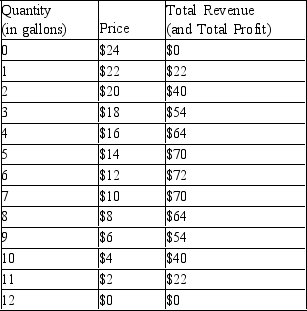 -Refer to Table 17-31. Discuss the difference between the monopoly outcome and the Nash equilibrium.
 (Essay)
4.9/5 (77)
(77) 
Filters
- Essay(0)
- Multiple Choice(0)
- Short Answer(0)
- True False(0)
- Matching(0)