



 Chat with AI
Exam 17: Oligopoly

Exam 1: Ten Principles of Economics439 Questions
Exam 2: Thinking Like an Economist617 Questions
Exam 3: Interdependence and the Gains From Trade527 Questions
Exam 4: The Market Forces of Supply and Demand697 Questions
Exam 5: Elasticity and Its Application594 Questions
Exam 6: Supply, Demand, and Government Policies645 Questions
Exam 7: Consumers, Producers, and the Efficiency of Markets549 Questions
Exam 8: Application: the Costs of Taxation513 Questions
Exam 9: Application: International Trade492 Questions
Exam 10: Externalities524 Questions
Exam 11: Public Goods and Common Resources433 Questions
Exam 12: The Design of the Tax System549 Questions
Exam 13: The Costs of Production420 Questions
Exam 14: Firms in Competitive Markets543 Questions
Exam 15: Monopoly637 Questions
Exam 16: Monopolistic Competition580 Questions
Exam 17: Oligopoly488 Questions
Exam 18: The Markets for the Factors of Production564 Questions
Exam 19: Earnings and Discrimination490 Questions
Exam 20: Income Inequality and Poverty455 Questions
Exam 21: The Theory of Consumer Choice431 Questions
Exam 22: Frontiers of Microeconomics440 Questions
Exam 23: Measuring a Nations Income520 Questions
Exam 24: Measuring the Cost of Living529 Questions
Exam 25: Production and Growth505 Questions
Exam 26: Saving, Investment, and the Financial System564 Questions
Exam 27: The Basic Tools of Finance500 Questions
Exam 28: Unemployment678 Questions
Exam 29: The Monetary System515 Questions
Exam 30: Money Growth and Inflation481 Questions
Exam 31: Open-Economy Macroeconomics: Basic Concepts522 Questions
Exam 32: A Macroeconomic Theory of the Open Economy475 Questions
Exam 33: Aggregate Demand and Aggregate Supply562 Questions
Exam 34: The Influence of Monetary and Fiscal Policy on Aggregate Demand508 Questions
Exam 35: The Short-Run Trade-Off Between Inflation and Unemployment491 Questions
Exam 36: Six Debates Over Macroeconomic Policy372 Questions
Select questions type


Table 17-4
The table shows the town of Mauston's demand schedule for gasoline. For simplicity, assume the town's gasoline seller(s) incur no costs in selling gasoline.  -Refer to Table 17-4. If the market for gasoline in Mauston is perfectly competitive, then the equilibrium price of gasoline is
 (Multiple Choice)
4.8/5  (79)
(79) Scenario 17-5
Assume that a local restaurant sells two items, salads and steaks. The restaurant's only two customers on a particular day are Mr. Carnivore and Ms. Leafygreens. Mr. Carnivore is willing to pay $20 for a steak and $7 for a salad. Ms. Leafygreens is willing to pay only $8 for a steak, but is willing to pay $12 for a salad. Assume that the restaurant can provide each of these items at zero marginal cost.
-Refer to Scenario 17-5. If the restaurant is unable to use tying, what is the profit-maximizing price to charge for a salad?
(Multiple Choice)
4.7/5 (74)
(74) Some business practices that appear to reduce competition, such as resale price maintenance, may have legitimate economic purposes.
(True/False)
4.8/5 (82)
(82) Assuming that oligopolists do not have the opportunity to collude, once they have reached the Nash equilibrium, it
(Multiple Choice)
5.0/5 (88)
(88) When firms are faced with making strategic choices to maximize profit, economists typically use
(Multiple Choice)
4.7/5 (77)
(77) Table 17-28
Suppose that two firms determine that each could lower its costs and increase its profits if both reduced their advertising budgets. But in order for the plan to work, each firm must agree to refrain from advertising. Each firm believes that advertising works by increasing the demand for the firm's product, but each firm also believes that if neither firm advertises, the cost savings will outweigh the lost sales. The table below lists each firm's individual profits:
Firm A
Breaks agreement Maintains agreement
and advertises and does not advertise  -Refer to Table 17-28. What is the outcome of this game?
 (Multiple Choice)
5.0/5 (79)
(79) Table 17-20
Nadia and Maddie are two college roommates who both prefer a clean common space in their dorm room, but neither enjoys cleaning. The roommates must each make a decision to either clean or not clean the dorm room's common space. The payoff table for this situation is provided below, where the higher a player's payoff number, the better off that player is. The payoffs in each cell are shown as (payoff for Nadia, payoff for Maddie).  -Refer to Table 17-20. What is Maddie's dominant strategy?
 (Multiple Choice)
4.7/5 (76)
(76) An equilibrium in which each firm in an oligopoly maximizes profit, given the actions of its rivals, is called
(Multiple Choice)
4.9/5 (91)
(91) If duopoly firms that are not colluding were able to successfully collude, then
(Multiple Choice)
4.7/5 (74)
(74) Explain the practice of resale price maintenance and discuss why it is controversial.
(Essay)
4.8/5 (87)
(87) Table 17-16
This table shows a game played between two players, A and B. The payoffs are given in the table as (Payoff to A, Payoff to B). 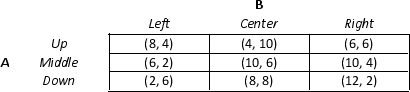 -Refer to Table 17-16. Which of the following outcomes represents a Nash equilibrium in the game?
 (Multiple Choice)
4.8/5 (73)
(73) From society's standpoint, cooperation among oligopolists is
(Multiple Choice)
4.8/5 (81)
(81) Table 17-2
Imagine a small town in which only two residents, Abby and Brad, own wells that produce safe drinking water. Each week Abby and Brad work together to decide how many gallons of water to pump. They bring water to town and sell it at whatever price the market will bear. To keep things simple, suppose that Abby and Brad can pump as much water as they want without cost so that the marginal cost is zero. The weekly town demand schedule and total revenue schedule for water is shown in the table below:  -Refer to Table 17-2. If this market for water were perfectly competitive instead of monopolistic, how many gallons of water would be produced and sold?
 (Multiple Choice)
4.9/5 (81)
(81) As the number of firms in an oligopoly becomes very large, the price effect disappears.
(True/False)
4.9/5 (83)
(83) Suppose that Thierry and Abdul are duopolists. Thierry is producing 700 units of output, and Abdul is producing 500 units of output. When Abdul produces 500 units, Thierry maximizes profit by producing 700 units. When Thierry produces 700 units of output, Abdul maximizes profit by producing 500 units. Thierry and Abdul are
(Multiple Choice)
4.9/5 (92)
(92) 
Filters
- Essay(0)
- Multiple Choice(0)
- Short Answer(0)
- True False(0)
- Matching(0)