



 Chat with AI
Exam 17: Oligopoly

Exam 1: Ten Principles of Economics439 Questions
Exam 2: Thinking Like an Economist617 Questions
Exam 3: Interdependence and the Gains From Trade527 Questions
Exam 4: The Market Forces of Supply and Demand697 Questions
Exam 5: Elasticity and Its Application594 Questions
Exam 6: Supply, Demand, and Government Policies645 Questions
Exam 7: Consumers, Producers, and the Efficiency of Markets549 Questions
Exam 8: Application: the Costs of Taxation513 Questions
Exam 9: Application: International Trade492 Questions
Exam 10: Externalities524 Questions
Exam 11: Public Goods and Common Resources433 Questions
Exam 12: The Design of the Tax System549 Questions
Exam 13: The Costs of Production420 Questions
Exam 14: Firms in Competitive Markets543 Questions
Exam 15: Monopoly637 Questions
Exam 16: Monopolistic Competition580 Questions
Exam 17: Oligopoly488 Questions
Exam 18: The Markets for the Factors of Production564 Questions
Exam 19: Earnings and Discrimination490 Questions
Exam 20: Income Inequality and Poverty455 Questions
Exam 21: The Theory of Consumer Choice431 Questions
Exam 22: Frontiers of Microeconomics440 Questions
Exam 23: Measuring a Nations Income520 Questions
Exam 24: Measuring the Cost of Living529 Questions
Exam 25: Production and Growth505 Questions
Exam 26: Saving, Investment, and the Financial System564 Questions
Exam 27: The Basic Tools of Finance500 Questions
Exam 28: Unemployment678 Questions
Exam 29: The Monetary System515 Questions
Exam 30: Money Growth and Inflation481 Questions
Exam 31: Open-Economy Macroeconomics: Basic Concepts522 Questions
Exam 32: A Macroeconomic Theory of the Open Economy475 Questions
Exam 33: Aggregate Demand and Aggregate Supply562 Questions
Exam 34: The Influence of Monetary and Fiscal Policy on Aggregate Demand508 Questions
Exam 35: The Short-Run Trade-Off Between Inflation and Unemployment491 Questions
Exam 36: Six Debates Over Macroeconomic Policy372 Questions
Select questions type


If the members of an oligopoly could agree on a total quantity to produce and a price to charge, what quantity and price would they choose? Will this choice represent a Nash equilibrium?
(Essay)
4.8/5  (77)
(77) Figure 17-5. Two companies, ABC and QRS, are sellers in the same market. Each company decides whether to charge a high price or a low price. In the figure, the dollar amounts are payoffs and they represent annual profits for the two companies.  -Refer to Figure 17-5. Suppose the outcome of the game is one in which ABC's profit is $4 million and QRS's profit is $14 million. The most likely explanation for this outcome is that
 (Multiple Choice)
4.9/5 (71)
(71) Table 17-1
Imagine a small town in which only two residents, Rochelle and Alec, own wells that produce safe drinking water. Each week Rochelle and Alec work together to decide how many gallons of water to pump. They bring the water to town and sell it at whatever price the market will bear. To keep things simple, suppose that Rochelle and Alec can pump as much water as they want without cost so that the marginal cost of water equals zero. The weekly town demand schedule and total revenue schedule for water is shown in the table below: 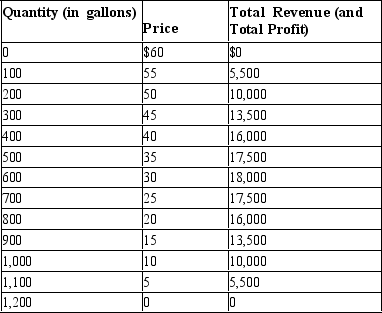 21.
-Refer to Table 17-1. If Rochelle and Alec operate as a profit-maximizing monopoly in the market for water, how much profit will each of them earn?
21.
-Refer to Table 17-1. If Rochelle and Alec operate as a profit-maximizing monopoly in the market for water, how much profit will each of them earn? (Multiple Choice)
4.9/5 (88)
(88) Table 17-6
Imagine a small town in which only two residents, Kunal and Naj, own wells that produce safe drinking water. Each week Kunal and Naj work together to decide how many gallons of water to pump, to bring the water to town, and to sell it at whatever price the market will bear. Assume Kunal and Naj can pump as much water as they want without cost so that the marginal cost of water equals zero.
The weekly town demand schedule and total revenue schedule for water are shown in the table below. 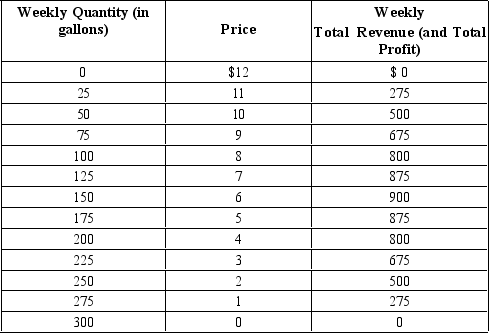 -Refer to Table 17-6. The socially efficient level of water supplied to the market would be
 (Multiple Choice)
4.8/5 (82)
(82) When strategic interactions are important to pricing and production decisions, a typical firm will
(Multiple Choice)
4.8/5 (78)
(78) Which of these situations produces the largest profits for oligopolists?
(Multiple Choice)
4.7/5 (74)
(74) Why are the actions of firms interdependent in an oligopoly market but not in a monopolistically competitive market?
(Essay)
4.8/5 (77)
(77) Table 17-12
The table shows the town of Driveaway's demand schedule for gasoline. Assume the town's gasoline seller(s) incurs a cost of $2 for each gallon sold, with no fixed cost.  -Refer to Table 17-12. Suppose there are exactly two sellers of gasoline in Driveaway: Amogo and Spilmerica. If Amogo sells 150 gallons and Spilmerica sells 100 gallons, then
 (Multiple Choice)
4.9/5 (82)
(82) Consider a game of the "Jack and Jill" type in which a market is a duopoly and each firm decides to produce either a "high" quantity of output or a "low" quantity of output. If the two firms successfully reach and maintain the cooperative outcome of the game, then
(Multiple Choice)
4.8/5 (80)
(80) In the U.S. government's 1998 suit against the Microsoft Corporation, a central issue was whether Microsoft should be allowed to integrate its Internet browser into its Windows operating system. Microsoft responded that
(Multiple Choice)
4.9/5 (69)
(69) Table 17-20
Nadia and Maddie are two college roommates who both prefer a clean common space in their dorm room, but neither enjoys cleaning. The roommates must each make a decision to either clean or not clean the dorm room's common space. The payoff table for this situation is provided below, where the higher a player's payoff number, the better off that player is. The payoffs in each cell are shown as (payoff for Nadia, payoff for Maddie).  -Refer to Table 17-20. What is the Nash Equilibrium in this dorm room cleaning game?
 (Multiple Choice)
4.9/5 (80)
(80) Any market that is served by an oligopoly is in effect served by a monopoly.
(True/False)
4.9/5 (67)
(67) The paradoxical nature of oligopoly can be demonstrated by the fact that, even though the monopoly outcome is best for the oligopolists,
(Multiple Choice)
4.9/5 (78)
(78) Suppose three firms form a cartel and agree to charge a specific price for their output. Each individual firm has an incentive to maintain the agreement because the firm's individual profits will be the greatest under the cartel arrangement.
(True/False)
4.7/5 (71)
(71) Which strategy was the most successful in the prisoners' dilemma tournament?
(Short Answer)
4.8/5 (78)
(78) In the case of oligopolistic markets, self-interest makes cooperation difficult and it often leads to an undesirable outcome for the firms that are involved.
(True/False)
4.9/5 (74)
(74) After initial success, the OPEC cartel saw the price of oil and the revenues of its members decline due, in part, to
(Multiple Choice)
4.9/5 (82)
(82) The theory of oligopoly provides another reason that free trade can benefit all countries because
(Multiple Choice)
4.9/5 (70)
(70) 
Filters
- Essay(0)
- Multiple Choice(0)
- Short Answer(0)
- True False(0)
- Matching(0)