



 Chat with AI
Exam 17: Oligopoly

Exam 1: Ten Principles of Economics439 Questions
Exam 2: Thinking Like an Economist617 Questions
Exam 3: Interdependence and the Gains From Trade527 Questions
Exam 4: The Market Forces of Supply and Demand697 Questions
Exam 5: Elasticity and Its Application594 Questions
Exam 6: Supply, Demand, and Government Policies645 Questions
Exam 7: Consumers, Producers, and the Efficiency of Markets549 Questions
Exam 8: Application: the Costs of Taxation513 Questions
Exam 9: Application: International Trade492 Questions
Exam 10: Externalities524 Questions
Exam 11: Public Goods and Common Resources433 Questions
Exam 12: The Design of the Tax System549 Questions
Exam 13: The Costs of Production420 Questions
Exam 14: Firms in Competitive Markets543 Questions
Exam 15: Monopoly637 Questions
Exam 16: Monopolistic Competition580 Questions
Exam 17: Oligopoly488 Questions
Exam 18: The Markets for the Factors of Production564 Questions
Exam 19: Earnings and Discrimination490 Questions
Exam 20: Income Inequality and Poverty455 Questions
Exam 21: The Theory of Consumer Choice431 Questions
Exam 22: Frontiers of Microeconomics440 Questions
Exam 23: Measuring a Nations Income520 Questions
Exam 24: Measuring the Cost of Living529 Questions
Exam 25: Production and Growth505 Questions
Exam 26: Saving, Investment, and the Financial System564 Questions
Exam 27: The Basic Tools of Finance500 Questions
Exam 28: Unemployment678 Questions
Exam 29: The Monetary System515 Questions
Exam 30: Money Growth and Inflation481 Questions
Exam 31: Open-Economy Macroeconomics: Basic Concepts522 Questions
Exam 32: A Macroeconomic Theory of the Open Economy475 Questions
Exam 33: Aggregate Demand and Aggregate Supply562 Questions
Exam 34: The Influence of Monetary and Fiscal Policy on Aggregate Demand508 Questions
Exam 35: The Short-Run Trade-Off Between Inflation and Unemployment491 Questions
Exam 36: Six Debates Over Macroeconomic Policy372 Questions
Select questions type


Scenario 17-4.
Consider two cigarette companies, PM Inc. and Brown Inc. If neither company advertises, the two companies split the market and earn $50 million each. If they both advertise, they again split the market, but profits are lower by $10 million since each company must bear the cost of advertising. Yet if one company advertises while the other does not, the one that advertises attracts customers from the other. In this case, the company that advertises earns $60 million while the company that does not advertise earns only $30 million.
-Refer to Scenario 17-4. PM Inc.'s dominant strategy is to
(Multiple Choice)
4.7/5  (73)
(73) Table 17-30
Imagine a small town in which only two residents, Abby and Brad, own wells that produce safe drinking water. Each week Abby and Brad work together to decide how many gallons of water to pump. They bring water to town and sell it at whatever price the market will bear. To keep things simple, suppose that Abby and Brad can pump as much water as they want without cost so that the marginal cost is zero. The weekly town demand schedule and total revenue schedule for water is shown in the table below: 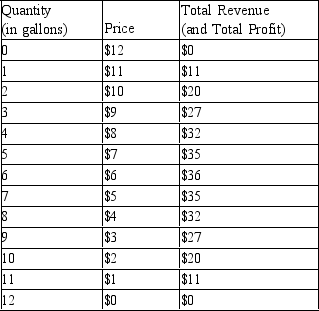 -Refer to Table 17-30. Briefly explain why each duopolist earns a lower profit at the Nash equilibrium than if they cooperated to produce the monopoly output.
 (Essay)
4.7/5 (84)
(84) Scenario 17-4.
Consider two cigarette companies, PM Inc. and Brown Inc. If neither company advertises, the two companies split the market and earn $50 million each. If they both advertise, they again split the market, but profits are lower by $10 million since each company must bear the cost of advertising. Yet if one company advertises while the other does not, the one that advertises attracts customers from the other. In this case, the company that advertises earns $60 million while the company that does not advertise earns only $30 million.
-Refer to Scenario 17-4. What will these two companies do if they behave as individual profit maximizers?
(Multiple Choice)
4.9/5 (81)
(81) Explain how the output effect and the price effect influence the production decision of the individual oligopolist.
(Essay)
4.9/5 (84)
(84) During the 1990s, the members of OPEC operated independently from one another, causing the world market for crude oil to become close to
(Multiple Choice)
4.8/5 (85)
(85) Table 17-26
Two prescription drug manufacturers (Firm A and Firm B) are faced with lawsuits from states to recover the healthcare related expenses associated with side-effects from its drugs. Each drug manufacturer has evidence that indicates that taking its prescription drug causes liver failure. State prosecutors do not have access to the same data used by drug manufacturers and thus will have difficulty recovering full costs without the help of at least one of the drug manufacturer's studies. Each firm has been presented with an opportunity to lower its liability in the suit if it cooperates with attorneys representing the states.  Refer to Table 17-26. Pursuing its own best interests, Firm A will concede that taking their prescription drug
causes liver failure
e. only if Firm B concedes that taking its drug causes liver failure.
f. only if Firm B does not concede that taking its drug causes liver failure.
g. regardless of whether Firm B concedes that taking its drug causes liver failure.
h. None of the above. In pursuing its own best interests, Firm A will in no case concede that taking its prescription drug causes liver failure.
ANSWER: d
POINTS: 1
DIFFICULTY: Difficulty: Moderate
LEARNING OBJECTIVES: ECON.MANK.15.84 - LO: 17-2
NATIONAL STANDARDS: United States - BUSPROG: Analytic
TOPICS: DISC: Game Theory
KEYWORDS: BLOOM'S: Application
NOTES: r
-Refer to Table 17-26. If both firms follow a dominant strategy, Firm B's profits (losses) will be
Refer to Table 17-26. Pursuing its own best interests, Firm A will concede that taking their prescription drug
causes liver failure
e. only if Firm B concedes that taking its drug causes liver failure.
f. only if Firm B does not concede that taking its drug causes liver failure.
g. regardless of whether Firm B concedes that taking its drug causes liver failure.
h. None of the above. In pursuing its own best interests, Firm A will in no case concede that taking its prescription drug causes liver failure.
ANSWER: d
POINTS: 1
DIFFICULTY: Difficulty: Moderate
LEARNING OBJECTIVES: ECON.MANK.15.84 - LO: 17-2
NATIONAL STANDARDS: United States - BUSPROG: Analytic
TOPICS: DISC: Game Theory
KEYWORDS: BLOOM'S: Application
NOTES: r
-Refer to Table 17-26. If both firms follow a dominant strategy, Firm B's profits (losses) will be (Multiple Choice)
4.8/5 (81)
(81) Hot dog vendors on the beach fail to cooperate with one another on the quantity of hot dogs they should sell to earn monopoly profits. A consequence of their failure is that, relative to the outcome the vendors would like,
(Multiple Choice)
4.9/5 (91)
(91) Figure 17-3. Hector and Bart are roommates. On a particular day, their apartment needs to be cleaned. Each person has to decide whether to take part in cleaning. At the end of the day, either the apartment will be completely clean (if one or both roommates take part in cleaning), or it will remain dirty (if neither roommate cleans). With happiness measured on a scale of 1 (very unhappy) to 10 (very happy), the possible outcomes are as follows:  -Refer to Figure 17-3. In pursuing his own self-interest, Bart will
 (Multiple Choice)
4.9/5 (78)
(78) Scenario 17-2.
Imagine that two oil companies, BQ and Exxoff, own adjacent oil fields. Under the fields is a common pool of oil worth $144 million. Drilling a well to recover oil costs $5 million per well. If each company drills one well, each will get half of the oil and earn a $67 million profit ($72 million in revenue - $5 million in costs). Assume that having X percent of the total wells means that a company will collect X percent of the total revenue.
-Refer to Scenario 17-2. Exxoff's dominant strategy would lead to what sort of well-drilling behavior?
(Multiple Choice)
4.9/5 (66)
(66) Table 17-5
The information in the table below shows the total demand for premium-channel digital cable TV subscriptions in a small urban market. Assume that each digital cable TV operator pays a fixed cost of $200,000 (per year) to provide premium digital channels in the market area and that the marginal cost of providing the premium channel service to a household is zero.  -Refer to Table 17-5. Assume there are two digital cable TV companies operating in this market. If they are able to collude on the quantity of subscriptions that will be sold and on the price that will be charged for subscriptions, then their agreement will stipulate that
 (Multiple Choice)
4.9/5 (81)
(81) Briefly describe the two arguments that economists make to defend the practice of resale price maintenance.
(Essay)
4.8/5 (80)
(80) Table 17-3
Imagine a small town in a remote area where only two residents, Maria and Miguel, own dairies that produce milk that is safe to drink. Each week Maria and Miguel work together to decide how many gallons of milk to produce. They bring milk to town and sell it at whatever price the market will bear. To keep things simple, suppose that Maria and Miguel can produce as much milk as they want without cost so that the marginal cost is zero. The weekly town demand schedule and total revenue schedule for milk is shown in the table below:  -Refer to Table 17-3. Suppose the town enacts new antitrust laws that prohibit Maria and Miguel from operating as a monopoly. How much profit will Miguel and Maria each earn once they reach a Nash equilibrium?
 (Multiple Choice)
4.9/5 (80)
(80) Figure 17-4. Aaron and Ed are roommates. After a big snowstorm, their driveway needs to be shoveled. Each person has to decide whether to take part in shoveling the driveway. At the end of the day, either the driveway will be shoveled (if one or both roommates take part in shoveling), or it will remain unshoveled (if neither roommate shovels). With happiness measured on a scale of 1 (very unhappy) to 10 (very happy), the possible outcomes are as follows:  -Refer to Figure 17-4. If this game is played only once, then which of the following outcomes is the most likely one?
 (Multiple Choice)
4.7/5 (76)
(76) Scenario 17-3.
Consider two countries, Kinglandia and Rovinastan, that are engaged in an arms race. Each country must decide whether to build new weapons or to disarm existing weapons. Each country prefers to have more arms than the other because a large arsenal gives it more influence in world affairs. But each country also prefers to live in a world safe from the other country's weapons. The following table shows the possible outcomes for each decision combination. The numbers in each cell represent the country's ranking of the outcome (10 = best outcome, 1 = worst outcome).  -Refer to Scenario 17-3. If Rovinastan chooses to disarm its existing weapons, then Kinglandia will
 (Multiple Choice)
4.9/5 (76)
(76) Figure 17-4. Aaron and Ed are roommates. After a big snowstorm, their driveway needs to be shoveled. Each person has to decide whether to take part in shoveling the driveway. At the end of the day, either the driveway will be shoveled (if one or both roommates take part in shoveling), or it will remain unshoveled (if neither roommate shovels). With happiness measured on a scale of 1 (very unhappy) to 10 (very happy), the possible outcomes are as follows:
-Refer to Figure 17-4. The dominant strategy for Ed is to
-Refer to Figure 17-4. The dominant strategy for Ed is to (Multiple Choice)
4.9/5 (79)
(79) 
Filters
- Essay(0)
- Multiple Choice(0)
- Short Answer(0)
- True False(0)
- Matching(0)