



 Chat with AI
Exam 17: Oligopoly

Exam 1: Ten Principles of Economics439 Questions
Exam 2: Thinking Like an Economist617 Questions
Exam 3: Interdependence and the Gains From Trade527 Questions
Exam 4: The Market Forces of Supply and Demand697 Questions
Exam 5: Elasticity and Its Application594 Questions
Exam 6: Supply, Demand, and Government Policies645 Questions
Exam 7: Consumers, Producers, and the Efficiency of Markets549 Questions
Exam 8: Application: the Costs of Taxation513 Questions
Exam 9: Application: International Trade492 Questions
Exam 10: Externalities524 Questions
Exam 11: Public Goods and Common Resources433 Questions
Exam 12: The Design of the Tax System549 Questions
Exam 13: The Costs of Production420 Questions
Exam 14: Firms in Competitive Markets543 Questions
Exam 15: Monopoly637 Questions
Exam 16: Monopolistic Competition580 Questions
Exam 17: Oligopoly488 Questions
Exam 18: The Markets for the Factors of Production564 Questions
Exam 19: Earnings and Discrimination490 Questions
Exam 20: Income Inequality and Poverty455 Questions
Exam 21: The Theory of Consumer Choice431 Questions
Exam 22: Frontiers of Microeconomics440 Questions
Exam 23: Measuring a Nations Income520 Questions
Exam 24: Measuring the Cost of Living529 Questions
Exam 25: Production and Growth505 Questions
Exam 26: Saving, Investment, and the Financial System564 Questions
Exam 27: The Basic Tools of Finance500 Questions
Exam 28: Unemployment678 Questions
Exam 29: The Monetary System515 Questions
Exam 30: Money Growth and Inflation481 Questions
Exam 31: Open-Economy Macroeconomics: Basic Concepts522 Questions
Exam 32: A Macroeconomic Theory of the Open Economy475 Questions
Exam 33: Aggregate Demand and Aggregate Supply562 Questions
Exam 34: The Influence of Monetary and Fiscal Policy on Aggregate Demand508 Questions
Exam 35: The Short-Run Trade-Off Between Inflation and Unemployment491 Questions
Exam 36: Six Debates Over Macroeconomic Policy372 Questions
Select questions type


Table 17-22
Brian and Matt own the only two bicycle repair shops in town. Each must choose between a low price for repair work and a high price. The annual economic profit from each strategy is indicated in the table. The profits are shown as (Matt, Brian) in each cell.  -Refer to Table 17-22. Which of the following statements is correct?
 (Multiple Choice)
4.8/5  (90)
(90) Table 17-23
Two bottled beverage manufacturers (Firm A and Firm B) determine that they could lower their costs, and thus increase their profits, if they reduced their advertising budgets. But for the plan to work, each firm must agree to refrain from advertising. Each firm believes that advertising works by increasing the demand for the firm's product, but each firm also believes that if neither firm advertises, the costs savings will outweigh the lost sales. Listed in the table below are the individual profits for each firm.  -Refer to Table 17-23. At the Nash equilibrium, how much profit will Firm B earn?
 (Multiple Choice)
4.7/5 (85)
(85) Table 17-33
Suppose that Robert and Howard own the only two movie studios in California. Each producer must choose between a low budget and a high budget strategy for his next film. The economic profit from each strategy is indicated in the table below:
Howard
Low budget High budget  -Refer to Table 17-33. Is there a Nash equilibrium? If so, describe it.
 (Essay)
4.8/5 (68)
(68) In an oligopoly, the total output produced in the market is
(Multiple Choice)
4.9/5 (77)
(77) The Sherman Antitrust Act prohibits competing firms from even talking about fixing prices.
(True/False)
4.9/5 (79)
(79) If a certain market were a monopoly, then the monopolist would maximize its profit by producing 4,000 units of output. If, instead, that market were a duopoly, then which of the following outcomes would be most likely if the duopolists successfully collude?
(Multiple Choice)
4.8/5 (80)
(80) Some people consider the NCAA (National Collegiate Athletic Association)
to be a in the market for college athletics.
(Short Answer)
4.7/5 (70)
(70) In the prisoners' dilemma game with Bonnie and Clyde as the players, the likely outcome is one
(Multiple Choice)
4.8/5 (82)
(82) Table 17-21
The Chicken Game is named for a contest in which drivers test their courage by driving straight at each other. John and Paul have a common interest to avoid crashing into each other, but they also have a personal, competing interest to not turn first to demonstrate their courage to those observing the contest. The payoff table for this situation is provided below. The payoffs are shown as (John, Paul).  -Refer to Table 17-21. If Paul chooses Turn, what will John choose to do and what will John's payoff equal?
 (Multiple Choice)
4.7/5 (82)
(82) Scenario 17-3.
Consider two countries, Kinglandia and Rovinastan, that are engaged in an arms race. Each country must decide whether to build new weapons or to disarm existing weapons. Each country prefers to have more arms than the other because a large arsenal gives it more influence in world affairs. But each country also prefers to live in a world safe from the other country's weapons. The following table shows the possible outcomes for each decision combination. The numbers in each cell represent the country's ranking of the outcome (10 = best outcome, 1 = worst outcome).  -Refer to Scenario 17-3. Which of these statements is correct?
 (Multiple Choice)
4.9/5 (79)
(79) Table 17-11
Only two firms, ABC and XYZ, sell a particular product. The table below shows the demand curve for their product. Each firm has the same constant marginal cost of $8 and zero fixed cost.  -Refer to Table 17-11. ABC and XYZ agree to maximize joint profits. However, while ABC produces the agreed upon amount, XYZ breaks the agreement and produces 5 more than agreed. How much profit does XYZ make?
 (Multiple Choice)
4.7/5 (84)
(84) Assume that Samorola has entered into an enforceable resale price maintenance agreement with Trint and U- Mobile. Which of the following will always be true?
(Multiple Choice)
4.8/5 (93)
(93) Suppose two companies own adjacent oil fields. Under the two fields is a common pool of oil worth $60 million. For each well that is drilled, the company that drills the well incurs a cost of $4 million. Each company can drill up to two wells. What is the likely outcome of this game if each company pursues its own self-interest?
(Multiple Choice)
4.8/5 (77)
(77) Table 17-7
The information in the table below shows the total demand for internet radio subscriptions in a small urban market. Assume that each company that provides these subscriptions incurs an annual fixed cost of $20,000 (per year) and that the marginal cost of providing an additional subscription is always $16. 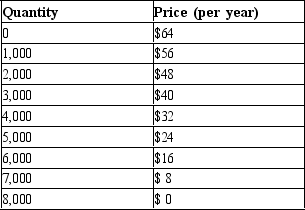 -Refer to Table 17-7. Assume there are two profit-maximizing internet radio providers operating in this market. Further assume that they are not able to collude on the price and quantity of subscriptions to sell. How many subscriptions will be sold altogether when this market reaches a Nash equilibrium?
 (Multiple Choice)
5.0/5 (87)
(87) Table 17-26
Two prescription drug manufacturers (Firm A and Firm B) are faced with lawsuits from states to recover the healthcare related expenses associated with side-effects from its drugs. Each drug manufacturer has evidence that indicates that taking its prescription drug causes liver failure. State prosecutors do not have access to the same data used by drug manufacturers and thus will have difficulty recovering full costs without the help of at least one of the drug manufacturer's studies. Each firm has been presented with an opportunity to lower its liability in the suit if it cooperates with attorneys representing the states.  Refer to Table 17-26. Pursuing its own best interests, Firm A will concede that taking their prescription drug
causes liver failure
e. only if Firm B concedes that taking its drug causes liver failure.
f. only if Firm B does not concede that taking its drug causes liver failure.
g. regardless of whether Firm B concedes that taking its drug causes liver failure.
h. None of the above. In pursuing its own best interests, Firm A will in no case concede that taking its prescription drug causes liver failure.
ANSWER: d
POINTS: 1
DIFFICULTY: Difficulty: Moderate
LEARNING OBJECTIVES: ECON.MANK.15.84 - LO: 17-2
NATIONAL STANDARDS: United States - BUSPROG: Analytic
TOPICS: DISC: Game Theory
KEYWORDS: BLOOM'S: Application
NOTES: r
-Refer to Table 17-26. When this game reaches a Nash equilibrium, profits for Firm A and Firm B will be
Refer to Table 17-26. Pursuing its own best interests, Firm A will concede that taking their prescription drug
causes liver failure
e. only if Firm B concedes that taking its drug causes liver failure.
f. only if Firm B does not concede that taking its drug causes liver failure.
g. regardless of whether Firm B concedes that taking its drug causes liver failure.
h. None of the above. In pursuing its own best interests, Firm A will in no case concede that taking its prescription drug causes liver failure.
ANSWER: d
POINTS: 1
DIFFICULTY: Difficulty: Moderate
LEARNING OBJECTIVES: ECON.MANK.15.84 - LO: 17-2
NATIONAL STANDARDS: United States - BUSPROG: Analytic
TOPICS: DISC: Game Theory
KEYWORDS: BLOOM'S: Application
NOTES: r
-Refer to Table 17-26. When this game reaches a Nash equilibrium, profits for Firm A and Firm B will be (Multiple Choice)
5.0/5 (62)
(62) Which of the following statements about oligopolies is not correct?
(Multiple Choice)
4.8/5 (73)
(73) 
Filters
- Essay(0)
- Multiple Choice(0)
- Short Answer(0)
- True False(0)
- Matching(0)