



 Chat with AI
Exam 17: Oligopoly

Exam 1: Ten Principles of Economics439 Questions
Exam 2: Thinking Like an Economist617 Questions
Exam 3: Interdependence and the Gains From Trade527 Questions
Exam 4: The Market Forces of Supply and Demand697 Questions
Exam 5: Elasticity and Its Application594 Questions
Exam 6: Supply, Demand, and Government Policies645 Questions
Exam 7: Consumers, Producers, and the Efficiency of Markets549 Questions
Exam 8: Application: the Costs of Taxation513 Questions
Exam 9: Application: International Trade492 Questions
Exam 10: Externalities524 Questions
Exam 11: Public Goods and Common Resources433 Questions
Exam 12: The Design of the Tax System549 Questions
Exam 13: The Costs of Production420 Questions
Exam 14: Firms in Competitive Markets543 Questions
Exam 15: Monopoly637 Questions
Exam 16: Monopolistic Competition580 Questions
Exam 17: Oligopoly488 Questions
Exam 18: The Markets for the Factors of Production564 Questions
Exam 19: Earnings and Discrimination490 Questions
Exam 20: Income Inequality and Poverty455 Questions
Exam 21: The Theory of Consumer Choice431 Questions
Exam 22: Frontiers of Microeconomics440 Questions
Exam 23: Measuring a Nations Income520 Questions
Exam 24: Measuring the Cost of Living529 Questions
Exam 25: Production and Growth505 Questions
Exam 26: Saving, Investment, and the Financial System564 Questions
Exam 27: The Basic Tools of Finance500 Questions
Exam 28: Unemployment678 Questions
Exam 29: The Monetary System515 Questions
Exam 30: Money Growth and Inflation481 Questions
Exam 31: Open-Economy Macroeconomics: Basic Concepts522 Questions
Exam 32: A Macroeconomic Theory of the Open Economy475 Questions
Exam 33: Aggregate Demand and Aggregate Supply562 Questions
Exam 34: The Influence of Monetary and Fiscal Policy on Aggregate Demand508 Questions
Exam 35: The Short-Run Trade-Off Between Inflation and Unemployment491 Questions
Exam 36: Six Debates Over Macroeconomic Policy372 Questions
Select questions type


Table 17-3
Imagine a small town in a remote area where only two residents, Maria and Miguel, own dairies that produce milk that is safe to drink. Each week Maria and Miguel work together to decide how many gallons of milk to produce. They bring milk to town and sell it at whatever price the market will bear. To keep things simple, suppose that Maria and Miguel can produce as much milk as they want without cost so that the marginal cost is zero. The weekly town demand schedule and total revenue schedule for milk is shown in the table below:  -Refer to Table 17-3. Suppose that Maria and Miguel work together in order to operate as a profit-maximizing monopolist. What price will they charge for milk?
 (Multiple Choice)
4.9/5  (74)
(74) Suppose the market for home-grown peppers in the town of Smallville is comprised of two farmers. Explain why they might try to collude.
(Essay)
4.8/5 (82)
(82) Table 17-5
The information in the table below shows the total demand for premium-channel digital cable TV subscriptions in a small urban market. Assume that each digital cable TV operator pays a fixed cost of $200,000 (per year) to provide premium digital channels in the market area and that the marginal cost of providing the premium channel service to a household is zero.  -Refer to Table 17-5. Assume there are two profit-maximizing digital cable TV companies operating in this market. Further assume that they are not able to collude on the price and quantity of premium digital channel subscriptions to sell. How many premium digital channel cable TV subscriptions will be sold altogether when this market reaches a Nash equilibrium?
 (Multiple Choice)
4.9/5 (67)
(67) Which of the following questions about predatory pricing remains unresolved?
(Multiple Choice)
4.8/5 (78)
(78) Table 17-34
Suppose that two oil companies - BP and Exxon - own adjacent natural gas fields. The profits that each firm earns depends on both the number of wells it drills and the number of wells drilled by the other firm. The table below lists each firm's individual profits:
Exxon
Drill one well Drill two wells  -Refer to Table 17-34. Is there a Nash equilibrium? If so, describe it.
 (Essay)
4.9/5 (73)
(73) Figure 17-5. Two companies, ABC and QRS, are sellers in the same market. Each company decides whether to charge a high price or a low price. In the figure, the dollar amounts are payoffs and they represent annual profits for the two companies.  -Refer to Figure 17-5. Suppose we observe that the outcome of the game is one in which each company earns a profit of $10 million. This outcome
 (Multiple Choice)
4.7/5 (75)
(75) Table 17-4
The table shows the town of Mauston's demand schedule for gasoline. For simplicity, assume the town's gasoline seller(s) incur no costs in selling gasoline.  -Refer to Table 17-4. If the market for gasoline in Mauston is a monopoly, then the profit-maximizing monopolist will charge a price of
 (Multiple Choice)
4.8/5 (70)
(70) Table 17-11
Only two firms, ABC and XYZ, sell a particular product. The table below shows the demand curve for their product. Each firm has the same constant marginal cost of $8 and zero fixed cost.  -Refer to Table 17-11. If ABC and XYZ operate to jointly maximize profits, then what is the price?
 (Multiple Choice)
4.8/5 (79)
(79) Before the , agreements between oligopolists were unenforceable contracts; afterwards, such agreements were criminal conspiracies.
(Short Answer)
5.0/5 (81)
(81) Scenario 17-1.
Assume that the countries of Irun and Urun are the only two producers of crude oil. Further assume that both countries have entered into an agreement to maintain certain production levels in order to maximize profits. In the world market for oil, the demand curve is downward sloping.
-Refer to Scenario 17-1. The fact that both countries have colluded to earn higher profit shows their desire to keep their combined level of output
(Multiple Choice)
4.9/5 (62)
(62) Table 17-26
Two prescription drug manufacturers (Firm A and Firm B) are faced with lawsuits from states to recover the healthcare related expenses associated with side-effects from its drugs. Each drug manufacturer has evidence that indicates that taking its prescription drug causes liver failure. State prosecutors do not have access to the same data used by drug manufacturers and thus will have difficulty recovering full costs without the help of at least one of the drug manufacturer's studies. Each firm has been presented with an opportunity to lower its liability in the suit if it cooperates with attorneys representing the states.  Refer to Table 17-26. Pursuing its own best interests, Firm A will concede that taking their prescription drug
causes liver failure
e. only if Firm B concedes that taking its drug causes liver failure.
f. only if Firm B does not concede that taking its drug causes liver failure.
g. regardless of whether Firm B concedes that taking its drug causes liver failure.
h. None of the above. In pursuing its own best interests, Firm A will in no case concede that taking its prescription drug causes liver failure.
ANSWER: d
POINTS: 1
DIFFICULTY: Difficulty: Moderate
LEARNING OBJECTIVES: ECON.MANK.15.84 - LO: 17-2
NATIONAL STANDARDS: United States - BUSPROG: Analytic
TOPICS: DISC: Game Theory
KEYWORDS: BLOOM'S: Application
NOTES: r
-Refer to Table 17-26. Pursuing its own best interests, Firm B will concede that taking its drug causes liver failure
Refer to Table 17-26. Pursuing its own best interests, Firm A will concede that taking their prescription drug
causes liver failure
e. only if Firm B concedes that taking its drug causes liver failure.
f. only if Firm B does not concede that taking its drug causes liver failure.
g. regardless of whether Firm B concedes that taking its drug causes liver failure.
h. None of the above. In pursuing its own best interests, Firm A will in no case concede that taking its prescription drug causes liver failure.
ANSWER: d
POINTS: 1
DIFFICULTY: Difficulty: Moderate
LEARNING OBJECTIVES: ECON.MANK.15.84 - LO: 17-2
NATIONAL STANDARDS: United States - BUSPROG: Analytic
TOPICS: DISC: Game Theory
KEYWORDS: BLOOM'S: Application
NOTES: r
-Refer to Table 17-26. Pursuing its own best interests, Firm B will concede that taking its drug causes liver failure (Multiple Choice)
4.7/5 (75)
(75) Suppose that Bieber and Rihanna are duopolists in the music industry. In May, they agree to work together as a monopolist, charging the monopoly price for their music and producing the monopoly quantity of songs. By June, each singer is considering breaking the agreement. What would you expect to happen next?
(Multiple Choice)
4.9/5 (74)
(74) Table 17-13
Two home-improvement stores (Lopes and HomeMax) in a growing urban area are interested in expanding their market share. Both are interested in expanding the size of their store and parking lot to accommodate potential growth in their customer base. The following game depicts the strategic outcomes that result from the game. Increases in annual profits of the two home-improvement stores are shown in the table below.  14.
-Refer to Table 17-13. Suppose the owners of Lopes and HomeMax meet for a friendly game of golf one afternoon and happen to discuss a strategy to optimize growth related profit. If they both agree to cooperate on a strategy that maximizes their joint profits, annual profit will grow by
14.
-Refer to Table 17-13. Suppose the owners of Lopes and HomeMax meet for a friendly game of golf one afternoon and happen to discuss a strategy to optimize growth related profit. If they both agree to cooperate on a strategy that maximizes their joint profits, annual profit will grow by (Multiple Choice)
4.8/5 (79)
(79) Table 17-18
This table shows a game played between two firms, Firm A and Firm B. In this game each firm must decide how much output (Q) to produce: 10 units or 12 units. The profit for each firm is given in the table as (Profit for Firm A, Profit for Firm B).  -Refer to Table 17-18. The Nash equilibrium for this game is
 (Multiple Choice)
4.8/5 (85)
(85) Oligopolies can end up looking like competitive markets if the number of firms is
(Multiple Choice)
4.7/5 (91)
(91) Table 17-4
The table shows the town of Mauston's demand schedule for gasoline. For simplicity, assume the town's gasoline seller(s) incur no costs in selling gasoline.
-Refer to Table 17-4. Suppose there are exactly two sellers of gasoline in Mauston: Shellon and Standstop. If Shellon sells 150 gallons and Standstop sells 200 gallons, then
-Refer to Table 17-4. Suppose there are exactly two sellers of gasoline in Mauston: Shellon and Standstop. If Shellon sells 150 gallons and Standstop sells 200 gallons, then (Multiple Choice)
4.8/5 (65)
(65) Table 17-16
This table shows a game played between two players, A and B. The payoffs are given in the table as (Payoff to A, Payoff to B). 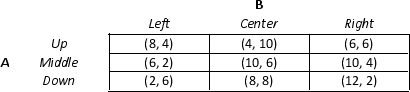 -Refer to Table 17-16. Which of the following statements is true regarding this game?
 (Multiple Choice)
4.9/5 (68)
(68) Table 17-7
The information in the table below shows the total demand for internet radio subscriptions in a small urban market. Assume that each company that provides these subscriptions incurs an annual fixed cost of $20,000 (per year) and that the marginal cost of providing an additional subscription is always $16.  -Refer to Table 17-7. Assume there are two profit-maximizing internet radio providers operating in this market. Further assume that they are able to collude on the quantity of subscriptions that will be sold and on the price that will be charged for subscriptions. If the firms divide the market evenly, how much profit will each company earn?
 (Multiple Choice)
4.8/5 (77)
(77) 
Filters
- Essay(0)
- Multiple Choice(0)
- Short Answer(0)
- True False(0)
- Matching(0)