



 Chat with AI
Exam 17: Oligopoly

Exam 1: Ten Principles of Economics439 Questions
Exam 2: Thinking Like an Economist617 Questions
Exam 3: Interdependence and the Gains From Trade527 Questions
Exam 4: The Market Forces of Supply and Demand697 Questions
Exam 5: Elasticity and Its Application594 Questions
Exam 6: Supply, Demand, and Government Policies645 Questions
Exam 7: Consumers, Producers, and the Efficiency of Markets549 Questions
Exam 8: Application: the Costs of Taxation513 Questions
Exam 9: Application: International Trade492 Questions
Exam 10: Externalities524 Questions
Exam 11: Public Goods and Common Resources433 Questions
Exam 12: The Design of the Tax System549 Questions
Exam 13: The Costs of Production420 Questions
Exam 14: Firms in Competitive Markets543 Questions
Exam 15: Monopoly637 Questions
Exam 16: Monopolistic Competition580 Questions
Exam 17: Oligopoly488 Questions
Exam 18: The Markets for the Factors of Production564 Questions
Exam 19: Earnings and Discrimination490 Questions
Exam 20: Income Inequality and Poverty455 Questions
Exam 21: The Theory of Consumer Choice431 Questions
Exam 22: Frontiers of Microeconomics440 Questions
Exam 23: Measuring a Nations Income520 Questions
Exam 24: Measuring the Cost of Living529 Questions
Exam 25: Production and Growth505 Questions
Exam 26: Saving, Investment, and the Financial System564 Questions
Exam 27: The Basic Tools of Finance500 Questions
Exam 28: Unemployment678 Questions
Exam 29: The Monetary System515 Questions
Exam 30: Money Growth and Inflation481 Questions
Exam 31: Open-Economy Macroeconomics: Basic Concepts522 Questions
Exam 32: A Macroeconomic Theory of the Open Economy475 Questions
Exam 33: Aggregate Demand and Aggregate Supply562 Questions
Exam 34: The Influence of Monetary and Fiscal Policy on Aggregate Demand508 Questions
Exam 35: The Short-Run Trade-Off Between Inflation and Unemployment491 Questions
Exam 36: Six Debates Over Macroeconomic Policy372 Questions
Select questions type


A dominant strategy is a strategy that is best for a player in a game regardless of the strategies chosen by the other players.
(True/False)
4.9/5  (82)
(82) Figure 17-3. Hector and Bart are roommates. On a particular day, their apartment needs to be cleaned. Each person has to decide whether to take part in cleaning. At the end of the day, either the apartment will be completely clean (if one or both roommates take part in cleaning), or it will remain dirty (if neither roommate cleans). With happiness measured on a scale of 1 (very unhappy) to 10 (very happy), the possible outcomes are as follows:  -Refer to Figure 17-3. The dominant strategy for Hector is to
 (Multiple Choice)
4.9/5 (75)
(75) Table 17-15
This table shows a game played between two players, A and B. The payoffs in the table are shown as (Payoff to A, Payoff to B).  -Refer to Table 17-15. If player B chooses Right, player A should choose
 (Multiple Choice)
4.8/5 (74)
(74) Table 17-12
The table shows the town of Driveaway's demand schedule for gasoline. Assume the town's gasoline seller(s) incurs a cost of $2 for each gallon sold, with no fixed cost.  -Refer to Table 17-12. Suppose we observe that the price of a gallon of gasoline in Driveaway is $5; we observe as well that a particular seller's profit is $150. Given this observation, which of the following scenarios is most likely?
 (Multiple Choice)
4.8/5 (77)
(77) Table 17-14
This table shows a game played between two players, A and B. The payoffs in the table are shown as (Payoff to A, Payoff to B).  -Refer to Table 17-14. If player A chooses his/her best strategy, player B should
 (Multiple Choice)
4.8/5 (88)
(88) In a two-person repeated game, a tit-for-tat strategy starts with
(Multiple Choice)
4.9/5 (79)
(79) If a market is a duopoly and additional firms enter and do not cooperate, then
(Multiple Choice)
4.9/5 (83)
(83) Table 17-5
The information in the table below shows the total demand for premium-channel digital cable TV subscriptions in a small urban market. Assume that each digital cable TV operator pays a fixed cost of $200,000 (per year) to provide premium digital channels in the market area and that the marginal cost of providing the premium channel service to a household is zero. 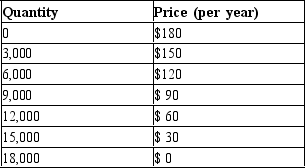 -Refer to Table 17-5. Assume there are two profit-maximizing digital cable TV companies operating in this market. Further assume that they are not able to collude on the price and quantity of premium digital channel subscriptions to sell. What price will premium digital channel cable TV subscriptions be sold at when this market reaches a Nash equilibrium?
 (Multiple Choice)
4.9/5 (80)
(80) Table 17-21
The Chicken Game is named for a contest in which drivers test their courage by driving straight at each other. John and Paul have a common interest to avoid crashing into each other, but they also have a personal, competing interest to not turn first to demonstrate their courage to those observing the contest. The payoff table for this situation is provided below. The payoffs are shown as (John, Paul).  -Refer to Table 17-21. If John chooses Drive Straight, what will Paul choose to do and what will Paul's payoff equal?
 (Multiple Choice)
4.9/5 (73)
(73) If duopolists individually pursue their own self-interest when deciding how much to produce, the profit-maximizing price they will charge for their product will be
(Multiple Choice)
4.9/5 (73)
(73) Table 17-14
This table shows a game played between two players, A and B. The payoffs in the table are shown as (Payoff to A, Payoff to B).
-Refer to Table 17-14. If both players choose their best strategies, player A will earn a payoff of
-Refer to Table 17-14. If both players choose their best strategies, player A will earn a payoff of (Multiple Choice)
4.9/5 (67)
(67) Table 17-9
The table shows the demand schedule for a particular product.  -Refer to Table 17-9. Suppose the market for this product is served by two firms that have formed a cartel. What price will the cartel charge in this market if the marginal cost of production is $4?
 (Multiple Choice)
4.8/5 (73)
(73) When a group of firms acts in unison to maximize profits as if they were a monopoly, they form a
.
(Short Answer)
4.8/5 (87)
(87) Table 17-5
The information in the table below shows the total demand for premium-channel digital cable TV subscriptions in a small urban market. Assume that each digital cable TV operator pays a fixed cost of $200,000 (per year) to provide premium digital channels in the market area and that the marginal cost of providing the premium channel service to a household is zero.
-Refer to Table 17-5. If there is only one digital cable TV company in this market, what price would it charge for a premium digital channel subscription to maximize its profit?
-Refer to Table 17-5. If there is only one digital cable TV company in this market, what price would it charge for a premium digital channel subscription to maximize its profit? (Multiple Choice)
4.7/5 (77)
(77) In the prisoners' dilemma game, confessing is a dominant strategy for each of the two prisoners.
(True/False)
4.8/5 (77)
(77) 
Filters
- Essay(0)
- Multiple Choice(0)
- Short Answer(0)
- True False(0)
- Matching(0)