



 Chat with AI
Exam 17: Oligopoly

Exam 1: Ten Principles of Economics439 Questions
Exam 2: Thinking Like an Economist617 Questions
Exam 3: Interdependence and the Gains From Trade527 Questions
Exam 4: The Market Forces of Supply and Demand697 Questions
Exam 5: Elasticity and Its Application594 Questions
Exam 6: Supply, Demand, and Government Policies645 Questions
Exam 7: Consumers, Producers, and the Efficiency of Markets549 Questions
Exam 8: Application: the Costs of Taxation513 Questions
Exam 9: Application: International Trade492 Questions
Exam 10: Externalities524 Questions
Exam 11: Public Goods and Common Resources433 Questions
Exam 12: The Design of the Tax System549 Questions
Exam 13: The Costs of Production420 Questions
Exam 14: Firms in Competitive Markets543 Questions
Exam 15: Monopoly637 Questions
Exam 16: Monopolistic Competition580 Questions
Exam 17: Oligopoly488 Questions
Exam 18: The Markets for the Factors of Production564 Questions
Exam 19: Earnings and Discrimination490 Questions
Exam 20: Income Inequality and Poverty455 Questions
Exam 21: The Theory of Consumer Choice431 Questions
Exam 22: Frontiers of Microeconomics440 Questions
Exam 23: Measuring a Nations Income520 Questions
Exam 24: Measuring the Cost of Living529 Questions
Exam 25: Production and Growth505 Questions
Exam 26: Saving, Investment, and the Financial System564 Questions
Exam 27: The Basic Tools of Finance500 Questions
Exam 28: Unemployment678 Questions
Exam 29: The Monetary System515 Questions
Exam 30: Money Growth and Inflation481 Questions
Exam 31: Open-Economy Macroeconomics: Basic Concepts522 Questions
Exam 32: A Macroeconomic Theory of the Open Economy475 Questions
Exam 33: Aggregate Demand and Aggregate Supply562 Questions
Exam 34: The Influence of Monetary and Fiscal Policy on Aggregate Demand508 Questions
Exam 35: The Short-Run Trade-Off Between Inflation and Unemployment491 Questions
Exam 36: Six Debates Over Macroeconomic Policy372 Questions
Select questions type


Nike and Reebok (athletic shoe companies) are considering whether to advertise during the Super Bowl. Devise a simple prisoners' dilemma game to demonstrate the strategic considerations that are relevant to this decision. Does the repeated game scenario differ from a single period game? Is it possible that a repeated game (without collusive agreements) could lead to an outcome that is better than a single-period game? Explain the circumstances in which this may be true.
(Essay)
4.9/5  (80)
(80) Table 17-8
For a certain small town, the table shows the demand schedule for water. Assume the marginal cost of supplying water is constant at $4 per bottle. 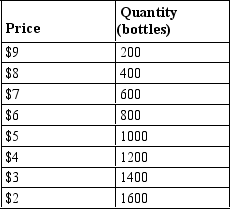 -Refer to Table 17-8. If there are two suppliers of water, Victor and Sami, and if they have successfully formed a cartel, then what would be the price and the market quantity?
 (Multiple Choice)
4.7/5 (67)
(67) Table 17-22
Brian and Matt own the only two bicycle repair shops in town. Each must choose between a low price for repair work and a high price. The annual economic profit from each strategy is indicated in the table. The profits are shown as (Matt, Brian) in each cell.  -Refer to Table 17-22. Which of the following statements is correct if Brian and Matt will play this game only once?
 (Multiple Choice)
4.8/5 (77)
(77) As the number of sellers in an oligopoly becomes very large,
(Multiple Choice)
4.8/5 (75)
(75) In which of the following markets are strategic interactions among firms most likely to occur?
(Multiple Choice)
4.8/5 (87)
(87) Table 17-18
This table shows a game played between two firms, Firm A and Firm B. In this game each firm must decide how much output (Q) to produce: 10 units or 12 units. The profit for each firm is given in the table as (Profit for Firm A, Profit for Firm B).  -Refer to Table 17-18. If these two firms agree to cooperate to maximize their joint profit, the outcome of the game will be
 (Multiple Choice)
4.9/5 (84)
(84) Table 17-9
The table shows the demand schedule for a particular product.  -Refer to Table 17-9. If the marginal cost of production in this market is $4, what is the socially efficient quantity of output?
 (Multiple Choice)
4.8/5 (87)
(87) Table 17-18
This table shows a game played between two firms, Firm A and Firm B. In this game each firm must decide how much output (Q) to produce: 10 units or 12 units. The profit for each firm is given in the table as (Profit for Firm A, Profit for Firm B).
-Refer to Table 17-18. If these two firms play this game repeatedly, the likely outcome will be
-Refer to Table 17-18. If these two firms play this game repeatedly, the likely outcome will be (Multiple Choice)
4.9/5 (74)
(74) Table 17-11
Only two firms, ABC and XYZ, sell a particular product. The table below shows the demand curve for their product. Each firm has the same constant marginal cost of $8 and zero fixed cost.  -Refer to Table 17-11. ABC and XYZ agree to jointly maximize profits. If ABC and XYZ each break the agreement and each produce 5 more than agreed upon, how much less profit does each make?
 (Multiple Choice)
4.7/5 (82)
(82) The notion of a tit-for-tat strategy applies to a prisoners' dilemma game that is played repeatedly, but it does not apply if the game is played only once.
(True/False)
4.9/5 (92)
(92) Table 17-19
Consider a small town that has two grocery stores from which residents can choose to buy a loaf of bread. The store owners each must make a decision to set a high bread price or a low bread price. The payoff table, showing profit per week, is provided below. The profit in each cell is shown as (Store 1, Store 2).  -Refer to Table 17-19. If grocery store 2 sets a low price, what price should grocery store 1 set? And what will grocery store 1's payoff equal?
 (Multiple Choice)
4.9/5 (81)
(81) Table 17-20
Nadia and Maddie are two college roommates who both prefer a clean common space in their dorm room, but neither enjoys cleaning. The roommates must each make a decision to either clean or not clean the dorm room's common space. The payoff table for this situation is provided below, where the higher a player's payoff number, the better off that player is. The payoffs in each cell are shown as (payoff for Nadia, payoff for Maddie).  -Refer to Table 17-20. If Nadia chooses to clean, then Maddie will
 (Multiple Choice)
5.0/5 (79)
(79) Oligopolies produce more when they collude then when they do not.
(True/False)
4.8/5 (72)
(72) If one firm left a duopoly market where the firms did not cooperate then
(Multiple Choice)
4.9/5 (62)
(62) The manufacturer of South Face sells jackets to retail stores for $120 each, and it requires the retail stores to charge customers $150 per jacket. Any retailer that charges less than $150 would violate its contract with South Face. What do economists call this business practice?
(Multiple Choice)
4.8/5 (65)
(65) What are the three examples of controversial business practices that antitrust laws often prohibit?
(Essay)
4.9/5 (76)
(76) Like monopolists, oligopolists are aware that an increase in the quantity of output always
(Multiple Choice)
4.9/5 (77)
(77) 
Filters
- Essay(0)
- Multiple Choice(0)
- Short Answer(0)
- True False(0)
- Matching(0)