



 Chat with AI
Exam 17: Oligopoly

Exam 1: Ten Principles of Economics439 Questions
Exam 2: Thinking Like an Economist617 Questions
Exam 3: Interdependence and the Gains From Trade527 Questions
Exam 4: The Market Forces of Supply and Demand697 Questions
Exam 5: Elasticity and Its Application594 Questions
Exam 6: Supply, Demand, and Government Policies645 Questions
Exam 7: Consumers, Producers, and the Efficiency of Markets549 Questions
Exam 8: Application: the Costs of Taxation513 Questions
Exam 9: Application: International Trade492 Questions
Exam 10: Externalities524 Questions
Exam 11: Public Goods and Common Resources433 Questions
Exam 12: The Design of the Tax System549 Questions
Exam 13: The Costs of Production420 Questions
Exam 14: Firms in Competitive Markets543 Questions
Exam 15: Monopoly637 Questions
Exam 16: Monopolistic Competition580 Questions
Exam 17: Oligopoly488 Questions
Exam 18: The Markets for the Factors of Production564 Questions
Exam 19: Earnings and Discrimination490 Questions
Exam 20: Income Inequality and Poverty455 Questions
Exam 21: The Theory of Consumer Choice431 Questions
Exam 22: Frontiers of Microeconomics440 Questions
Exam 23: Measuring a Nations Income520 Questions
Exam 24: Measuring the Cost of Living529 Questions
Exam 25: Production and Growth505 Questions
Exam 26: Saving, Investment, and the Financial System564 Questions
Exam 27: The Basic Tools of Finance500 Questions
Exam 28: Unemployment678 Questions
Exam 29: The Monetary System515 Questions
Exam 30: Money Growth and Inflation481 Questions
Exam 31: Open-Economy Macroeconomics: Basic Concepts522 Questions
Exam 32: A Macroeconomic Theory of the Open Economy475 Questions
Exam 33: Aggregate Demand and Aggregate Supply562 Questions
Exam 34: The Influence of Monetary and Fiscal Policy on Aggregate Demand508 Questions
Exam 35: The Short-Run Trade-Off Between Inflation and Unemployment491 Questions
Exam 36: Six Debates Over Macroeconomic Policy372 Questions
Select questions type


Table 17-8
For a certain small town, the table shows the demand schedule for water. Assume the marginal cost of supplying water is constant at $4 per bottle. 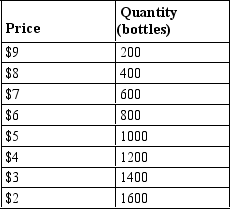 -Refer to Table 17-8. If there were many suppliers of bottled water, what would be the price and quantity?
Free
(Multiple Choice)
4.8/5  (87)
(87) Correct Answer: Verified
C
Table 17-8
For a certain small town, the table shows the demand schedule for water. Assume the marginal cost of supplying water is constant at $4 per bottle.
-Refer to Table 17-8. If there are two suppliers of water, Victor and Sami, and if they have successfully formed a cartel and split the market evenly, then how many bottles will Sami supply?
-Refer to Table 17-8. If there are two suppliers of water, Victor and Sami, and if they have successfully formed a cartel and split the market evenly, then how many bottles will Sami supply?Free
(Multiple Choice)
4.7/5 (75)
(75) Correct Answer:Verified
VerifiedC
Assume oligopoly firms are profit maximizers, they do not form a cartel, and they take other firms' production levels as given. Then in equilibrium the output effect
Free
(Multiple Choice)
4.9/5 (76)
(76) Correct Answer:Verified
VerifiedC
Scenario 17-4.
Consider two cigarette companies, PM Inc. and Brown Inc. If neither company advertises, the two companies split the market and earn $50 million each. If they both advertise, they again split the market, but profits are lower by $10 million since each company must bear the cost of advertising. Yet if one company advertises while the other does not, the one that advertises attracts customers from the other. In this case, the company that advertises earns $60 million while the company that does not advertise earns only $30 million.
-Refer to Scenario 17-4. If these two companies collude and agree upon the best joint strategy,
(Multiple Choice)
4.8/5 (89)
(89) Scenario 17-6
Assume that a local telecommunications company sells high speed internet access and cable television. The company's only two customers are Taylor and Tim. Taylor is willing to pay $50 per month for high speed internet access and $50 per month for cable television. Tim is willing to pay only $20 per month for high speed internet access, but is willing to pay $70 per month for cable television. Assume that the telecommunications company can provide each of these products at zero marginal cost.
-Refer to Scenario 17-6. If the telecommunications provider is able to use tying to price high speed internet access and cable television, what is the profit-maximizing price to charge for the "tied" good?
(Short Answer)
4.9/5 (65)
(65) Economists claim that a resale price maintenance agreement is not anti-competitive because
(Multiple Choice)
4.8/5 (83)
(83) Table 17-6
Imagine a small town in which only two residents, Kunal and Naj, own wells that produce safe drinking water. Each week Kunal and Naj work together to decide how many gallons of water to pump, to bring the water to town, and to sell it at whatever price the market will bear. Assume Kunal and Naj can pump as much water as they want without cost so that the marginal cost of water equals zero.
The weekly town demand schedule and total revenue schedule for water are shown in the table below. 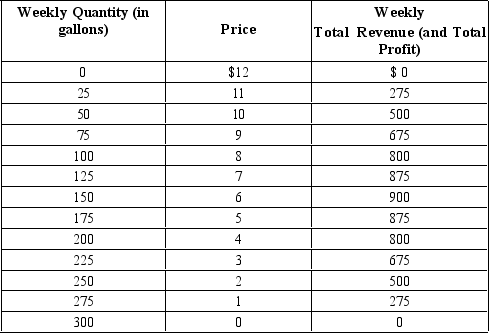 -Refer to Table 17-6. If the market for water were perfectly competitive instead of monopolistic, how many gallons of water would be produced and sold?
 (Multiple Choice)
4.8/5 (78)
(78) Suppose the market for home-grown peppers in the town of Smallville is comprised of two farmers. Suppose the two farmers try to collude. Explain why their collusion might not be successful.
(Essay)
4.8/5 (77)
(77) One way that public policy encourages cooperation among oligopolists is through antitrust law.
(True/False)
4.7/5 (97)
(97) Figure 17-5. Two companies, ABC and QRS, are sellers in the same market. Each company decides whether to charge a high price or a low price. In the figure, the dollar amounts are payoffs and they represent annual profits for the two companies.  -Refer to Figure 17-5. In what sense is the game involving ABC and QRS similar to the prisoners' dilemma game involving Bonnie and Clyde?
 (Multiple Choice)
4.8/5 (77)
(77) Table 17-21
The Chicken Game is named for a contest in which drivers test their courage by driving straight at each other. John and Paul have a common interest to avoid crashing into each other, but they also have a personal, competing interest to not turn first to demonstrate their courage to those observing the contest. The payoff table for this situation is provided below. The payoffs are shown as (John, Paul).  -Refer to Table 17-21. What is (are) the Nash equilibrium (equilibria) in this Chicken game?
 (Multiple Choice)
4.8/5 (71)
(71) Figure 17-3. Hector and Bart are roommates. On a particular day, their apartment needs to be cleaned. Each person has to decide whether to take part in cleaning. At the end of the day, either the apartment will be completely clean (if one or both roommates take part in cleaning), or it will remain dirty (if neither roommate cleans). With happiness measured on a scale of 1 (very unhappy) to 10 (very happy), the possible outcomes are as follows:  -Refer to Figure 17-3. In pursuing his own self-interest, Hector will
 (Multiple Choice)
4.9/5 (74)
(74) Even when allowed to collude, firms in an oligopoly may choose to cheat on their agreements with the rest of the cartel. Why?
(Essay)
4.8/5 (87)
(87) Table 17-25
There are just two producers of a certain product. Each is considering offering promotional discounts.  -Refer to Table 17-25. The dominant strategy
 (Multiple Choice)
4.8/5 (86)
(86) Describe the output and price effects that influence the profit-maximizing decision faced by a firm in an oligopoly market. How does this differ from output and price effects in a monopoly market?
(Essay)
4.7/5 (89)
(89) As the number of firms in an oligopoly increases, the magnitude of the price effect increases.
(True/False)
4.8/5 (68)
(68) Which of the following groups or entities has the authority to initiate legal suits to enforce antitrust laws?
(Multiple Choice)
4.8/5 (76)
(76) Table 17-6
Imagine a small town in which only two residents, Kunal and Naj, own wells that produce safe drinking water. Each week Kunal and Naj work together to decide how many gallons of water to pump, to bring the water to town, and to sell it at whatever price the market will bear. Assume Kunal and Naj can pump as much water as they want without cost so that the marginal cost of water equals zero.
The weekly town demand schedule and total revenue schedule for water are shown in the table below.
-Refer to Table 17-6. Suppose the town enacts new antitrust laws that prohibit Kunal and Naj from operating as a monopolist. What will quantity of water will each of them produce once the Nash equilibrium is reached?
-Refer to Table 17-6. Suppose the town enacts new antitrust laws that prohibit Kunal and Naj from operating as a monopolist. What will quantity of water will each of them produce once the Nash equilibrium is reached? (Multiple Choice)
4.7/5 (70)
(70) Because oligopoly markets have only a few sellers, the actions of any one seller
(Multiple Choice)
4.9/5 (74)
(74) 
Filters
- Essay(0)
- Multiple Choice(0)
- Short Answer(0)
- True False(0)
- Matching(0)