



 Chat with AI
Exam 17: Oligopoly

Exam 1: Ten Principles of Economics439 Questions
Exam 2: Thinking Like an Economist617 Questions
Exam 3: Interdependence and the Gains From Trade527 Questions
Exam 4: The Market Forces of Supply and Demand697 Questions
Exam 5: Elasticity and Its Application594 Questions
Exam 6: Supply, Demand, and Government Policies645 Questions
Exam 7: Consumers, Producers, and the Efficiency of Markets549 Questions
Exam 8: Application: the Costs of Taxation513 Questions
Exam 9: Application: International Trade492 Questions
Exam 10: Externalities524 Questions
Exam 11: Public Goods and Common Resources433 Questions
Exam 12: The Design of the Tax System549 Questions
Exam 13: The Costs of Production420 Questions
Exam 14: Firms in Competitive Markets543 Questions
Exam 15: Monopoly637 Questions
Exam 16: Monopolistic Competition580 Questions
Exam 17: Oligopoly488 Questions
Exam 18: The Markets for the Factors of Production564 Questions
Exam 19: Earnings and Discrimination490 Questions
Exam 20: Income Inequality and Poverty455 Questions
Exam 21: The Theory of Consumer Choice431 Questions
Exam 22: Frontiers of Microeconomics440 Questions
Exam 23: Measuring a Nations Income520 Questions
Exam 24: Measuring the Cost of Living529 Questions
Exam 25: Production and Growth505 Questions
Exam 26: Saving, Investment, and the Financial System564 Questions
Exam 27: The Basic Tools of Finance500 Questions
Exam 28: Unemployment678 Questions
Exam 29: The Monetary System515 Questions
Exam 30: Money Growth and Inflation481 Questions
Exam 31: Open-Economy Macroeconomics: Basic Concepts522 Questions
Exam 32: A Macroeconomic Theory of the Open Economy475 Questions
Exam 33: Aggregate Demand and Aggregate Supply562 Questions
Exam 34: The Influence of Monetary and Fiscal Policy on Aggregate Demand508 Questions
Exam 35: The Short-Run Trade-Off Between Inflation and Unemployment491 Questions
Exam 36: Six Debates Over Macroeconomic Policy372 Questions
Select questions type


Table 17-14
This table shows a game played between two players, A and B. The payoffs in the table are shown as (Payoff to A, Payoff to B).  -Refer to Table 17-14. Which of the following statements about this game is true?
 (Multiple Choice)
4.8/5  (95)
(95) If four firms comprise the entire golf club industry, the market would be
(Multiple Choice)
4.7/5 (80)
(80) Assume that Bart's Batteries has entered into a resale price maintenance agreement with Radio Shanty but not with Prime Purchase. In this case,
(Multiple Choice)
4.8/5 (86)
(86) If a person can prove that she was damaged by an illegal arrangement to restrain trade, that person can sue and recover
(Multiple Choice)
4.7/5 (76)
(76) The oligopoly price will be greater than marginal cost but less than the monopoly price when
(Multiple Choice)
5.0/5 (90)
(90) Consider a market served by a monopolist, Firm A. A new firm, Firm B, enters the market and, as a result, Firm A lowers its price to try to drive Firm B out of the market. This practice is known as
(Multiple Choice)
4.9/5 (93)
(93) When oligopolistic firms interacting with one another each choose their best strategy given the strategies chosen by other firms in the market, we have
(Multiple Choice)
4.9/5 (80)
(80) Table 17-3
Imagine a small town in a remote area where only two residents, Maria and Miguel, own dairies that produce milk that is safe to drink. Each week Maria and Miguel work together to decide how many gallons of milk to produce. They bring milk to town and sell it at whatever price the market will bear. To keep things simple, suppose that Maria and Miguel can produce as much milk as they want without cost so that the marginal cost is zero. The weekly town demand schedule and total revenue schedule for milk is shown in the table below: 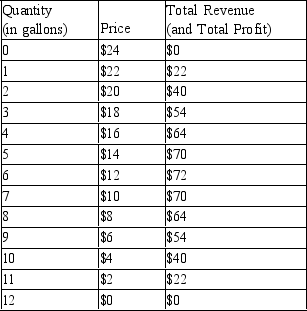 -Refer to Table 17-3. Suppose that Maria and Miguel work together in order to operate as a profit-maximizing monopolist. How many gallons of milk will be produced and sold?
 (Multiple Choice)
4.9/5 (85)
(85) The problems faced by oligopolies with three or more members are entirely different from the problems faced by duopolies.
(True/False)
4.7/5 (78)
(78) Table 17-13
Two home-improvement stores (Lopes and HomeMax) in a growing urban area are interested in expanding their market share. Both are interested in expanding the size of their store and parking lot to accommodate potential growth in their customer base. The following game depicts the strategic outcomes that result from the game. Increases in annual profits of the two home-improvement stores are shown in the table below.  14.
-Refer to Table 17-13. Suppose the owners of Lopes and HomeMax meet for a friendly game of golf one afternoon and happen to discuss a strategy to optimize growth related profit. They should both agree to
14.
-Refer to Table 17-13. Suppose the owners of Lopes and HomeMax meet for a friendly game of golf one afternoon and happen to discuss a strategy to optimize growth related profit. They should both agree to (Multiple Choice)
4.9/5 (68)
(68) Table 17-11
Only two firms, ABC and XYZ, sell a particular product. The table below shows the demand curve for their product. Each firm has the same constant marginal cost of $8 and zero fixed cost.  -Refer to Table 17-11. If ABC and XYZ operate to jointly maximize profits and agree to share the profit equally, then how much profit will each of them earn?
 (Multiple Choice)
4.8/5 (86)
(86) Table 17-2
Imagine a small town in which only two residents, Abby and Brad, own wells that produce safe drinking water. Each week Abby and Brad work together to decide how many gallons of water to pump. They bring water to town and sell it at whatever price the market will bear. To keep things simple, suppose that Abby and Brad can pump as much water as they want without cost so that the marginal cost is zero. The weekly town demand schedule and total revenue schedule for water is shown in the table below: 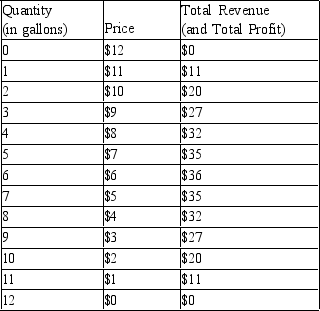 -Refer to Table 17-2. Suppose that Abby and Brad work together to operate as a profit-maximizing monopolist. What price will they charge for water?
 (Multiple Choice)
4.7/5 (88)
(88) As a group, oligopolists would always earn the highest profit if they would
(Multiple Choice)
4.9/5 (87)
(87) Scenario 17-3.
Consider two countries, Kinglandia and Rovinastan, that are engaged in an arms race. Each country must decide whether to build new weapons or to disarm existing weapons. Each country prefers to have more arms than the other because a large arsenal gives it more influence in world affairs. But each country also prefers to live in a world safe from the other country's weapons. The following table shows the possible outcomes for each decision combination. The numbers in each cell represent the country's ranking of the outcome (10 = best outcome, 1 = worst outcome).  -Refer to Scenario 17-3. Suppose the two countries agreed to disarm existing weapons. In reality these two countries may have a hard time keeping this agreement due to which of the following reasons? (i) Even though Kinglandia has no incentive to cheat on the agreement, Rovinastan has an incentive to cheat on the agreement.
(ii) Much like the prisoners' dilemma, both countries are better off reneging on the
Agreement and building new weapons.
(iii) Both countries want to increase their world power by building new weapons.
-Refer to Scenario 17-3. Suppose the two countries agreed to disarm existing weapons. In reality these two countries may have a hard time keeping this agreement due to which of the following reasons? (i) Even though Kinglandia has no incentive to cheat on the agreement, Rovinastan has an incentive to cheat on the agreement.
(ii) Much like the prisoners' dilemma, both countries are better off reneging on the
Agreement and building new weapons.
(iii) Both countries want to increase their world power by building new weapons. (Multiple Choice)
4.8/5 (97)
(97) Table 17-2
Imagine a small town in which only two residents, Abby and Brad, own wells that produce safe drinking water. Each week Abby and Brad work together to decide how many gallons of water to pump. They bring water to town and sell it at whatever price the market will bear. To keep things simple, suppose that Abby and Brad can pump as much water as they want without cost so that the marginal cost is zero. The weekly town demand schedule and total revenue schedule for water is shown in the table below:
-Refer to Table 17-2. If this market for water were perfectly competitive instead of monopolistic, what would be the price for water?
-Refer to Table 17-2. If this market for water were perfectly competitive instead of monopolistic, what would be the price for water? (Multiple Choice)
4.9/5 (77)
(77) Why do economists use game theory to study the actions of firms in oligopoly markets but not in other markets?
(Essay)
4.7/5 (72)
(72) Table 17-13
Two home-improvement stores (Lopes and HomeMax) in a growing urban area are interested in expanding their market share. Both are interested in expanding the size of their store and parking lot to accommodate potential growth in their customer base. The following game depicts the strategic outcomes that result from the game. Increases in annual profits of the two home-improvement stores are shown in the table below. 14.
-Refer to Table 17-13. Increasing the size of its store and parking lot is a dominant strategy for
14.
-Refer to Table 17-13. Increasing the size of its store and parking lot is a dominant strategy for (Multiple Choice)
4.7/5 (89)
(89) Table 17-20
Nadia and Maddie are two college roommates who both prefer a clean common space in their dorm room, but neither enjoys cleaning. The roommates must each make a decision to either clean or not clean the dorm room's common space. The payoff table for this situation is provided below, where the higher a player's payoff number, the better off that player is. The payoffs in each cell are shown as (payoff for Nadia, payoff for Maddie).  -Refer to Table 17-20. If Maddie chooses not to clean, then Nadia will
 (Multiple Choice)
4.9/5 (91)
(91) Table 17-5
The information in the table below shows the total demand for premium-channel digital cable TV subscriptions in a small urban market. Assume that each digital cable TV operator pays a fixed cost of $200,000 (per year) to provide premium digital channels in the market area and that the marginal cost of providing the premium channel service to a household is zero. 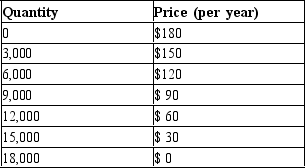 -Refer to Table 17-5. Assume there are two profit-maximizing digital cable TV companies operating in this market. Further assume that they are able to collude on the quantity of subscriptions that will be sold and on the price that will be charged for subscriptions. How much profit will each company earn?
 (Multiple Choice)
5.0/5 (83)
(83) 
Filters
- Essay(0)
- Multiple Choice(0)
- Short Answer(0)
- True False(0)
- Matching(0)