



 Chat with AI
Exam 17: Oligopoly

Exam 1: Ten Principles of Economics439 Questions
Exam 2: Thinking Like an Economist617 Questions
Exam 3: Interdependence and the Gains From Trade527 Questions
Exam 4: The Market Forces of Supply and Demand697 Questions
Exam 5: Elasticity and Its Application594 Questions
Exam 6: Supply, Demand, and Government Policies645 Questions
Exam 7: Consumers, Producers, and the Efficiency of Markets549 Questions
Exam 8: Application: the Costs of Taxation513 Questions
Exam 9: Application: International Trade492 Questions
Exam 10: Externalities524 Questions
Exam 11: Public Goods and Common Resources433 Questions
Exam 12: The Design of the Tax System549 Questions
Exam 13: The Costs of Production420 Questions
Exam 14: Firms in Competitive Markets543 Questions
Exam 15: Monopoly637 Questions
Exam 16: Monopolistic Competition580 Questions
Exam 17: Oligopoly488 Questions
Exam 18: The Markets for the Factors of Production564 Questions
Exam 19: Earnings and Discrimination490 Questions
Exam 20: Income Inequality and Poverty455 Questions
Exam 21: The Theory of Consumer Choice431 Questions
Exam 22: Frontiers of Microeconomics440 Questions
Exam 23: Measuring a Nations Income520 Questions
Exam 24: Measuring the Cost of Living529 Questions
Exam 25: Production and Growth505 Questions
Exam 26: Saving, Investment, and the Financial System564 Questions
Exam 27: The Basic Tools of Finance500 Questions
Exam 28: Unemployment678 Questions
Exam 29: The Monetary System515 Questions
Exam 30: Money Growth and Inflation481 Questions
Exam 31: Open-Economy Macroeconomics: Basic Concepts522 Questions
Exam 32: A Macroeconomic Theory of the Open Economy475 Questions
Exam 33: Aggregate Demand and Aggregate Supply562 Questions
Exam 34: The Influence of Monetary and Fiscal Policy on Aggregate Demand508 Questions
Exam 35: The Short-Run Trade-Off Between Inflation and Unemployment491 Questions
Exam 36: Six Debates Over Macroeconomic Policy372 Questions
Select questions type


Chrissy and Marvin are competitors in a local market and each is trying to decide if it is worthwhile to advertise. If both of them advertise, each will earn a profit of $10,000. If neither of them advertise, each will earn a profit of $20,000. If one advertises and the other doesn't, then the one who advertises will earn a profit of $30,000 and the other will earn $14,000. To earn the highest profit, Chrissy
(Multiple Choice)
4.9/5  (76)
(76) Table 17-15
This table shows a game played between two players, A and B. The payoffs in the table are shown as (Payoff to A, Payoff to B).  -Refer to Table 17-15. Which of the following statements regarding this game is true?
 (Multiple Choice)
4.9/5 (85)
(85) Table 17-10
The table shows the demand schedule for a particular product. 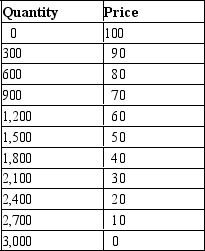 -Refer to Table 17-10. Suppose the market for this product is served by two firms who have formed a cartel and are colluding to set the price and quantity in this market. If the marginal cost to produce this product is constant at $40 per unit, then what price will the cartel set in this market?
 (Multiple Choice)
4.9/5 (81)
(81) When price is above marginal cost, selling one more unit at the current price will increase profit. This concept is known as the
(Multiple Choice)
4.8/5 (83)
(83) Table 17-12
The table shows the town of Driveaway's demand schedule for gasoline. Assume the town's gasoline seller(s) incurs a cost of $2 for each gallon sold, with no fixed cost.  -Refer to Table 17-12. If there are exactly two sellers of gasoline in Driveaway and if they collude, then which of the following outcomes is most likely?
 (Multiple Choice)
4.8/5 (83)
(83) In a typical cartel agreement, the cartel maximizes profit when it
(Multiple Choice)
4.7/5 (91)
(91) Table 17-21
The Chicken Game is named for a contest in which drivers test their courage by driving straight at each other. John and Paul have a common interest to avoid crashing into each other, but they also have a personal, competing interest to not turn first to demonstrate their courage to those observing the contest. The payoff table for this situation is provided below. The payoffs are shown as (John, Paul).  -Refer to Table 17-21. What is Paul's dominant strategy?
 (Multiple Choice)
4.9/5 (86)
(86) If two players engaged in a prisoner's dilemma game are likely to repeat the game, they are more likely to cooperate than if they play the game only once.
(True/False)
4.7/5 (81)
(81) What happens when the prisoners' dilemma game is repeated numerous times in an oligopoly market?
(Multiple Choice)
4.8/5 (92)
(92) OPEC (Organization of Petroleum Exporting Countries) is an example of a cartel in the output market for petroleum. Major League Baseball could be considered a cartel in the market for baseball players.
(Short Answer)
5.0/5 (72)
(72) Table 17-26
Two prescription drug manufacturers (Firm A and Firm B) are faced with lawsuits from states to recover the healthcare related expenses associated with side-effects from its drugs. Each drug manufacturer has evidence that indicates that taking its prescription drug causes liver failure. State prosecutors do not have access to the same data used by drug manufacturers and thus will have difficulty recovering full costs without the help of at least one of the drug manufacturer's studies. Each firm has been presented with an opportunity to lower its liability in the suit if it cooperates with attorneys representing the states.  Refer to Table 17-26. Pursuing its own best interests, Firm A will concede that taking their prescription drug
causes liver failure
e. only if Firm B concedes that taking its drug causes liver failure.
f. only if Firm B does not concede that taking its drug causes liver failure.
g. regardless of whether Firm B concedes that taking its drug causes liver failure.
h. None of the above. In pursuing its own best interests, Firm A will in no case concede that taking its prescription drug causes liver failure.
ANSWER: d
POINTS: 1
DIFFICULTY: Difficulty: Moderate
LEARNING OBJECTIVES: ECON.MANK.15.84 - LO: 17-2
NATIONAL STANDARDS: United States - BUSPROG: Analytic
TOPICS: DISC: Game Theory
KEYWORDS: BLOOM'S: Application
NOTES: r
-Refer to Table 17-26. If both firms follow a dominant strategy, Firm A's profits (losses) will be
Refer to Table 17-26. Pursuing its own best interests, Firm A will concede that taking their prescription drug
causes liver failure
e. only if Firm B concedes that taking its drug causes liver failure.
f. only if Firm B does not concede that taking its drug causes liver failure.
g. regardless of whether Firm B concedes that taking its drug causes liver failure.
h. None of the above. In pursuing its own best interests, Firm A will in no case concede that taking its prescription drug causes liver failure.
ANSWER: d
POINTS: 1
DIFFICULTY: Difficulty: Moderate
LEARNING OBJECTIVES: ECON.MANK.15.84 - LO: 17-2
NATIONAL STANDARDS: United States - BUSPROG: Analytic
TOPICS: DISC: Game Theory
KEYWORDS: BLOOM'S: Application
NOTES: r
-Refer to Table 17-26. If both firms follow a dominant strategy, Firm A's profits (losses) will be (Multiple Choice)
4.8/5 (81)
(81) In pursuing its own interest, an oligopoly firm will decide to increase production by 1 unit as long as
(Multiple Choice)
5.0/5 (84)
(84) Table 17-12
The table shows the town of Driveaway's demand schedule for gasoline. Assume the town's gasoline seller(s) incurs a cost of $2 for each gallon sold, with no fixed cost.
-Refer to Table 17-12. If the market for gasoline in Driveaway is perfectly competitive, then the equilibrium price of gasoline is
-Refer to Table 17-12. If the market for gasoline in Driveaway is perfectly competitive, then the equilibrium price of gasoline is (Multiple Choice)
4.9/5 (93)
(93) If nations such as Germany, Japan, and the United States prohibited international trade in automobiles, a likely effect would be that
(Multiple Choice)
4.8/5 (84)
(84) Table 17-31
Imagine a small town in a remote area where only two residents, Maria and Miguel, own dairies that produce milk that is safe to drink. Each week Maria and Miguel work together to decide how many gallons of milk to produce. They bring milk to town and sell it at whatever price the market will bear. To keep things simple, suppose that Maria and Miguel can produce as much milk as they want without cost so that the marginal cost is zero. The weekly town demand schedule and total revenue schedule for milk is shown in the table below: 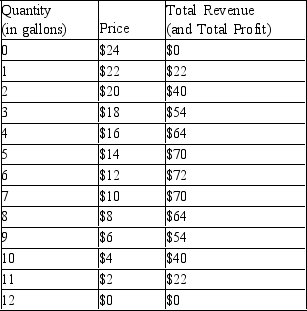 -Refer to Table 17-31. Briefly explain why each duopolist earns a lower profit at the Nash equilibrium than if they cooperated to produce the monopoly output.
 (Essay)
4.8/5 (87)
(87) In which of the following games is it clearly the case that the cooperative outcome of the game is good for the two players and bad for society?
(Multiple Choice)
4.8/5 (65)
(65) 
Filters
- Essay(0)
- Multiple Choice(0)
- Short Answer(0)
- True False(0)
- Matching(0)