



 Chat with AI
Exam 17: Oligopoly

Exam 1: Ten Principles of Economics439 Questions
Exam 2: Thinking Like an Economist617 Questions
Exam 3: Interdependence and the Gains From Trade527 Questions
Exam 4: The Market Forces of Supply and Demand697 Questions
Exam 5: Elasticity and Its Application594 Questions
Exam 6: Supply, Demand, and Government Policies645 Questions
Exam 7: Consumers, Producers, and the Efficiency of Markets549 Questions
Exam 8: Application: the Costs of Taxation513 Questions
Exam 9: Application: International Trade492 Questions
Exam 10: Externalities524 Questions
Exam 11: Public Goods and Common Resources433 Questions
Exam 12: The Design of the Tax System549 Questions
Exam 13: The Costs of Production420 Questions
Exam 14: Firms in Competitive Markets543 Questions
Exam 15: Monopoly637 Questions
Exam 16: Monopolistic Competition580 Questions
Exam 17: Oligopoly488 Questions
Exam 18: The Markets for the Factors of Production564 Questions
Exam 19: Earnings and Discrimination490 Questions
Exam 20: Income Inequality and Poverty455 Questions
Exam 21: The Theory of Consumer Choice431 Questions
Exam 22: Frontiers of Microeconomics440 Questions
Exam 23: Measuring a Nations Income520 Questions
Exam 24: Measuring the Cost of Living529 Questions
Exam 25: Production and Growth505 Questions
Exam 26: Saving, Investment, and the Financial System564 Questions
Exam 27: The Basic Tools of Finance500 Questions
Exam 28: Unemployment678 Questions
Exam 29: The Monetary System515 Questions
Exam 30: Money Growth and Inflation481 Questions
Exam 31: Open-Economy Macroeconomics: Basic Concepts522 Questions
Exam 32: A Macroeconomic Theory of the Open Economy475 Questions
Exam 33: Aggregate Demand and Aggregate Supply562 Questions
Exam 34: The Influence of Monetary and Fiscal Policy on Aggregate Demand508 Questions
Exam 35: The Short-Run Trade-Off Between Inflation and Unemployment491 Questions
Exam 36: Six Debates Over Macroeconomic Policy372 Questions
Select questions type


Suppose that Barack and Michelle are duopolists. Barack is producing 300 units of output, and Michelle is producing 400 units of output. When Michelle produces 400 units, Barack maximizes profit by producing 300 units. When Barack produces 300 units of output, Michelle maximizes profit by producing 400 units. Barack and Michelle are
(Multiple Choice)
4.9/5  (79)
(79) All examples of the prisoner's dilemma game are characterized by one and only one Nash equilibrium.
(True/False)
4.8/5 (81)
(81) An oligopoly would tend to restrict output and drive up price if
(Multiple Choice)
4.8/5 (92)
(92) Table 17-28
Suppose that two firms determine that each could lower its costs and increase its profits if both reduced their advertising budgets. But in order for the plan to work, each firm must agree to refrain from advertising. Each firm believes that advertising works by increasing the demand for the firm's product, but each firm also believes that if neither firm advertises, the cost savings will outweigh the lost sales. The table below lists each firm's individual profits:
Firm A
Breaks agreement Maintains agreement
and advertises and does not advertise  -Refer to Table 17-28. Which of the following statement(s) correctly characterizes the outcome of this game?
 (Multiple Choice)
4.9/5 (81)
(81) Figure 17-1  -Refer to Figure 17-1. Suppose this market is served by two firms who each face the marginal cost curve shown in the diagram. The marginal revenue curve that a monopolist would face in this market is also shown. If the firms are able to collude successfully,
 (Multiple Choice)
4.7/5 (67)
(67) In choosing among alternative courses of action, Raj must consider how others might respond to the action he takes. In the language of game theory, we say that Raj must think
(Multiple Choice)
4.8/5 (69)
(69) Scenario 17-1.
Assume that the countries of Irun and Urun are the only two producers of crude oil. Further assume that both countries have entered into an agreement to maintain certain production levels in order to maximize profits. In the world market for oil, the demand curve is downward sloping.
-Refer to Scenario 17-1. As long as the combined level of output is less than the Nash equilibrium level, both Irun and Urun have the individual incentive to
(Multiple Choice)
5.0/5 (73)
(73) The game that oligopolists play in trying to reach the oligopoly outcome is similar to the game that the two prisoners play in the prisoners' dilemma.
(True/False)
4.9/5 (77)
(77) The essence of an oligopolistic market is that there are only a few sellers.
(True/False)
4.9/5 (79)
(79) Table 17-20
Nadia and Maddie are two college roommates who both prefer a clean common space in their dorm room, but neither enjoys cleaning. The roommates must each make a decision to either clean or not clean the dorm room's common space. The payoff table for this situation is provided below, where the higher a player's payoff number, the better off that player is. The payoffs in each cell are shown as (payoff for Nadia, payoff for Maddie).  -Refer to Table 17-20. If Nadia chooses to not clean, then Maddie will
 (Multiple Choice)
4.8/5 (75)
(75) Table 17-19
Consider a small town that has two grocery stores from which residents can choose to buy a loaf of bread. The store owners each must make a decision to set a high bread price or a low bread price. The payoff table, showing profit per week, is provided below. The profit in each cell is shown as (Store 1, Store 2).  -Refer to Table 17-19. If grocery store 1 sets a high price, what price should grocery store 2 set? And what will grocery store 2's payoff equal?
 (Multiple Choice)
4.8/5 (71)
(71) Table 17-7
The information in the table below shows the total demand for internet radio subscriptions in a small urban market. Assume that each company that provides these subscriptions incurs an annual fixed cost of $20,000 (per year) and that the marginal cost of providing an additional subscription is always $16. 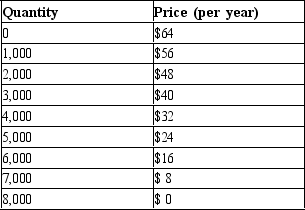 -Refer to Table 17-7. Assume that there are two profit-maximizing internet radio providers operating in this market. Further assume that they are not able to collude on the price and quantity of subscriptions to sell. How much profit will each firm earn when this market reaches a Nash equilibrium?
 (Multiple Choice)
4.7/5 (90)
(90) Scenario 17-2.
Imagine that two oil companies, BQ and Exxoff, own adjacent oil fields. Under the fields is a common pool of oil worth $144 million. Drilling a well to recover oil costs $5 million per well. If each company drills one well, each will get half of the oil and earn a $67 million profit ($72 million in revenue - $5 million in costs). Assume that having X percent of the total wells means that a company will collect X percent of the total revenue.
-Refer to Scenario 17-2. If BQ and Exxoff are able to successfully collude to maximize their joint profits, BQ will earn
(Multiple Choice)
4.7/5 (87)
(87) Table 17-12
The table shows the town of Driveaway's demand schedule for gasoline. Assume the town's gasoline seller(s) incurs a cost of $2 for each gallon sold, with no fixed cost.  -Refer to Table 17-12. If the market for gasoline in Driveaway is a monopoly, then the monopolist's maximum profit is
 (Multiple Choice)
4.7/5 (76)
(76) Table 17-11
Only two firms, ABC and XYZ, sell a particular product. The table below shows the demand curve for their product. Each firm has the same constant marginal cost of $8 and zero fixed cost.  -Refer to Table 17-11. How much less do each of these firms earn in the Nash equilibrium than if they jointly maximize profits?
 (Multiple Choice)
4.9/5 (89)
(89) We must be knowledgeable of how people behave in strategic situations if we are to understand
(Multiple Choice)
4.8/5 (80)
(80) Table 17-7
The information in the table below shows the total demand for internet radio subscriptions in a small urban market. Assume that each company that provides these subscriptions incurs an annual fixed cost of $20,000 (per year) and that the marginal cost of providing an additional subscription is always $16.
-Refer to Table 17-7. Assume there are two profit-maximizing internet radio providers operating in this market. Further assume that they are not able to collude on the price and quantity of subscriptions to sell. What price will they charge for a subscription when this market reaches a Nash equilibrium?
-Refer to Table 17-7. Assume there are two profit-maximizing internet radio providers operating in this market. Further assume that they are not able to collude on the price and quantity of subscriptions to sell. What price will they charge for a subscription when this market reaches a Nash equilibrium? (Multiple Choice)
5.0/5 (86)
(86) 
Filters
- Essay(0)
- Multiple Choice(0)
- Short Answer(0)
- True False(0)
- Matching(0)