



 Chat with AI
Exam 55: Cardiopulmonary Rehabilitation

Exam 1: History of Respiratory Care30 Questions
Exam 2: Delivering Evidence-Based Respiratory Care22 Questions
Exam 3: Quality, Patient Safety, and Communication, and Recordkeeping49 Questions
Exam 4: Principles of Infection Prevention and Control34 Questions
Exam 5: Ethical and Legal Implications of Practice41 Questions
Exam 6: Physical Principles of Respiratory Care88 Questions
Exam 7: E-Medicine in Respiratory Care21 Questions
Exam 8: Fundamentals of Respiratory Care Research10 Questions
Exam 9: The Respiratory System129 Questions
Exam 10: The Cardiovascular System68 Questions
Exam 11: Ventilation78 Questions
Exam 12: Gas Exchange and Transport88 Questions
Exam 13: Solutions, Body Fluids, and Electrolytes94 Questions
Exam 14: Acid-Base Balance100 Questions
Exam 15: Regulation of Breathing50 Questions
Exam 16: Bedside Assessment of the Patient100 Questions
Exam 17: Interpreting Clinical and Laboratory Data38 Questions
Exam 18: Interpreting the Electrocardiogram35 Questions
Exam 19: Analysis and Monitoring of Gas Exchange115 Questions
Exam 20: Pulmonary Function Testing70 Questions
Exam 21: Review of Thoracic Imaging47 Questions
Exam 22: Flexible Bronchoscopy and the Respiratory Therapist25 Questions
Exam 23: Nutrition Assessment46 Questions
Exam 24: Pulmonary Infections56 Questions
Exam 25: Obstructive Lung Disease: Chronic Obstructive Pulmonary Disease Copd, Asthma, and Related Diseases59 Questions
Exam 26: Interstitial Lung Disease45 Questions
Exam 27: Pleural Diseases42 Questions
Exam 28: Pulmonary Vascular Disease57 Questions
Exam 29: Acute Respiratory Distress Syndrome30 Questions
Exam 30: Trauma, Burns and Near Drowning21 Questions
Exam 31: Lung Cancer28 Questions
Exam 32: Neuromuscular and Other Diseases of the Chest Wall29 Questions
Exam 33: Disorders of Sleep30 Questions
Exam 34: Neonatal and Pediatric Respiratory Disorders70 Questions
Exam 35: Airway Pharmacology67 Questions
Exam 36: Airway Management117 Questions
Exam 37: Emergency Cardiovascular Life Support70 Questions
Exam 38: Humidity and Bland Aerosol Therapy109 Questions
Exam 39: Aerosol Drug Therapy116 Questions
Exam 40: Storage and Delivery of Medical Gases78 Questions
Exam 41: Medical Gas Therapy93 Questions
Exam 42: Lung Expansion Therapy63 Questions
Exam 43: Airway Clearance Therapy Act90 Questions
Exam 44: Respiratory Failure and the Need for Ventilatory Support54 Questions
Exam 45: Mechanical Ventilators70 Questions
Exam 46: Physiology of Ventilatory Support89 Questions
Exam 47: Patient Ventilator Interaction22 Questions
Exam 48: Initiating and Adjusting Invasive Ventilatory Support97 Questions
Exam 49: Noninvasive Ventilation51 Questions
Exam 50: Extracorporeal Life Support Ecls25 Questions
Exam 51: Monitoring the Patient in the Intensive Care Unit60 Questions
Exam 52: Discontinuing Ventilatory Support62 Questions
Exam 53: Neonatal and Pediatric Respiratory Care34 Questions
Exam 54: Patient Education and Health Promotion20 Questions
Exam 55: Cardiopulmonary Rehabilitation64 Questions
Exam 56: Respiratory Care in Alternative Settings130 Questions
Select questions type


Under which of the following conditions would you recommend ending a cardiopulmonary exercise evaluation?
1) Electrocardiogram indicating sinus tachycardia
2) 10% fall from baseline oxyhemoglobin (HbO2) saturation
3) Fall in systolic blood pressure of more than 20 mm Hg
4) Request from the patient to terminate the test

Free
(Multiple Choice)
5.0/5  (75)
(75) Correct Answer: Verified
A
Minimum equipment requirements for the physical reconditioning component of a pulmonary rehabilitation program include which of the following?
1) Inspiratory resistive breathing devices
2) Rowing machines or upper extremity ergometers
3) Pulse oximeters (for pulse rate/SaO2)
4) Stationary bicycles
Free
(Multiple Choice)
4.9/5 (84)
(84) Correct Answer:Verified
VerifiedC
Which of the following occur when the ventilatory threshold is exceeded during exercise?
1) Metabolism becomes anaerobic.
2) Energy production increases.
3) Fatigue increases.
Free
(Multiple Choice)
4.8/5 (58)
(58) Correct Answer:Verified
VerifiedC
During inspiratory resistive exercises, the desired load should be about what percentage of the maximum inspiratory pressure?
(Multiple Choice)
4.9/5 (74)
(74) While you are assisting in a treadmill cardiopulmonary stress test procedure, the patient complains to you of severe shortness of breath and some chest pain. Which of the following actions would you recommend at this time?
(Multiple Choice)
4.8/5 (93)
(93) Which of the following measures during cardiopulmonary exercise evaluation are most useful in differentiating between exercise intolerance of cardiac versus ventilatory origin?
1) Maximum heart rate
2) O2max
3) PaCO2
4) PaO2
(Multiple Choice)
4.7/5 (75)
(75) What government programs can serve as a source for reimbursement for pulmonary rehabilitation?
1) Prospective payment system (PPS)
2) Comprehensive outpatient rehabilitative facility (CORF)
3) Veterans Administration benefits
4) Civilian Health and Medical Programs of the Uniformed Services (CHAMPUS)
(Multiple Choice)
4.9/5 (73)
(73) In which of the following ways does the body respond to increased levels of physical activity?
1) Decreased cardiac output
2) Increased minute ventilation
3) Neuroendocrine stimulation
(Multiple Choice)
4.7/5 (94)
(94) To increase the likelihood that positive patient results are lasting, what must pulmonary rehabilitation programs provide?
(Multiple Choice)
4.7/5 (83)
(83) What is the first step in evaluating patients for participation in a pulmonary rehabilitation program?
(Multiple Choice)
4.8/5 (82)
(82) Which of the following outcome measures is considered a major predictor for improvement in a COPD patient's health-related quality-of-life?
(Multiple Choice)
4.8/5 (67)
(67) Common goals shared by most pulmonary rehabilitation programs include which of the following?
1) Improvement in physical activity levels
2) Control of respiratory infections
3) Reduction in medical costs and hospitalizations
4) Family education, counseling, and support
(Multiple Choice)
5.0/5 (81)
(81) Which of the following patients with irreversible airway obstruction are the best candidates for pulmonary rehabilitation? 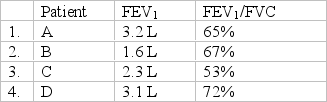
(Multiple Choice)
4.8/5 (82)
(82) Attrition in pulmonary rehabilitation programs is most associated with which of the following?
(Multiple Choice)
4.8/5 (79)
(79) The O2max at termination of exercise (as a percentage of the predicted) for five patients appears below. Which of these patients is the best candidate for pulmonary rehabilitation?
(Multiple Choice)
4.9/5 (69)
(69) To maximize patient safety during cardiopulmonary stress testing, which of the following precautions would you recommend?
1) Immediate availability of a crash cart
2) Staff training in emergency life support
3) Presence of a physician throughout testing
4) Patient physical exam or ECG before testing
(Multiple Choice)
4.8/5 (67)
(67) What are the overall goals of rehabilitation?
1) To reverse the course or progression of the disease process
2) To minimize the disability's impact on the individual or family
3) To maximize the functional ability of the individual
(Multiple Choice)
4.9/5 (77)
(77) Which of the following are reasonable expectations for a pulmonary rehabilitation program?
1) Reduction in hospitalizations
2) Improvement in ambulation
3) Reversal of the disease process
4) Control of respiratory infections
(Multiple Choice)
4.9/5 (80)
(80) What is the ideal class size for pulmonary rehabilitation programs?
(Multiple Choice)
4.9/5 (77)
(77) 
Filters
- Essay(0)
- Multiple Choice(0)
- Short Answer(0)
- True False(0)
- Matching(0)