



 Chat with AI
Exam 6: Physical Principles of Respiratory Care

Exam 1: History of Respiratory Care30 Questions
Exam 2: Delivering Evidence-Based Respiratory Care22 Questions
Exam 3: Quality, Patient Safety, and Communication, and Recordkeeping49 Questions
Exam 4: Principles of Infection Prevention and Control34 Questions
Exam 5: Ethical and Legal Implications of Practice41 Questions
Exam 6: Physical Principles of Respiratory Care88 Questions
Exam 7: E-Medicine in Respiratory Care21 Questions
Exam 8: Fundamentals of Respiratory Care Research10 Questions
Exam 9: The Respiratory System129 Questions
Exam 10: The Cardiovascular System68 Questions
Exam 11: Ventilation78 Questions
Exam 12: Gas Exchange and Transport88 Questions
Exam 13: Solutions, Body Fluids, and Electrolytes94 Questions
Exam 14: Acid-Base Balance100 Questions
Exam 15: Regulation of Breathing50 Questions
Exam 16: Bedside Assessment of the Patient100 Questions
Exam 17: Interpreting Clinical and Laboratory Data38 Questions
Exam 18: Interpreting the Electrocardiogram35 Questions
Exam 19: Analysis and Monitoring of Gas Exchange115 Questions
Exam 20: Pulmonary Function Testing70 Questions
Exam 21: Review of Thoracic Imaging47 Questions
Exam 22: Flexible Bronchoscopy and the Respiratory Therapist25 Questions
Exam 23: Nutrition Assessment46 Questions
Exam 24: Pulmonary Infections56 Questions
Exam 25: Obstructive Lung Disease: Chronic Obstructive Pulmonary Disease Copd, Asthma, and Related Diseases59 Questions
Exam 26: Interstitial Lung Disease45 Questions
Exam 27: Pleural Diseases42 Questions
Exam 28: Pulmonary Vascular Disease57 Questions
Exam 29: Acute Respiratory Distress Syndrome30 Questions
Exam 30: Trauma, Burns and Near Drowning21 Questions
Exam 31: Lung Cancer28 Questions
Exam 32: Neuromuscular and Other Diseases of the Chest Wall29 Questions
Exam 33: Disorders of Sleep30 Questions
Exam 34: Neonatal and Pediatric Respiratory Disorders70 Questions
Exam 35: Airway Pharmacology67 Questions
Exam 36: Airway Management117 Questions
Exam 37: Emergency Cardiovascular Life Support70 Questions
Exam 38: Humidity and Bland Aerosol Therapy109 Questions
Exam 39: Aerosol Drug Therapy116 Questions
Exam 40: Storage and Delivery of Medical Gases78 Questions
Exam 41: Medical Gas Therapy93 Questions
Exam 42: Lung Expansion Therapy63 Questions
Exam 43: Airway Clearance Therapy Act90 Questions
Exam 44: Respiratory Failure and the Need for Ventilatory Support54 Questions
Exam 45: Mechanical Ventilators70 Questions
Exam 46: Physiology of Ventilatory Support89 Questions
Exam 47: Patient Ventilator Interaction22 Questions
Exam 48: Initiating and Adjusting Invasive Ventilatory Support97 Questions
Exam 49: Noninvasive Ventilation51 Questions
Exam 50: Extracorporeal Life Support Ecls25 Questions
Exam 51: Monitoring the Patient in the Intensive Care Unit60 Questions
Exam 52: Discontinuing Ventilatory Support62 Questions
Exam 53: Neonatal and Pediatric Respiratory Care34 Questions
Exam 54: Patient Education and Health Promotion20 Questions
Exam 55: Cardiopulmonary Rehabilitation64 Questions
Exam 56: Respiratory Care in Alternative Settings130 Questions
Select questions type


According to Pascal's principle, the pressure exerted by a liquid in a container depends on which of the following?
1) Depth of the liquid
2) Density of the liquid
3) Shape of the container

Free
(Multiple Choice)
4.8/5  (90)
(90) Correct Answer: Verified
B
What is the density of a mixture of 40% oxygen (O2) and 60% helium at STPD?
Free
(Multiple Choice)
4.8/5 (84)
(84) Correct Answer:Verified
VerifiedC
Assuming a constant flow, what will happen to a fluid if the cross-sectional area of the tube in which its flows decrease?
Free
(Multiple Choice)
4.9/5 (73)
(73) Correct Answer:Verified
VerifiedB
Both a compressed gas cylinder and its regulator are at room temperature with all valves in the off position. After the cylinder is opened and gas begins flowing, you note that the regulator is extremely cold to touch. Which of the following principles best explains this observation?
(Multiple Choice)
4.9/5 (66)
(66) During some pulmonary function tests, saturated gas exhaled from a patient's lungs is gathered at room temperature. Which of the following correction-factor tables would you use to determine what volume this gas occupied in the patient's lungs?
(Multiple Choice)
4.8/5 (66)
(66) You obtain a mercury barometric reading of 760 mm Hg at 17° C. Using the following factor table, compute the corrected pressure. 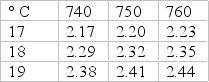
(Multiple Choice)
4.9/5 (86)
(86) Which of the following represents a direct measure of the kinetic activity of water vapor molecules?
(Multiple Choice)
4.8/5 (77)
(77) What is the most common application of Bernoulli's principle in respiratory care equipment?
(Multiple Choice)
4.8/5 (84)
(84) What is the motion referred to when solid molecules travel until they collide?
(Multiple Choice)
4.9/5 (80)
(80) According to Avogadro's law, under standard conditions of temperature and pressure (0° C and 760 mm Hg), 1 mol of any gas occupies which of the following?
(Multiple Choice)
4.7/5 (76)
(76) Which of the following are true about boiling?
1) Boiling a liquid requires more energy than does evaporating it.
2) A liquid's boiling point varies with the atmospheric pressure.
3) The greater the ambient pressure, the lower is the boiling point.
(Multiple Choice)
4.8/5 (77)
(77) The resistance to flow of a fluid through a tube can be computed according to which of the following formulas?
(Multiple Choice)
4.9/5 (83)
(83) Which of the following occurs when the temperature of a gas rises?
1) The kinetic activity of the gas increases.
2) The rate of molecular collisions increases.
3) The pressure exerted by the gas rises.
(Multiple Choice)
4.9/5 (74)
(74) The American National Standards Institute has set a water vapor content level of 30 mg/L as the minimum absolute humidity required for patients whose upper airways have been bypassed. This equals what body humidity (BH)?
(Multiple Choice)
4.9/5 (74)
(74) What is the temperature at which the vapor pressure of a liquid equals the pressure exerted on the liquid by the surrounding atmosphere?
(Multiple Choice)
4.9/5 (77)
(77) With all else equal, under which of the following conditions would the drop in pressure occurring while a fluid flows through a tube be greatest? 
(Multiple Choice)
4.8/5 (82)
(82) Which of the following best describes the physical concept of pressure?
(Multiple Choice)
5.0/5 (91)
(91) Which of the following are true of liquids?
1) They are easy to compress.
2) They exert pressure.
3) They exert buoyant force.
4) They conform to their containers.
(Multiple Choice)
4.7/5 (73)
(73) By which of the following means can the internal energy of a substance be increased?
1) Cooling the substance
2) Performing work on the substance
3) Heating the substance
(Multiple Choice)
4.7/5 (81)
(81) 
Filters
- Essay(0)
- Multiple Choice(0)
- Short Answer(0)
- True False(0)
- Matching(0)