



 Chat with AI
Exam 26: Interstitial Lung Disease

Exam 1: History of Respiratory Care30 Questions
Exam 2: Delivering Evidence-Based Respiratory Care22 Questions
Exam 3: Quality, Patient Safety, and Communication, and Recordkeeping49 Questions
Exam 4: Principles of Infection Prevention and Control34 Questions
Exam 5: Ethical and Legal Implications of Practice41 Questions
Exam 6: Physical Principles of Respiratory Care88 Questions
Exam 7: E-Medicine in Respiratory Care21 Questions
Exam 8: Fundamentals of Respiratory Care Research10 Questions
Exam 9: The Respiratory System129 Questions
Exam 10: The Cardiovascular System68 Questions
Exam 11: Ventilation78 Questions
Exam 12: Gas Exchange and Transport88 Questions
Exam 13: Solutions, Body Fluids, and Electrolytes94 Questions
Exam 14: Acid-Base Balance100 Questions
Exam 15: Regulation of Breathing50 Questions
Exam 16: Bedside Assessment of the Patient100 Questions
Exam 17: Interpreting Clinical and Laboratory Data38 Questions
Exam 18: Interpreting the Electrocardiogram35 Questions
Exam 19: Analysis and Monitoring of Gas Exchange115 Questions
Exam 20: Pulmonary Function Testing70 Questions
Exam 21: Review of Thoracic Imaging47 Questions
Exam 22: Flexible Bronchoscopy and the Respiratory Therapist25 Questions
Exam 23: Nutrition Assessment46 Questions
Exam 24: Pulmonary Infections56 Questions
Exam 25: Obstructive Lung Disease: Chronic Obstructive Pulmonary Disease Copd, Asthma, and Related Diseases59 Questions
Exam 26: Interstitial Lung Disease45 Questions
Exam 27: Pleural Diseases42 Questions
Exam 28: Pulmonary Vascular Disease57 Questions
Exam 29: Acute Respiratory Distress Syndrome30 Questions
Exam 30: Trauma, Burns and Near Drowning21 Questions
Exam 31: Lung Cancer28 Questions
Exam 32: Neuromuscular and Other Diseases of the Chest Wall29 Questions
Exam 33: Disorders of Sleep30 Questions
Exam 34: Neonatal and Pediatric Respiratory Disorders70 Questions
Exam 35: Airway Pharmacology67 Questions
Exam 36: Airway Management117 Questions
Exam 37: Emergency Cardiovascular Life Support70 Questions
Exam 38: Humidity and Bland Aerosol Therapy109 Questions
Exam 39: Aerosol Drug Therapy116 Questions
Exam 40: Storage and Delivery of Medical Gases78 Questions
Exam 41: Medical Gas Therapy93 Questions
Exam 42: Lung Expansion Therapy63 Questions
Exam 43: Airway Clearance Therapy Act90 Questions
Exam 44: Respiratory Failure and the Need for Ventilatory Support54 Questions
Exam 45: Mechanical Ventilators70 Questions
Exam 46: Physiology of Ventilatory Support89 Questions
Exam 47: Patient Ventilator Interaction22 Questions
Exam 48: Initiating and Adjusting Invasive Ventilatory Support97 Questions
Exam 49: Noninvasive Ventilation51 Questions
Exam 50: Extracorporeal Life Support Ecls25 Questions
Exam 51: Monitoring the Patient in the Intensive Care Unit60 Questions
Exam 52: Discontinuing Ventilatory Support62 Questions
Exam 53: Neonatal and Pediatric Respiratory Care34 Questions
Exam 54: Patient Education and Health Promotion20 Questions
Exam 55: Cardiopulmonary Rehabilitation64 Questions
Exam 56: Respiratory Care in Alternative Settings130 Questions
Select questions type


Which of the following medications has been shown to be useful in the treatment of almost all interstitial lung diseases?

Free
(Multiple Choice)
4.7/5  (79)
(79) Correct Answer: Verified
D
What auscultatory finding is most consistent with the diagnosis of interstitial lung disease (ILD)?
Free
(Multiple Choice)
4.8/5 (59)
(59) Correct Answer:Verified
VerifiedB
A 45 year-old patient with sarcoidosis complaints of being unable to perform his daily house chores due to shortness of breaths despite continued oxygen therapy of 2 L/min via a nasal cannula. You would recommend which of the following to the patient?
Free
(Multiple Choice)
4.8/5 (86)
(86) Correct Answer:Verified
VerifiedC
A patient is exposed a second time to an antigen and subsequently seeks medical attention with sudden shortness of breath, chest pain, fever, chills, malaise, and a cough that may be productive of purulent sputum. Which of the following is the most likely source for the antigen?
(Multiple Choice)
4.9/5 (85)
(85) Exacerbations of silicosis are most often treated with what medication?
(Multiple Choice)
4.8/5 (71)
(71) What is the most common treatment for patients with idiopathic pulmonary fibrosis (IPF)?
(Multiple Choice)
4.9/5 (77)
(77) What use, other than prognostic value, can serial pulmonary function tests provide for the management of interstitial lung disease patients?
(Multiple Choice)
4.8/5 (66)
(66) For what reason do patients with interstitial lung disease most commonly seek medical care?
(Multiple Choice)
4.9/5 (83)
(83) You are called to attend to an ER patient complaining of shortness of breath and severe dyspnea on exertion. Patient history is significant for a 30-year-pack smoking history, dry nonproductive cough, and occasional pedal edema. CXR findings are not remarkable except for mild cardiomegaly. You want to rule out ILD versus obstructive lung disease. Results for pulmonary function testing are shown below. 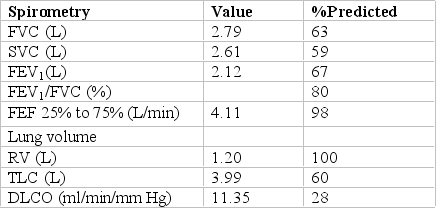 These results are consistent with:
 (Multiple Choice)
4.9/5 (72)
(72) What treatment is most useful in preventing subsequent right-sided heart failure in a patient with interstitial lung disease?
(Multiple Choice)
4.9/5 (76)
(76) What disease process is associated with much higher risk of tuberculosis?
(Multiple Choice)
4.7/5 (85)
(85) Which of the following indicates the typical chest radiographic findings of a patient with silicosis?
(Multiple Choice)
4.8/5 (88)
(88) What is the primary pathologic change that occurs in interstitial lung disease?
(Multiple Choice)
4.8/5 (79)
(79) What is the only therapy shown to prolong life in patients with end-stage, particularly fibrotic interstitial lung disease (ILD)?
(Multiple Choice)
4.8/5 (71)
(71) It is determined that a patient has silicosis. What profession is he most likely to have worked at?
(Multiple Choice)
4.9/5 (70)
(70) In simple coal worker's pneumoconiosis, a chest radiograph that is characterized by multiple small nodular opacities on the chest x-ray film is most likely to be associated with what clinical presentation?
(Multiple Choice)
4.9/5 (69)
(69) In interstitial lung disease, which of the following mechanisms contributes to impaired gas exchange?
1) Depression of respiratory drive
2) Diffusion defect
3) Shunt
4) Ventilation/perfusion mismatch
(Multiple Choice)
4.7/5 (91)
(91) What is the most common radiographic finding in the chest film of a patient with sarcoidosis?
(Multiple Choice)
4.7/5 (78)
(78) Which of the interstitial lung diseases is directly tied to exposure to first- and secondhand tobacco smoke?
(Multiple Choice)
4.8/5 (79)
(79) The disease seen in interstitial lung disease is primarily a/an _____ process.
(Multiple Choice)
4.8/5 (82)
(82) 
Filters
- Essay(0)
- Multiple Choice(0)
- Short Answer(0)
- True False(0)
- Matching(0)