



 Chat with AI
Exam 52: Animal Behavior

Exam 1: A View of Life66 Questions
Exam 2: Atoms and Molecules the Chemical Basis of Life69 Questions
Exam 3: The Chemistry of Life Organic Compounds68 Questions
Exam 4: Organization of the Cell71 Questions
Exam 5: Biological Membranes69 Questions
Exam 6: Cell Communication69 Questions
Exam 7: Energy and Metabolism73 Questions
Exam 8: How Cells Make Atp Energy-Releasing Pathways66 Questions
Exam 9: Photosynthesis Capturing Light Energy72 Questions
Exam 10: Chromosomes, Mitosis, and Meiosis66 Questions
Exam 11: The Basic Principles of Heredity78 Questions
Exam 12: Dna the Carrier of Genetic Information68 Questions
Exam 13: Gene Expression82 Questions
Exam 14: Gene Regulation77 Questions
Exam 15: Dna Technology and Genomics81 Questions
Exam 16: Human Genetics and the Human Genome75 Questions
Exam 17: Developmental Genetics83 Questions
Exam 18: Introduction to Darwinian Evolution66 Questions
Exam 19: Evolutionary Change in Populations72 Questions
Exam 20: Speciation and Macroevolution139 Questions
Exam 21: The Origin and Evolutionary History of Life67 Questions
Exam 22: The Evolution of Primates70 Questions
Exam 23: Understanding Diversity Systematics66 Questions
Exam 24: Viruses and Subviral Agents51 Questions
Exam 25: Bacteria and Archaea59 Questions
Exam 26: Protists69 Questions
Exam 27: Seedless Plants70 Questions
Exam 28: Seed Plants69 Questions
Exam 29: The Fungi69 Questions
Exam 30: An Introduction to Animal Diversity66 Questions
Exam 31: Sponges, Cnidarians, Ctenophores, and Protostomes99 Questions
Exam 32: The Deuterostomes75 Questions
Exam 33: Plant Structure Growth and Development73 Questions
Exam 34: Leaf Structure and Function76 Questions
Exam 35: Stem Structure and Transport75 Questions
Exam 36: Roots and Mineral Nutrition84 Questions
Exam 37: Reproduction in Flowering Plants81 Questions
Exam 38: Plant Developmental Responses to External and Internal Signals84 Questions
Exam 39: Animal Structure and Function an Introduction84 Questions
Exam 40: Protection Support and Movement68 Questions
Exam 41: Neural Signaling66 Questions
Exam 42: Neural Regulation67 Questions
Exam 43: Sensory Systems78 Questions
Exam 44: Internal Transport90 Questions
Exam 45: The Immune System Internal Defense79 Questions
Exam 46: Gas Exchange93 Questions
Exam 47: Processing Food and Nutrition90 Questions
Exam 48: Osmoregulation and Disposal of Metabolic Wastes111 Questions
Exam 49: Endocrine Regulation69 Questions
Exam 50: Reproduction95 Questions
Exam 51: Animal Development88 Questions
Exam 52: Animal Behavior83 Questions
Exam 53: Introduction to Ecology Population Ecology90 Questions
Exam 54: Community Ecology73 Questions
Exam 55: Ecosystems and the Biosphere91 Questions
Exam 56: Ecology and the Geography of Life81 Questions
Exam 57: Biological Diversity and Conservation Biology68 Questions
Select questions type


____ is best described as what and how an animal responds to stimuli in its environment.
(Multiple Choice)
4.8/5  (70)
(70) Which of the following terms is most closely associated with ultimate causes of behavior?
(Multiple Choice)
4.8/5 (87)
(87) Which term describes an animal whose behavior is tied to phases of the moon?
(Multiple Choice)
4.9/5 (91)
(91) In some animals, such as the marsh wren, one male bird mates with several females. This is known as:
(Multiple Choice)
4.8/5 (78)
(78) You see an advertisement on the television with a very good looking person showing off a new, shiny, powerful car. You seriously think about buying that particular car. Therefore, the person in the advertisement could best be described as the:
(Multiple Choice)
4.8/5 (70)
(70) The ____ secretes melatonin, a hormone that promotes sleep in human beings.
(Multiple Choice)
4.8/5 (72)
(72) Briefly describe the structure of a honeybee society. What are the benefits associated with this organization?
(Essay)
4.7/5 (81)
(81) Animals, like fiddler crabs, that are busiest at dawn or dusk are known as:
(Multiple Choice)
5.0/5 (76)
(76) The study of behavior in natural environments from an evolutionary perspective is called:
(Multiple Choice)
4.9/5 (83)
(83) A cat and a dog share a space in the barn. The cat gives birth to kittens in the dog's bed and then leaves them alone. Later, you notice that the kittens follow the dog around during the day. This is an example of which type of behavior?
(Multiple Choice)
5.0/5 (87)
(87) Figure 52-3 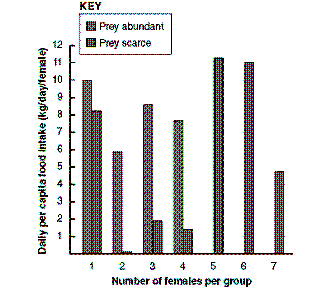 Based on the accompanying figure, when prey are abundant, the most effective hunting group size is:
 (Multiple Choice)
5.0/5 (73)
(73) When the food supply is far from a beehive, the scout bee will perform a(n) waggle dance.
(True/False)
4.9/5 (81)
(81) Which of the following has the strongest influence on the ability of a male white-crowned sparrow to sing at all?
(Multiple Choice)
4.8/5 (83)
(83) Which factor is most critical for organisms to facilitate social behavior?
(Multiple Choice)
4.7/5 (76)
(76) When a honey bee scout returns to the hive, it will perform a round dance to indicate that the nectar is close, while the waggle dance indicates the nectar is distant to the hive. This dance is an example of:
(Multiple Choice)
5.0/5 (74)
(74) The ability of an infant organism to be able to keep track of the location of its mother is an example of:
(Multiple Choice)
4.9/5 (76)
(76) 
Filters
- Essay(0)
- Multiple Choice(0)
- Short Answer(0)
- True False(0)
- Matching(0)