



 Chat with AI
Exam 43: Sensory Systems

Exam 1: A View of Life66 Questions
Exam 2: Atoms and Molecules the Chemical Basis of Life69 Questions
Exam 3: The Chemistry of Life Organic Compounds68 Questions
Exam 4: Organization of the Cell71 Questions
Exam 5: Biological Membranes69 Questions
Exam 6: Cell Communication69 Questions
Exam 7: Energy and Metabolism73 Questions
Exam 8: How Cells Make Atp Energy-Releasing Pathways66 Questions
Exam 9: Photosynthesis Capturing Light Energy72 Questions
Exam 10: Chromosomes, Mitosis, and Meiosis66 Questions
Exam 11: The Basic Principles of Heredity78 Questions
Exam 12: Dna the Carrier of Genetic Information68 Questions
Exam 13: Gene Expression82 Questions
Exam 14: Gene Regulation77 Questions
Exam 15: Dna Technology and Genomics81 Questions
Exam 16: Human Genetics and the Human Genome75 Questions
Exam 17: Developmental Genetics83 Questions
Exam 18: Introduction to Darwinian Evolution66 Questions
Exam 19: Evolutionary Change in Populations72 Questions
Exam 20: Speciation and Macroevolution139 Questions
Exam 21: The Origin and Evolutionary History of Life67 Questions
Exam 22: The Evolution of Primates70 Questions
Exam 23: Understanding Diversity Systematics66 Questions
Exam 24: Viruses and Subviral Agents51 Questions
Exam 25: Bacteria and Archaea59 Questions
Exam 26: Protists69 Questions
Exam 27: Seedless Plants70 Questions
Exam 28: Seed Plants69 Questions
Exam 29: The Fungi69 Questions
Exam 30: An Introduction to Animal Diversity66 Questions
Exam 31: Sponges, Cnidarians, Ctenophores, and Protostomes99 Questions
Exam 32: The Deuterostomes75 Questions
Exam 33: Plant Structure Growth and Development73 Questions
Exam 34: Leaf Structure and Function76 Questions
Exam 35: Stem Structure and Transport75 Questions
Exam 36: Roots and Mineral Nutrition84 Questions
Exam 37: Reproduction in Flowering Plants81 Questions
Exam 38: Plant Developmental Responses to External and Internal Signals84 Questions
Exam 39: Animal Structure and Function an Introduction84 Questions
Exam 40: Protection Support and Movement68 Questions
Exam 41: Neural Signaling66 Questions
Exam 42: Neural Regulation67 Questions
Exam 43: Sensory Systems78 Questions
Exam 44: Internal Transport90 Questions
Exam 45: The Immune System Internal Defense79 Questions
Exam 46: Gas Exchange93 Questions
Exam 47: Processing Food and Nutrition90 Questions
Exam 48: Osmoregulation and Disposal of Metabolic Wastes111 Questions
Exam 49: Endocrine Regulation69 Questions
Exam 50: Reproduction95 Questions
Exam 51: Animal Development88 Questions
Exam 52: Animal Behavior83 Questions
Exam 53: Introduction to Ecology Population Ecology90 Questions
Exam 54: Community Ecology73 Questions
Exam 55: Ecosystems and the Biosphere91 Questions
Exam 56: Ecology and the Geography of Life81 Questions
Exam 57: Biological Diversity and Conservation Biology68 Questions
Select questions type


Figure 43-2 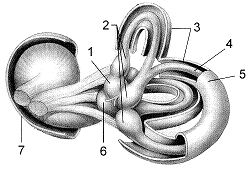 The structures labeled as 2 in the accompanying figure are the:
 (Multiple Choice)
5.0/5  (74)
(74) Discuss how a rod responds differently in the light than in the dark.
(Essay)
4.8/5 (83)
(83) Figure 43-3 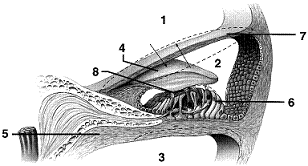 In the accompanying figure, the basilar membrane is labeled as:
 (Multiple Choice)
4.9/5 (83)
(83) Figure 43-3 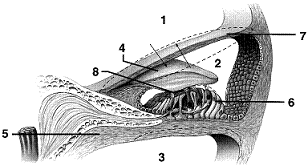 Which portion of the accompanying figure would be connected to the oval window of the cochlea?
 (Multiple Choice)
4.7/5 (67)
(67) Considering that all action potentials are essentially the same, how do we differentiate visual from auditory stimuli?
(Multiple Choice)
4.7/5 (79)
(79) What type of signal transduction process is first initiated when an odorant binds with a receptor on a cilium of an olfactory receptor?
(Multiple Choice)
4.7/5 (89)
(89) Which group of receptors is most important in helping a diver maintain an upright position while exploring a dark passageway in an underwater shipwreck?
(Multiple Choice)
4.8/5 (71)
(71) You observe a group of fish turn almost simultaneously in the same direction. Which receptors are they using?
(Multiple Choice)
4.7/5 (72)
(72) Sensory neurons release glutamate and neuropeptides such as ____ to enhance the effect of glutamate.
(Multiple Choice)
4.7/5 (62)
(62) Some species of sharks, rays, and bony fish sense the movement of prey through the use of:
(Multiple Choice)
4.9/5 (80)
(80) A person can discriminate loud sound from a soft sound because a loud sound:
(Multiple Choice)
4.8/5 (86)
(86) Bats, by emitting high-pitched sounds, can detect distant objects via:
(Multiple Choice)
4.9/5 (90)
(90) As the result of a genetic mutation, certain strains of mice eat so much that their stomachs burst. Which statement provides the most plausible explanation for why this would happened?
(Multiple Choice)
4.9/5 (70)
(70) Figure 43-2 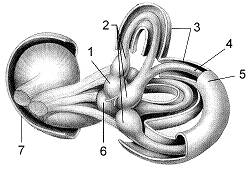 Refer to the accompanying figure. The structures responsible for detecting linear movement relative to the pull of gravity are labeled as ____.
 (Multiple Choice)
4.8/5 (74)
(74) Figure 43-2 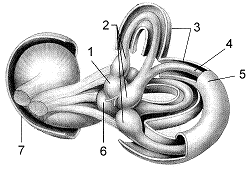 The structures labeled as 3 in the accompanying figure are the:
 (Multiple Choice)
5.0/5 (67)
(67) Gina comes home to a sink full of dirty dishes and remarks, "Yuck, what a horrible smell!" She then peels an orange and sighs, "On, that smells much better!" What allows Gina to distinguish between the different smells?
(Multiple Choice)
4.9/5 (64)
(64) Sound waves travel within the ear and cause hair cells of the organ of Corti to rub against the ____, initiating nerve impulses to the brain.
(Multiple Choice)
4.9/5 (71)
(71) Discuss the function of hair cells as sensory receptors, and identify two different locations and/or organs that utilize these receptors.
(Essay)
4.8/5 (81)
(81) 
Filters
- Essay(0)
- Multiple Choice(0)
- Short Answer(0)
- True False(0)
- Matching(0)